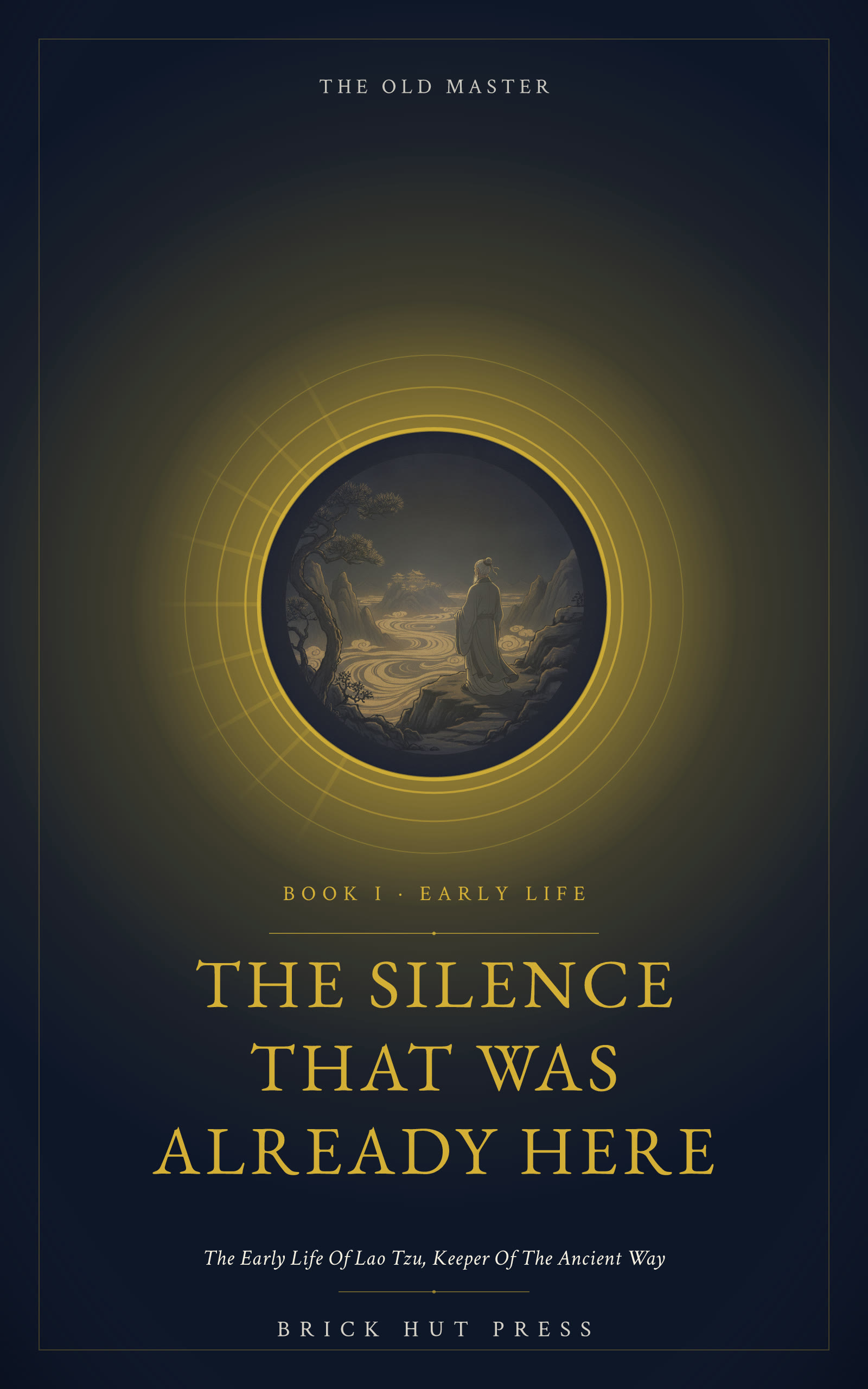
The Silence That Was Already Here
Before the Teaching, a Life. Before the Words, a Silence. Most who walk the Way know the Tao Te Ching, its eighty-one verses, its luminous paradoxes, its inexhaustible depth. But who was the man before the masterwork? What silences shaped him? What years of watching and listening and keeping prepared him to speak the words that would outlast empires? The Silence That Was Already Here enters that space, reverently, carefully, from within the tradition itself.
Read the full description
This is a devotional portrait of Lao Tzu's early life: the Zhou court, the royal archives, the slow interior ripening of the Old Master long before he set a single word to silk. Written in prose as spare and alive as the Tao Te Ching itself, this book is not scholarship at a distance. It is an act of contemplative attention, offered to practitioners of Taoism and all fellow travelers on the Way who long to know their teacher not only through his teaching, but through the life the Tao moved through to produce it.
About this volume
Before a single word of the Tao Te Ching is read, there is a life that the tradition insists on telling first, and this volume is the telling of it. The Silence That Was Already Here does not rush toward the Old Master's teaching so much as it walks the long road that made such teaching possible: the plum tree at Quren, the dust of Chu, the hall of records at the end of a dynasty, the long apprenticeship of a man who would become, for a time, the quiet keeper of a kingdom's memory before he became the voice of something no kingdom could hold.
What distinguishes this first volume is its patience with origins. Rather than treating the famous eighty-one-year gestation as a puzzle to be explained away or defended against modern skepticism, the book asks what the tradition meant to teach its children by remembering him this way at all: a birth without the violence of ordinary arrival, a sage who did not so much enter the world as finally become visible to it. From there the narrative moves to the soil itself, to the rivers and marshlands of Chu that shaped a boy who would grow up suspicious of the rigid courts of the north, attentive instead to water, to bending reeds, to the things that endure by yielding. The family chapters that follow, gathered under the quiet phrase "the Family of the Uncarved Block," trace the kind of household that could raise such a child: unadorned, unhurried, already instinctively aligned with the uncarved simplicity his later writings would spend a lifetime pointing toward.
The middle chapters settle into the Hall of Books, the great archive of the Zhou court where the young Lao Tzu came to serve as keeper of records, a position the volume treats with real seriousness rather than as mere biographical scaffolding. Here is a man entrusted with the memory of a dynasty already beginning to fracture, reading the rise and fall of houses and rites with the dispassion of someone who sees patterns larger than any single reign. The chapter titled "He Who Keeps the Record Does Not Write His Own Name" sits at the heart of this volume's quiet argument: that the sage's early vocation was not self-expression but self-effacement, a discipline of watching without inserting himself into the story he watched. It is a fitting foundation for a man whose eventual teaching would make so much of stepping back, of not forcing, of letting things find their own course.
The volume's best-known episode, Confucius's visit to ask about the rites, is handled here not as a theological skirmish between rival schools but as a meeting the tradition remembers because of what it reveals: an old archivist's gentle refusal to be drawn into the certainties of ritual propriety, offered not as rebuke but as a different way of seeing order altogether. Readers who come expecting fireworks will instead find something closer to the Tao Te Ching's own temperament, two men speaking past each other with courtesy, one already living inside the question the other was still trying to answer.
By its final chapters, "The World He Watched Unraveling" and "What He Never Said at Court," the book turns toward the pressures building beneath the Old Master's long tenure as keeper of records: a Zhou order fraying, a court increasingly deaf to restraint, a man accumulating decades of watching without yet speaking the words history would remember him for. "The Long Ripening" closes the volume not with departure or teaching but with the slow accumulation of readiness, the quiet before the turning that the second volume will take up.
Those drawn to Taoism's foundational figure will find here neither hagiography inflated with invented detail nor historical reconstruction stripped of reverence, but something closer to how the tradition itself has always told this story: unhurried, attentive to silence, trusting that the shape of a life, carefully watched, can teach as much as any sentence spoken aloud.
Not sure yet? Begin freely.
Born Already Old: An Invitation to Lao Tzu, a complete portrait of this life, free, kept in your own library here. The door into all 3 volumes.
Receive the free book →
Lives that walk beside Lao Tzu, chosen for their likeness, not their fame.