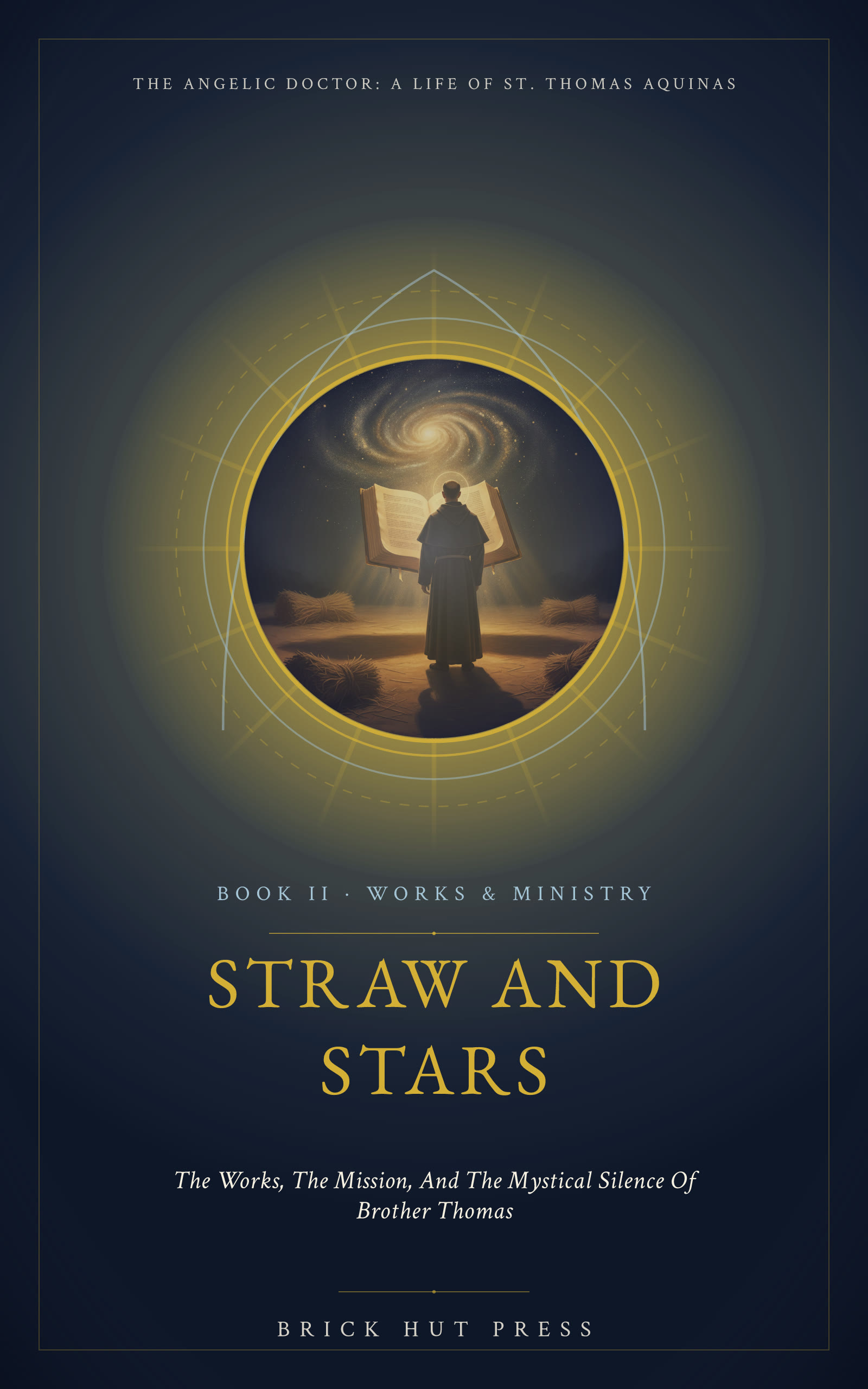
Straw and Stars
He Wrote Millions of Words About God, Then Called Them All Straw On December 6, 1273, Thomas Aquinas put down his pen and never wrote again. Not from illness. Not from despair. From something he had seen, something that made every carefully reasoned argument, every soaring theological proof, every line of the unfinished Summa Theologiae feel, in his own words, like straw. What happened in that moment?
Read the full description
And what does it mean for every believer who has ever tried to think their way closer to God? Straw and Stars: The Works, the Mission, and the Mystical Silence of Brother Thomas is a devotional journey through the working years that preceded that extraordinary silence. This is not a dry academic biography. It is an invitation, to walk alongside the greatest theologian the Church has ever known, to watch him lecture and dispute and pray and write, and to discover that his final wordlessness was not the contradiction of his life's work but its most perfect completion.
About this volume
The second volume of this life opens where the first leaves off, at the threshold of Thomas's public vocation, and it stays close to the work itself: the lectures, the disputations, the commentaries, the hymns, the great unfinished house of theology he built and then, at the very end, called straw. Readers who come to this book will walk the rue du Fouarre in the spring of 1256, cold and strewn with hay, and watch a thirty-one-year-old Dominican take a chair he was not, by the letter of the statutes, old enough to hold. From there the volume follows him outward, not away from prayer but deeper into it, showing a theologian who would not set pen to parchment without first kneeling, and who treated the act of writing as itself a kind of petition.
The chapters that follow take up, one by one, the labors by which Brother Thomas became the Angelic Doctor. There is the Summa Contra Gentiles, written not to comfort the already convinced but to reason with those who had never been given a reason to believe. There is the Catena Aurea, the patient weaving of a thousand voices of the Fathers into a single golden chain of commentary, a work of humility as much as scholarship. There are the great public disputations, where truth was not merely asserted but tested aloud, question by question, before rivals who wanted him to fail. And there is a gentler register too: the Eucharistic hymns, written for the Body of God, where the same mind that built syllogisms also built verse meant to be sung by ordinary people kneeling at the altar rail.
This volume does not pretend the path was smooth. It gives real weight to the Paris controversies, the moments when Thomas's embrace of Aristotle, his willingness to let reason walk into rooms theology had not yet furnished, made him enemies among men who should have been his allies. It follows him through a second Paris regency, a man fuller and more seasoned than the young master of Straw Street, still contending with the same arguments but no longer surprised by them. And it does not skip past Brother Reginald, the companion and secretary whose steady friendship made the whole labor possible, the man who took dictation through long nights and who would, in the end, be the one left holding the silence.
The arc of the book moves, finally, toward Naples, and toward the last lectures Thomas ever gave, and toward the sixth of December, 1273, when something happened at Mass that no biographer can fully explain and this one does not try to. What is certain, and what the volume treats with the gravity it deserves, is that Thomas afterward would not write again, and that when Reginald pressed him, troubled by the silence after so many pages, Thomas said only that compared to what he had seen, all that he had written seemed to him as straw. This book does not resolve that mystery into an answer. It lets it stand as the hinge on which the whole labor of his life turns, the vast cathedral of the Summa built by a man who, at the end, found it dwarfed by something wordless.
What makes this volume worth a reader's time is its refusal to separate the thinker from the man at prayer, the disputant from the hymn writer, the architect of the Summa from the friar who called his own house of arguments nothing beside what he had glimpsed. It is a portrait of a mind in full exercise and, at its close, a portrait of that same mind laying everything down. Readers who want to understand not only what Thomas Aquinas thought but why he finally stopped will find the whole of that story here, told chapter by chapter, from the straw of a Paris schoolroom to the silence that followed the stars he saw at the end.
Not sure yet? Begin freely.
Where Reason Kneels, a complete portrait of this life, free, kept in your own library here. The door into all 3 volumes.
Receive the free book →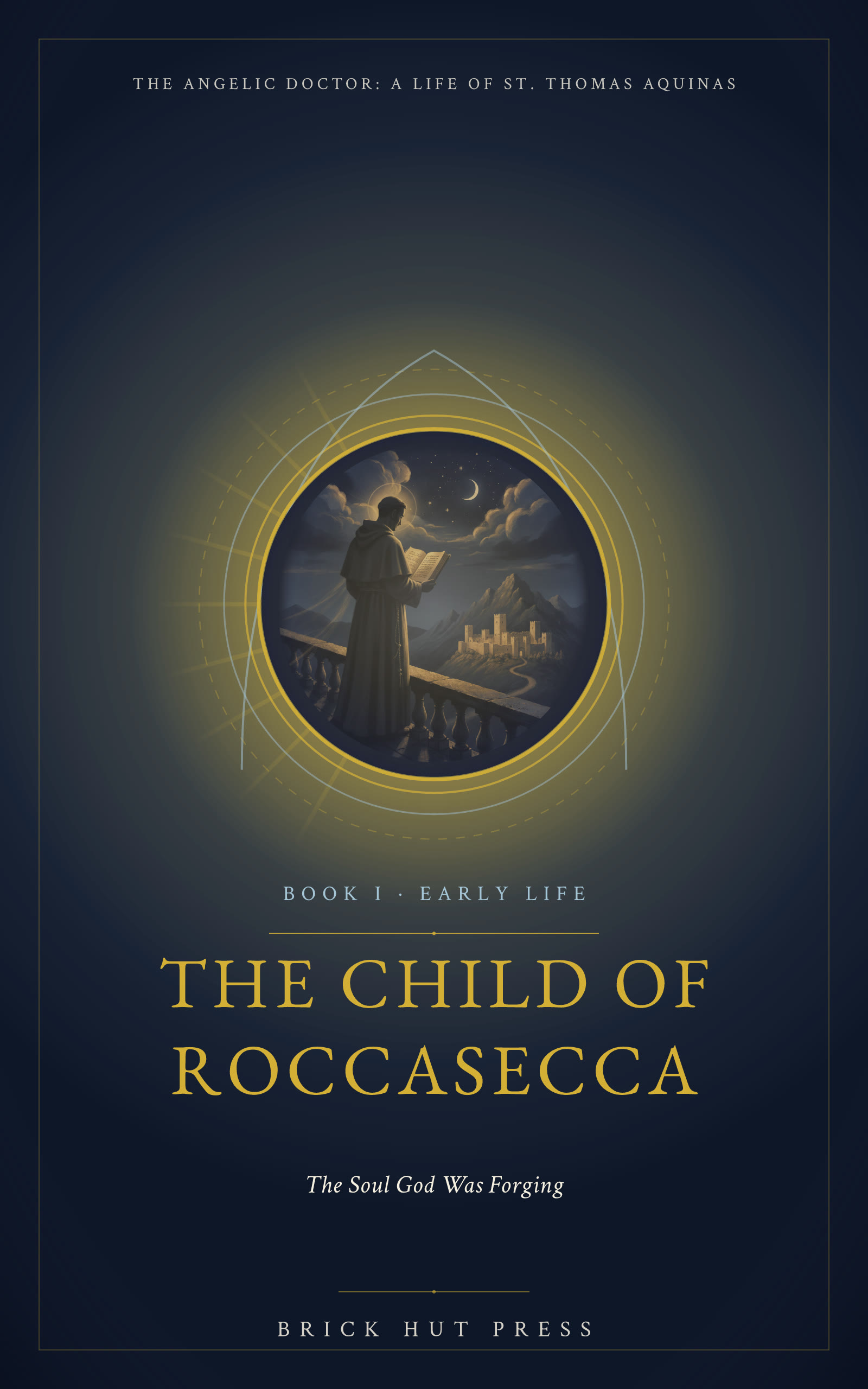
Lives that walk beside St. Thomas Aquinas, chosen for their likeness, not their fame.