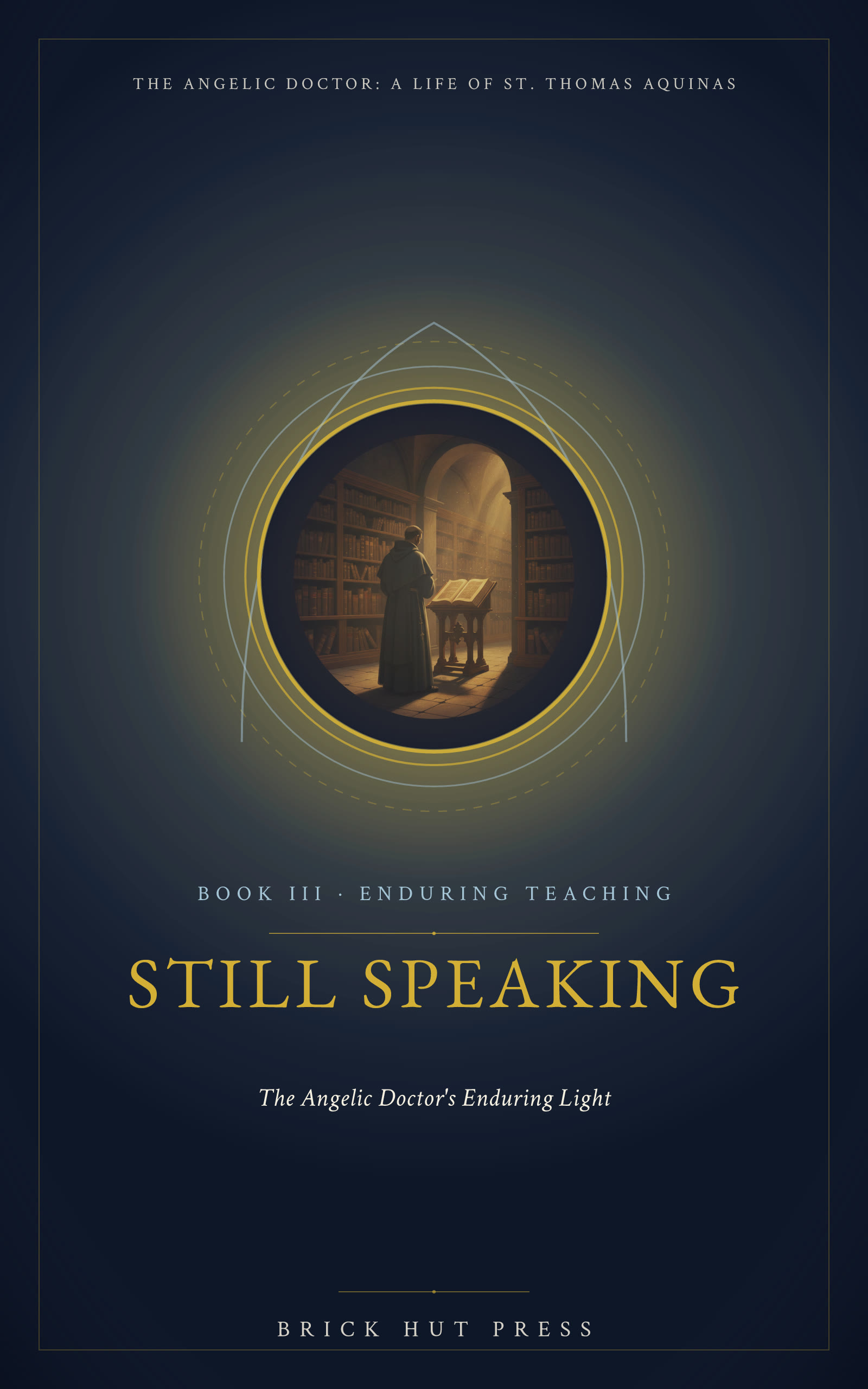
Still Speaking
The Saint Who Never Stopped Teaching, And the Church That Never Stopped Listening Thomas Aquinas died in 1274. His pen fell silent. His voice did not. Seven centuries of popes, councils, theologians, students, and ordinary believers have returned again and again to this one Dominican friar, not out of nostalgia, but out of necessity. When faith needs clarity, when reason needs anchoring, when the Church faces a world that insists the two cannot coexist, she turns to Aquinas.
Read the full description
Still Speaking tells the story of why. This is not a dry academic survey. It is a living account of an ongoing conversation, one that passed through bitter controversies and soaring vindications, through canonization and condemnation, through Reformation storms and Enlightenment pressures, through the great councils and the papal encyclicals that called each new generation back to the Angelic Doctor's inexhaustible light. If you have ever sensed that faith and reason belong together, Thomas Aquinas is the saint who proves it, and Still Speaking is the book that shows you how, and why it still matters today.
About this volume
This is the third volume of The Angelic Doctor, and it opens where a life properly ends: at the gate of Fossanova, with Thomas Aquinas carried in on a litter, asking only to die among men vowed to silence and poverty. But a saint's death is never the last word, and this book is about what came after, the long afterlife of a mind the Church first distrusted, then condemned in part, then raised to the altar, then placed, quite literally, on the altar itself. Readers who have followed the friar through his schooling, his great labors at Paris and Naples, and the slow building of the Summa will find here the harder, stranger story of reception: how a teacher who died in relative obscurity, his final work unfinished, became the Doctor Communis of the whole Latin Church.
The volume does not flinch from the uncomfortable chapters. It sits with the Paris condemnations of 1277, three years after Thomas's death, when churchmen the Order itself would later call to account judged some of his propositions too bold, and it asks plainly what that means for a saint, that the institution he served could, for a season, get him wrong. This honesty is not a wound to faith but a hinge for it: the book moves from that condemnation to the vindication that followed, Thomas's canonization under John XXII, and the slow, deliberate work by which the Church came to name him not merely orthodox but exemplary, a Doctor of the Church whose title, the book insists, means something more exacting than simple approval.
From there the arc widens outward into history proper. There is the striking image of the Summa Theologiae laid open on the altar at the Council of Trent, consulted alongside Scripture as the fathers worked out the Church's response to the Reformation. There is Leo XIII's Aeterni Patris, the nineteenth-century encyclical that called Thomas back from relative neglect and made Thomism the intellectual backbone of a modern Catholic revival, a decision whose consequences the book traces into seminaries, universities, and papal teaching down to the twentieth century. And there is Lumen Ecclesiae, Paul VI's letter marking the seventh centenary of Thomas's death, in which the Church spoke of him again, testing whether the old synthesis still had light to give a changed world.
At the center of the volume sits the theology itself, treated not as antiquarian curiosity but as living doctrine. A chapter on the Five Ways insists on reading them as Thomas intended, a map of reasonable approach rather than a knockdown proof, respecting both the limits and the confidence of natural reason. Another chapter takes up the axiom that organizes everything in Thomas's thought, that grace perfects nature rather than destroying it, and shows how this single conviction shapes his treatment of virtue, law, and the human person. A further chapter turns to the Eucharist, drawing out how Thomas's careful language of substance and accident still underlies the Church's teaching on the bread from heaven, recited in hymns he himself composed.
The book closes on something more personal: Thomas as patron of students, a saint remembered not for effortless brilliance but for a struggle recognized by those who taught beside him, and then a final reckoning with what his age understood, and our own may have forgotten, about the harmony of faith and reason. The last chapter's title promises no quiet ending. The Angelic Doctor, it suggests, is not a relic to be admired from a distance but a voice still capable of raising its tone, still speaking into rooms it was never expected to enter, still, in the oldest sense of the word, bellowing.
Not sure yet? Begin freely.
Where Reason Kneels, a complete portrait of this life, free, kept in your own library here. The door into all 3 volumes.
Receive the free book →
Lives that walk beside St. Thomas Aquinas, chosen for their likeness, not their fame.