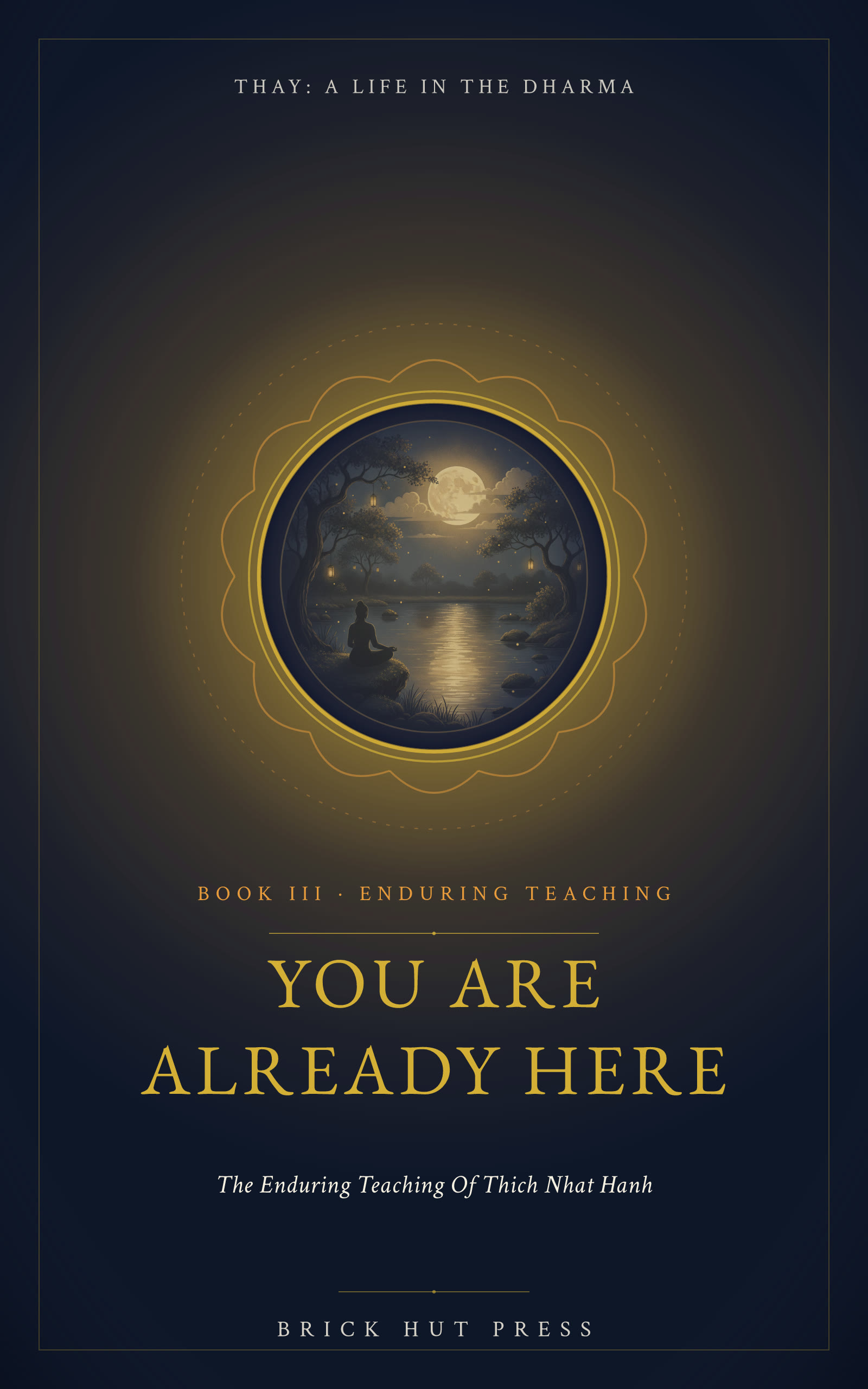
You Are Already Here
It is something rarer: a sustained encounter with a human life as teaching.
The Teaching That Never Stopped, A Luminous Portrait of Thich Nhat Hanh and the Living Practice He Left Behind He taught that you do not need to arrive anywhere. You are already here. In a world that races past the present moment, past silence, past breath, past the face of the person beside you, Thich Nhat Hanh spent more than nine decades pointing gently, persistently, and with radical love toward the only home that has ever existed.
Read the full description
You Are Already Here is the book for every person who has ever paused at a bell, slowed their step on a walking path, or felt something shift quietly inside them after reading a single page of his words. This is not a biography of facts and dates. It is something rarer: a sustained encounter with a human life as teaching. From the war-torn landscapes of Vietnam to the oak forests of Plum Village, from the corridors of international peace advocacy to the stillness of a final breath taken in complete equanimity, You Are Already Here traces the unbroken thread of one teacher's vision, interbeing, ethical living, fearless dying, and the sustaining power of community, not as doctrine to memorize, but as a way of being fully alive.
Not sure yet? Begin free.
The Smile That Held the World, a complete book about this life, free, kept in your own library here, read and heard.
Receive the free bookAbout this volume
This is the third volume of Thay: A Life in the Dharma, and it is not a chronicle of years but of teaching, the body of practice and insight that Thich Nhat Hanh left standing after his own breath stopped at Tu Hieu Temple in the cold hour past midnight on January 22, 2022. The first two volumes of this series carried him from boyhood in Hue through war, exile, and the founding of Plum Village. This volume asks a different question: what did he actually teach, and how does a teaching keep living once the teacher is gone. It opens, fittingly, with a bell, because for sixty years Thay insisted that a bell is itself a small bodhisattva, calling the listener home to three breaths of presence, and the book takes that insistence seriously as a way into everything else he gave away.
From there the chapters move through the architecture of his thought with patience rather than summary. Interbeing receives its own chapter, built around the image he returned to again and again, the cloud inside the flower, the rain inside the rice, the way nothing exists by itself. This is not treated as a philosophical curiosity but as the ground beneath every other practice he offered: mindful breathing, walking meditation, the single step that becomes, in his phrasing, this breath, this step. The volume then turns to the ethical scaffolding he built for lay and monastic life alike, the Five Mindfulness Trainings and the Fourteen Mindfulness Trainings of the Order of Interbeing, presented not as rules handed down but as a living map for how to love, eat, speak, and earn a living without causing harm, a heart trained to stay open even to what is difficult to hold.
A central chapter, "The Bodhisattva in the Burning House," faces directly into what made Thay's Buddhism inseparable from his life: a monk who would not retreat from a country at war, who carried the bodhisattva vow into refugee boats, into Paris peace talks, into decades of exile from the temple of his own ordination. The book does not separate his engaged Buddhism from his contemplative teaching, because he never did. Alongside this sits one of the volume's most tender sections, "No Death, No Fear," which gathers what he taught about dying, not as abstract doctrine but as something he lived out visibly in his final years at Tu Hieu, teaching by the manner of his own continuation.
The latter half of the book turns toward what remains. "The Sangha Is the Jewel" and "The Living Tradition: Plum Village After Thay" look honestly at how a community built around one teacher's voice sustains itself once that voice has gone quiet, how practice centers from Plum Village in France to monasteries in Vietnam, Thailand, and beyond continue to ring the same bell he rang. "What the Pine Trees Know" and "The Continuation: How to Receive a Teaching That Lives" ask the reader directly what it means to inherit a dharma that was never meant to be owned, only passed hand to hand, breath to breath, in the way he always insisted a teaching should move.
The book closes, as it must, with "This Very Breath," returning the reader to the single instruction underneath all the rest: that presence is available now, in this body, in this room, without waiting for a retreat or a teacher's permission. Readers who come to this volume for biography in the narrow sense will find instead something closer to what Thay himself offered, a doorway into practice framed by a life that practiced it fully. It assumes no prior study, only a willingness to sit still long enough to hear the bell, and to notice, as the title promises, that one is already here.


Lives that walk beside Thich Nhat Hanh, chosen for their likeness, not their fame.