Lotus in a Sea of Fire
He walked through war, grief, and decades of silence, and never stopped teaching love.
The Human Story Behind the Teaching That Changed Millions of Lives He was exiled from his homeland for daring to call for peace. He walked through war, grief, and decades of silence, and never stopped teaching love. Lotus in a Sea of Fire is the story of Thich Nhat Hanh: monk, poet, peacemaker, and one of the most quietly revolutionary spiritual figures of the modern age. This is not simply biography.
Read the full description
It is an invitation to understand how a life lived in full presence, through suffering, not around it, became a gift to the entire world. If you have ever sat with one of Thay's books, followed a guided breathing meditation, heard a bell of mindfulness ring through a retreat hall, or walked slowly across the earth trying to arrive at each step, you already know the fruit of his ministry. Now discover the roots. Lotus in a Sea of Fire traces the arc of Thich Nhat Hanh's extraordinary journey: from a young novice in Vietnam, through the fires of war and the birth of Engaged Buddhism, into exile, and onward to the founding of Plum Village and a global sangha that spans continents and contemplative traditions.
Not sure yet? Begin free.
The Smile That Held the World, a complete book about this life, free, kept in your own library here, read and heard.
Receive the free bookAbout this volume
Volume 2 of Thay: A Life in the Dharma takes up Thich Nhat Hanh's story at the moment it stops being the formation of a monk and becomes the shaping of a ministry. The lamp transmission at Tu Hieu that opens this book, flame passed from Master Thanh Quy Chan That to the forty-year-old monk kneeling before him, is not an ending to the first volume's novice years but a hinge. From here the book follows a life that moves outward from the temple courtyard into the full weight of a nation at war, and then outward again, past the borders of Vietnam entirely, into a global ministry that would eventually bear his name on four continents.
The early chapters stay close to the soil of Vietnam: the founding of a school built on compassion rather than sectarian loyalty, the birth of what Thich Nhat Hanh would call Engaged Buddhism, the insistence that meditation cushions and burning villages belonged to the same practice rather than two separate lives. Readers who want to understand how a contemplative tradition answers a war, not with slogans but with schools, clinics, and a refusal to take sides, will find the volume takes this question seriously rather than summarizing it. The founding of the Order of Interbeing, with its Fourteen Mindfulness Trainings, is given room here as the structural heart of this period: the moment Thich Nhat Hanh built a form sturdy enough to carry engaged practice forward once he himself could no longer stay.
That "could no longer stay" becomes the volume's central ache. The chapter called The Door Closes Behind Him marks the exile that would last decades, the Paris Peace Talks that consumed years of his advocacy and still could not open the way home, and the long, strange, generative season of homelessness that followed. This book does not flinch from the sorrow of that exile. It sits with it in Poems from the Exile, letting the verse itself carry what prose cannot, the grief of a monk separated from his root temple, his lineage, his country, for reasons entirely outside his choosing.
And yet the volume's real achievement is showing how exile became ground. A Plum Tree Takes Root in France traces the founding of Plum Village, the hamlet in the Dordogne that would become the beating heart of a worldwide sangha, while The American Rooms and Teaching the World to Walk follow the retreats, the talks, the walking meditations that introduced mindfulness to audiences who had never set foot in a Vietnamese temple and would never need to. The Books That Changed Lives takes up the writing itself, the slim, plainspoken volumes that carried phrases like interbeing and the miracle of mindfulness into languages and households Thich Nhat Hanh would never personally visit. Readers who come to this book already knowing those books will find here the ministry that produced them: the retreats, the students, the decades of unglamorous teaching that stand behind a single clear sentence on a page.
The volume closes gently rather than triumphantly. The Stroke and the Silence does not dramatize decline; it treats the loss of speech as its own teaching, wordless in a way the lamp transmission at Tu Hieu already prepared readers to recognize. Coming Home brings the arc full circle, back to the temple where the flame was first received, closing a life that began in a courtyard swept by a sixteen-year-old novice. This is a book for readers who want the full shape of a ministry, its founding, its exile, its flowering abroad, and its return, told with the patience the tradition itself asks of anyone who sits long enough to watch a single flame pass from one small vessel to another.

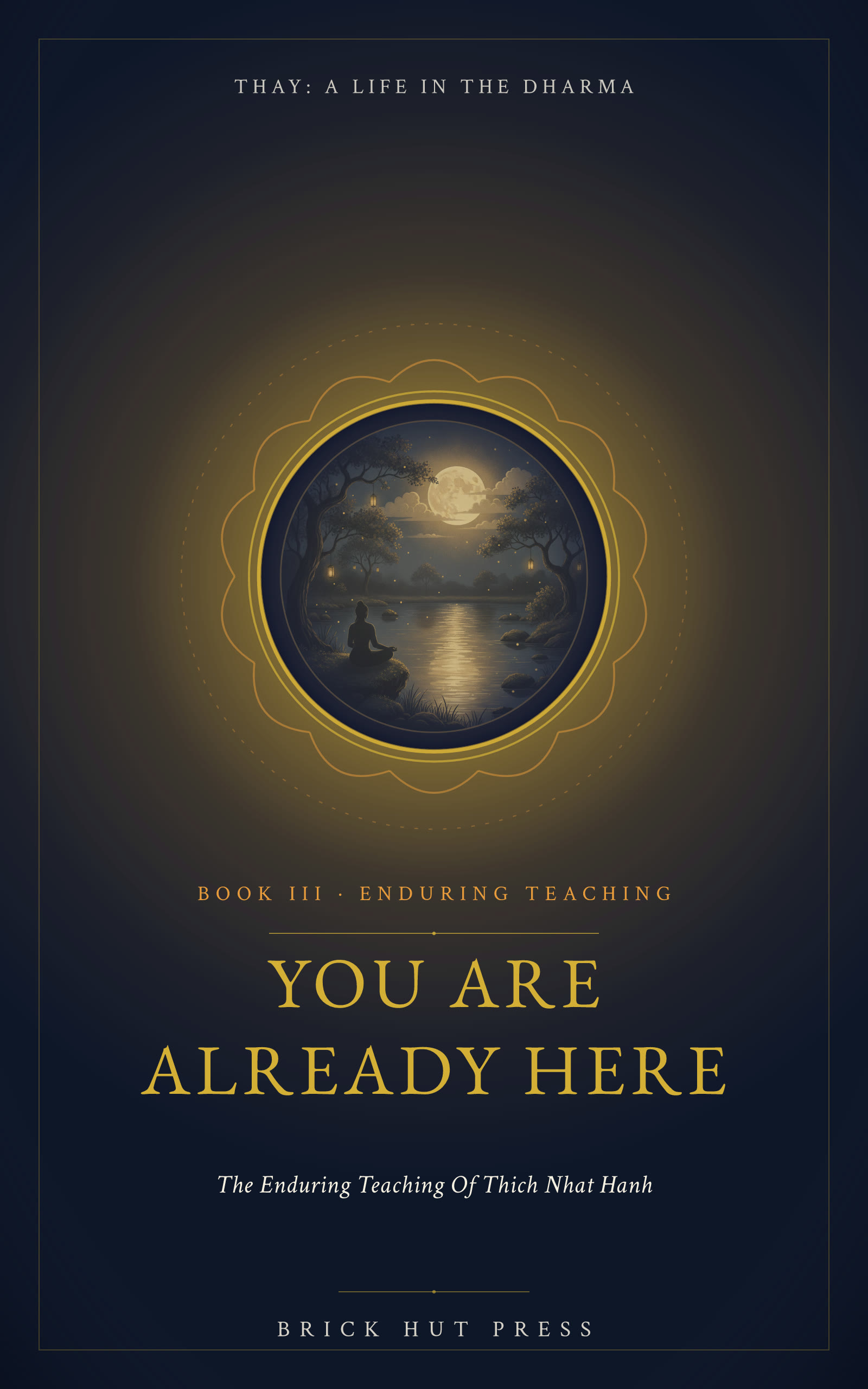
Lives that walk beside Thich Nhat Hanh, chosen for their likeness, not their fame.