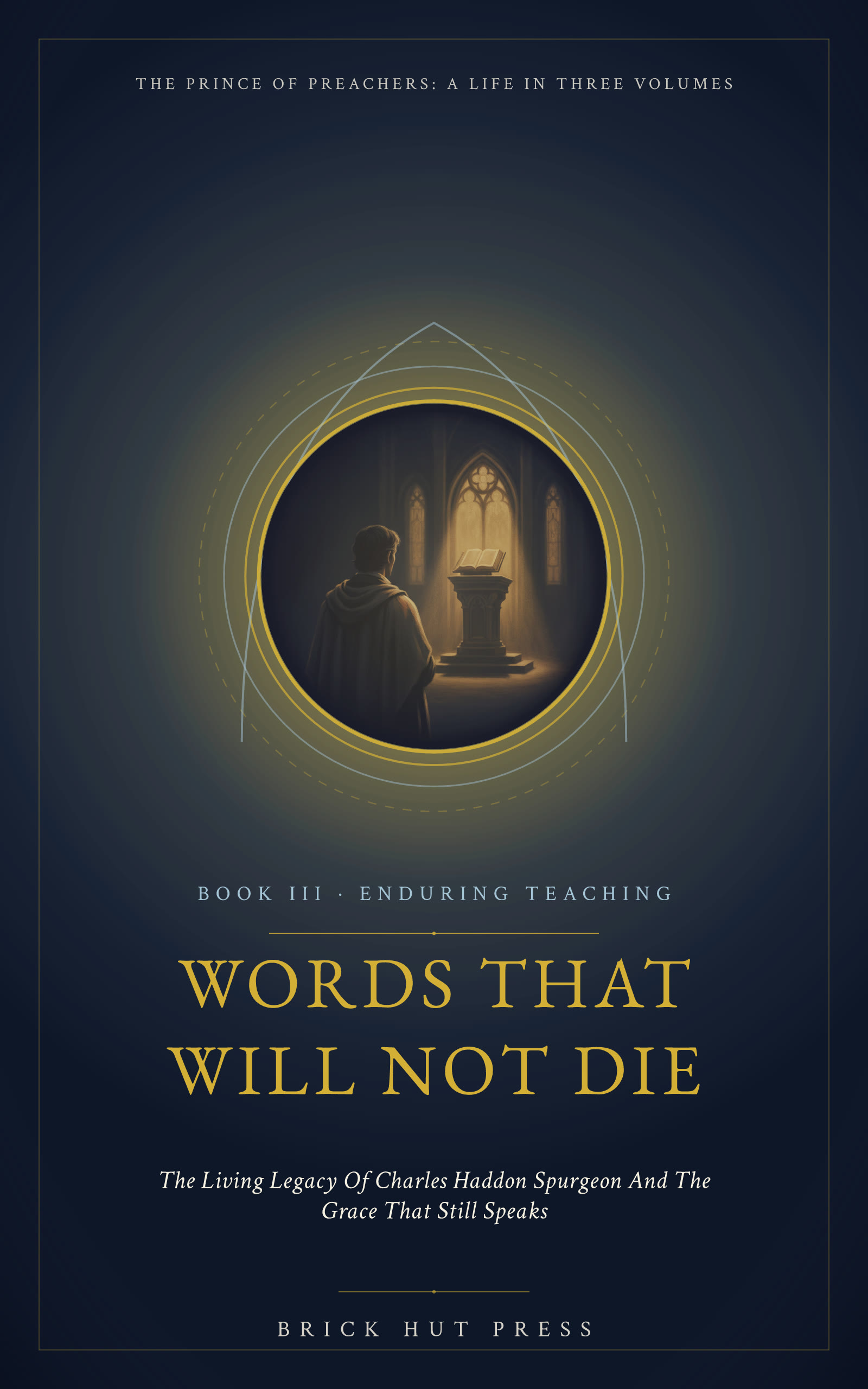
Words That Will Not Die
Then there is Charles Haddon Spurgeon, the Prince of Preachers, whose words crossed every ocean in his lifetime and have never stopped crossing them since.
He Died in 1892. His Voice Never Did. There are preachers who shaped their generation. Then there is Charles Haddon Spurgeon, the Prince of Preachers, whose words crossed every ocean in his lifetime and have never stopped crossing them since. Devotionals opened at dawn. Sermons printed, reprinted, downloaded, and wept over.
Read the full description
A vision of Christ-centered, grace-soaked preaching so alive it refuses to be buried with the man who first thundered it from the Metropolitan Tabernacle's pulpit. Words That Will Not Die is not a dry biography. It is an encounter. Written with the warmth, conviction, and plain-spoken directness that Spurgeon himself prized above elegance, this book traces the living legacy of history's most widely read preacher, and asks the question every generation must answer for itself: Why do his words still find us?
Not sure yet? Begin free.
Still Speaking, a complete book about this life, free, kept in your own library here, read and heard.
Receive the free bookAbout this volume
This is the volume that answers a question the first two volumes could only set up: what remains, once the man himself is gone. Book One gave you the boy at Stambourne and the Essex hayloft where the sixteen-year-old found grace. Book Two gave you the New Park Street pulpit, the Surrey Gardens catastrophe, the Metropolitan Tabernacle rising to hold the crowds, and the long, grinding Down-Grade years that cost him so much. Book Three opens on the four days in February 1892 when London queued past a plain oak coffin, and then it does something unusual for a closing volume: it keeps going past the funeral, because Spurgeon's own story did not end there, and neither does this book.
The chapters here follow the afterlife of a ministry rather than the decline of a man. "The Congregation That Would Not Disperse" asks what became of the five thousand who had filled that platform every Sunday, and of the institutions, orphanages, the Pastors' College, the publishing operation, that had grown up around one preacher's voice. From there the volume turns to the printed page itself: "Morning and Evening, World Without End" traces how a book of daily devotions written for his own household became a fixture on nightstands in homes that never heard him preach, while "Seven Volumes and the King of the Psalms" sits with "The Treasury of David," the vast commentary he labored over for two decades, and asks what it meant for a self-taught Baptist pastor to spend that kind of patience on the Psalter. "Lectures to a World Full of Preachers" and "The Doctrines of Grace, Freely Offered" take up the two halves of his theological temperament at once, the practical craft he handed to generations of students and the high Calvinism he insisted was never in tension with an open, urgent gospel invitation. "John Ploughman's Wisdom" gives room to the homelier, funnier Spurgeon, the one who wrote proverbs for farmhands and shop clerks and never thought that beneath him.
The volume does not flinch from the hardest chapter of his later ministry. "What the Down-Grade Was Actually About" returns to the controversy that cost him the fellowship of the Baptist Union and much of his health, and takes seriously, on his own terms, what he believed was at stake: not personality or pride, as critics then and since have sometimes charged, but whether the authority of Scripture and the substance of the gospel could be quietly traded away a doctrine at a time. Readers who want a tidy resolution will not find one here, because Spurgeon himself never got one in his lifetime; what the chapter offers instead is a clear account of the convictions he would not trade, even at great personal cost.
The second half of the book widens the lens. "The Sermons That Kept Going" follows the strange fact that new Spurgeon sermons continued to be published weekly for years after his death, preached now only on the page. "Susannah After" gives his widow her own chapter, her Book Fund ministry to poor pastors, her editing of his letters, her long widowhood spent guarding and extending his legacy rather than simply mourning it. "Spurgeon's College, Then and Over" and "Grace for This Generation" carry the story into the present tense, asking what his insistence on expository preaching, lay training, and gospel plainness still has to say to pulpits he never saw. The volume closes, fittingly, with "The Man Behind the Prince," a chapter that pulls back from institutions and influence to remember the husband, father, asthmatic sufferer, and melancholic believer whose faith was never theoretical.
Taken together, these twelve chapters make the case that Spurgeon's death was not an ending to be mourned so much as a threshold the work itself walked through. This is a volume for readers who have followed him from Stambourne to Mentone and want to know, honestly and without sentimentality, what grace left behind.
Lives that walk beside Charles Haddon Spurgeon, chosen for their likeness, not their fame.