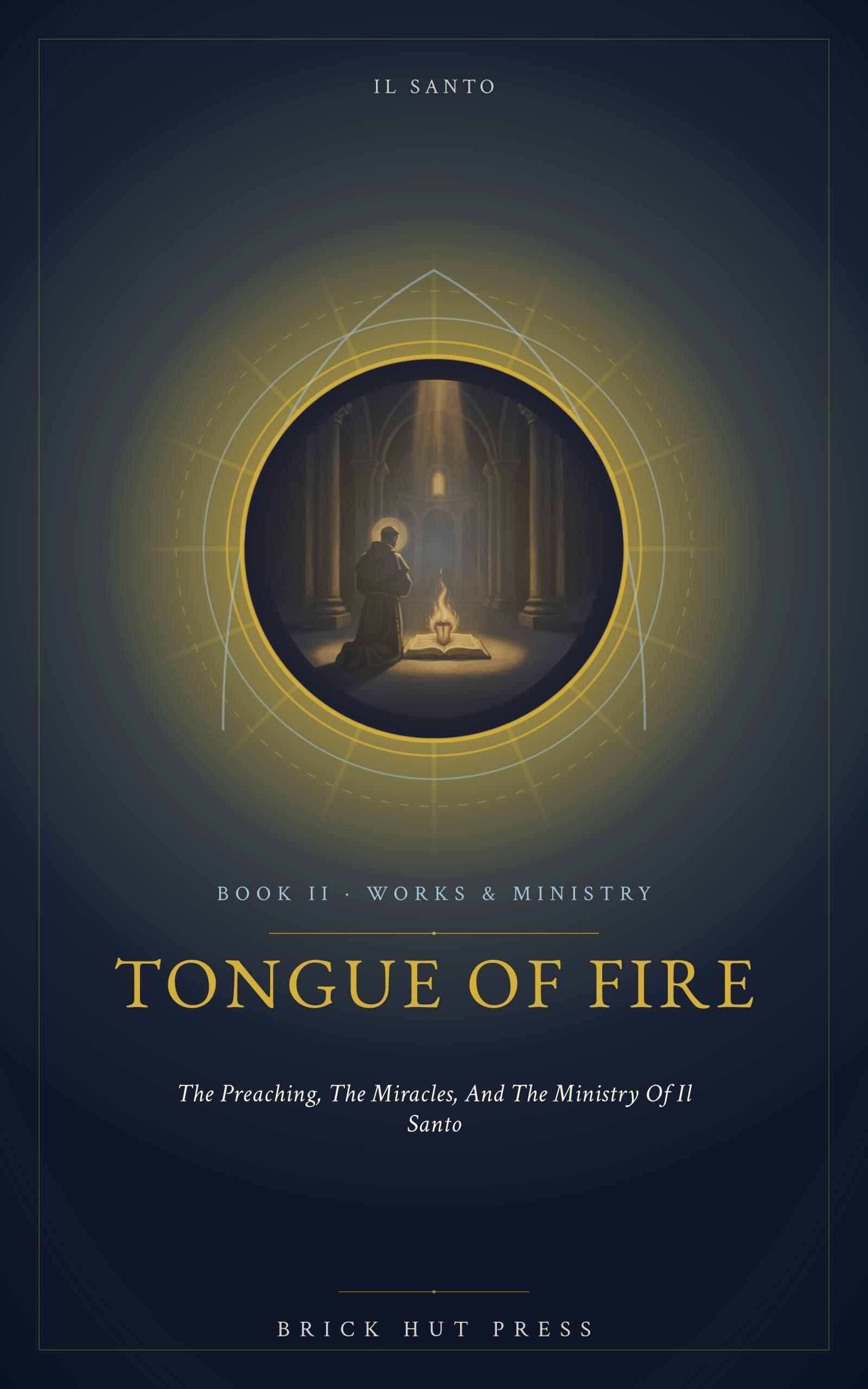
Tongue of Fire
He Preached to Thirty Thousand People in an Open Field, and They Wept, Converted, and Came Back for More. What turns a young man from a noble Portuguese family into the most beloved saint in Franciscan history? What gives a friar's voice such power that heretics fall silent, fish rise to the surface to listen, and a mule, hungry and exhausted, kneels before the Blessed Sacrament instead of its feed?
Read the full description
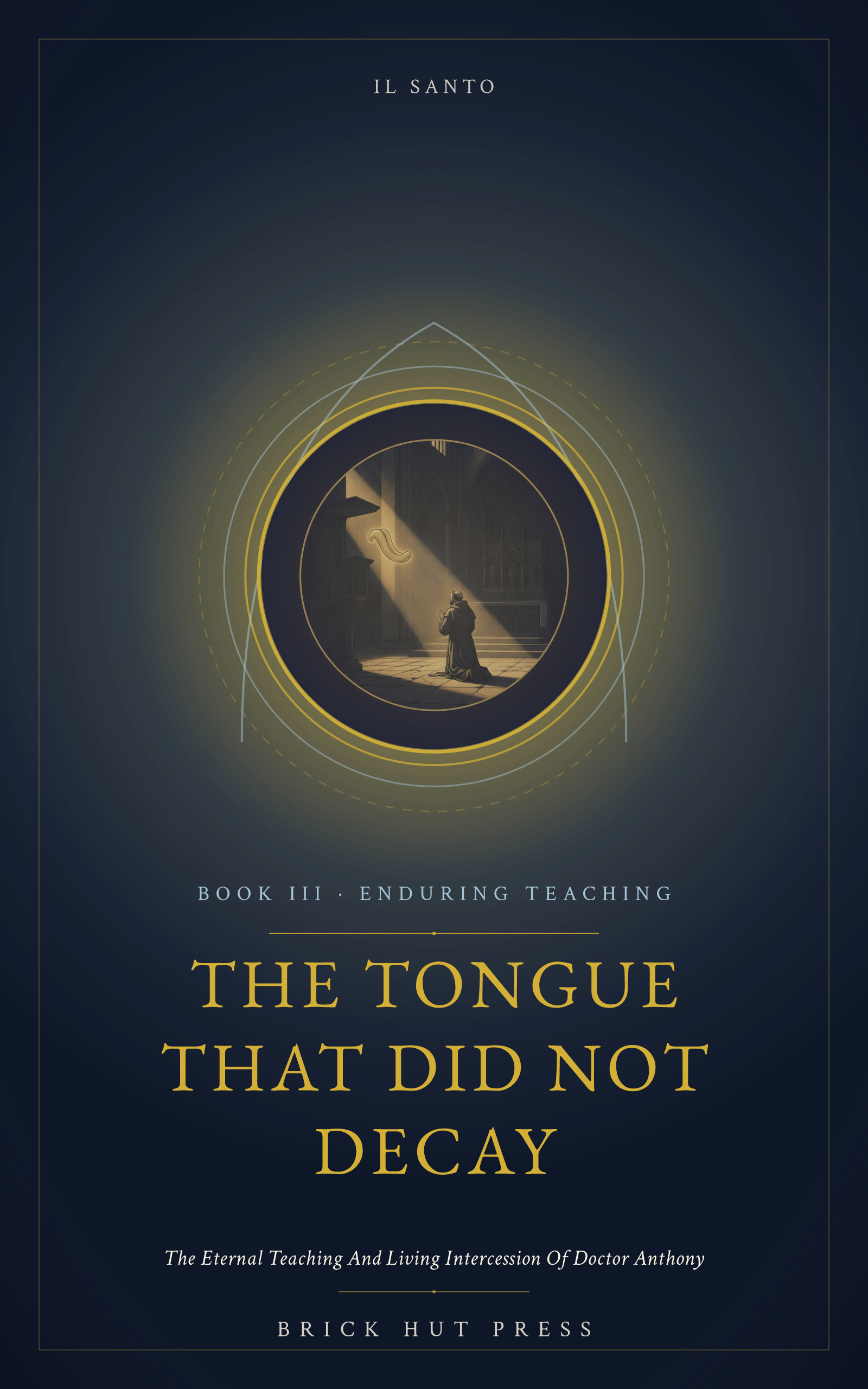
Tongue of Fire answers those questions not with dry hagiography, but with living, breathing encounter. This is the story of Saint Anthony of Padua, Il Santo, told warmly from within the Catholic faith, for all who already love him and for all who are about to. Drawing on Anthony's own surviving sermons and the oldest testimonies the tradition preserves, this devotional account places you shoulder-to-shoulder with the medieval crowds who traveled days on foot just to hear him preach. You will feel the heat of those open-air gatherings. You will understand why Francis of Assisi called this man his bishop . And you will come away knowing that the friar millions call upon to find lost keys was, first and above all, a Tongue of Fire, a preacher, a theologian, and a mercy-bearer whose ministry still burns.
About this volume
The letter that opens this volume is small enough to fold into a hand, and that smallness is the point. Francis of Assisi, who had once distrusted learning as a snare for the proud, wrote two sentences to a friar he barely knew and in doing so invented an office that had never existed in his young Order. Tongue of Fire begins there, at the hinge between the hidden Anthony of the first volume and the Anthony the world would come to know: the preacher who converted whole valleys of Cathar believers in the south of France, the theologian trusted by Francis himself to form the minds of the brothers, the wonder-worker whose fame would outrun even his own understanding of it.
This is the volume of the public ministry, and it does not flinch from the strangeness of what that ministry contained. Readers will walk the roads into Cathar country, where Il Santo met heresy not with condemnation alone but with the patient, scriptural argument that would become his signature. They will stand at Rimini on the riverbank, where the fish are said to have gathered to hear what the unbelieving would not, and at Bologna, where the bread multiplied and a hunger deeper than the body's own was answered. The mule that knelt before the Blessed Sacrament, refusing its own feed to bow, is given its full weight here, not as a curiosity but as a sign asked for and granted in a moment when faith itself was being tested in public. These episodes are treated as the tradition has always treated them: as graces given for a reason, pressed into the record by brothers and petitioners who had no cause to invent them and every reason to remember them exactly.
But the book does not rest only in the miraculous. It follows Anthony into the harder, more administrative corners of a life given to others: his defense of debtors and the poor against the predations of usury, a concern that would shape Franciscan social teaching for centuries after him, and his years as provincial minister, where the burden of authority sat on him differently than the burden of preaching ever had. A man who could silence a riverbank of fish found governing his own brothers a heavier, lonelier labor, and this volume does not smooth over that difficulty. It is honest about the cost of office laid on a man who had wanted, more than anything, to be left to his books and his God.
The volume's center of gravity, though, is Padua itself, and the Great Lent that made the city his own before it ever buried him. Readers will see the crowds that gathered before dawn to hear him, the confessions that reportedly lasted long into exhaustion, the city's ordinary business suspended because a friar had something to say that people could not bear to miss. And then, with the same unhurried attention given to the letter that opened the book, the volume brings us to the evening at Arcella, where the long labor of that Lent came due. The final chapter, on the children crying in the streets at news of his death, closes the ministry not with a miracle but with grief, the plainest and most convincing evidence of what Anthony had actually meant to the people among whom he had spent himself.
What this volume offers, finally, is not a catalogue of wonders detached from a life but an argument, made chapter by chapter, for how a hidden theologian became the Hammer of Heretics and the people's saint without ceasing to be the same man Francis had once addressed by name. It asks the reader to hold the miracles and the governance, the fish at Rimini and the burden of the provincial seal, in the same hand, because Anthony did. For readers who have followed him from the earlier volume's quiet formation, this is the record of what that formation was for. For readers coming to him fresh, it is as good a place as any to meet a saint still spoken of, eight centuries later, in the present tense.
Not sure yet? Begin freely.
The Saint Who Finds What Is Lost: An Invitation, a complete portrait of this life, free, kept in your own library here. The door into all 3 volumes.
Receive the free book →
Lives that walk beside Saint Anthony of Padua, chosen for their likeness, not their fame.