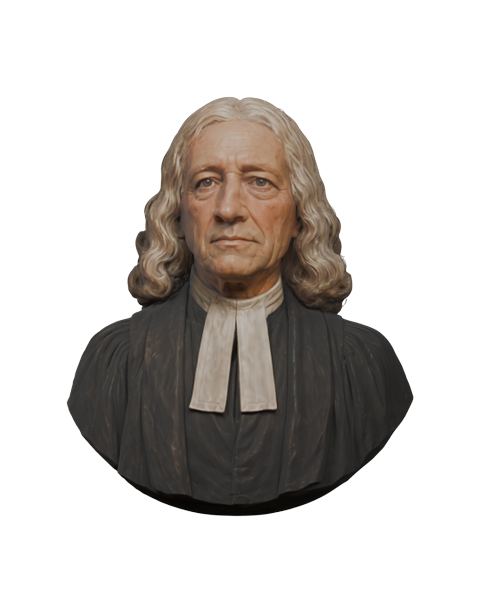
The Tinker's Son
He marched onto Civil War battlefields before he could name the God who guarded him.
Before He Wrote the Greatest Christian Allegory Ever Told, He Had to Live It He was born in a tinker's cottage. He marched onto Civil War battlefields before he could name the God who guarded him. He wrestled with spiritual terrors that nearly broke his mind, voices, visions, the crushing weight of a conscience that would not be silenced.
Read the full description
And through it all, a Providence he had not yet recognized was threading its way through every chapter of his unremarkable, extraordinary life. The Tinker's Son tells the story the world's most beloved allegory could never quite contain: the true pilgrimage of John Bunyan himself, a man found by grace before he ever went looking for it. The Man Behind The Pilgrim's Progress Millions have walked with Christian through the Slough of Despond, trembled at Doubting Castle, and cheered at the Celestial City. But few have paused to ask: Who was the man who dreamed all this, and why did he dream it? The answer begins not in Bedford Gaol with a pen and a Bible, but years earlier, in poverty and war and a soul stretched to its breaking point. This is the story of hard grace, the kind that does not flatter, does not hurry, and does not let go.
Not sure yet? Begin free.
The Tinker Who Saw Heaven, a complete book about this life, free, kept in your own library here, read and heard.
Begin reading, freeAbout this volume
Before John Bunyan ever wrote a line that the world would remember, he was a tinker's son in a cottage that smelled of scorched metal, a boy with black-rimmed hands who grew up expecting nothing from history and received, by the strange economy of grace, nearly everything. This first volume of Tinker, Preacher, Dreamer takes up that unlikely beginning: not the famous prisoner of Bedford Gaol, not yet the author of the allegory that would outlast empires, but the child of Harrowden, the apprentice brazier, the young man of Elstow green whose soul was, for years, a battlefield no one else could see.
The volume opens with the forge fire that never quite goes out, and it stays close to that kind of ordinary, textured detail throughout: the smell of tallow and smoke, the arithmetic of a poor household reassembling itself after a first wife's death, the unglamorous rhythm of a trade that kept a family fed only when the rain held off. From there the book follows young John through the terrors that marked his boyhood, chiefly the dreams and the waking dread of hell that seized a child who had no language yet for what was happening inside him, and through the convulsions of a nation at war with itself, the drums and musters that reached even a village as unremarkable as Elstow. Readers who come to Bunyan already knowing The Pilgrim's Progress will recognize, in these early chapters, the raw material of Christian's own terrors, long before there was a book to put them in.
The middle chapters turn toward the people who shaped him almost without his noticing: a wife remembered here simply as the girl with two books, whose modest dowry of two old devotional volumes did more to unsettle Bunyan's conscience than any sermon he had yet sat under; the ringing of the bells, a small and almost comic episode of superstition and guilt that the volume treats with the seriousness it deserves, since for Bunyan it was no small thing; the arguing, praying women he overheard one ordinary day on a doorstep in Bedford, whose talk of grace struck him as a foreign language spoken by people who seemed to possess some joy he lacked. The volume does not rush past these scenes. It lingers on the village green, on the voices he could not stop overhearing, on the slow, humiliating, unglamorous process by which a loud, sharp-tongued young tradesman became someone capable of hearing them at all.
At the center of the book stands Holy Mr. Gifford, the Bedford pastor whose patient, unsentimental ministry gave Bunyan's inward war a name and, eventually, a congregation. But the volume does not pretend this settled anything quickly. The chapters that follow, The Great Darkness above all, sit honestly with the long season of despair, blasphemous thoughts, and spiritual terror that nearly broke him before it remade him, the same darkness he would later set down with unsparing plainness in his own account of his conversion. This book does not soften that darkness into a tidy lesson. It asks the reader to stay inside it as Bunyan himself had to stay inside it, year after year, with no guarantee of an ending.
The volume closes not with triumph but with reception: a tinker's son received at last among the gathered congregation at Bedford, and a final accounting of what those years of darkness left behind in him, the scars and the gifts both. Readers looking for the famous preacher, the prisoner, the dreamer of the Progress, will find here instead the making of that man, assembled from a forge, a green, a doorstep, and a darkness he did not choose but could not escape. It is a volume about how God finds a soul long before that soul can imagine being found, told with the patience and specificity the story has always deserved.
Lives that walk beside John Bunyan, chosen for their likeness, not their fame.