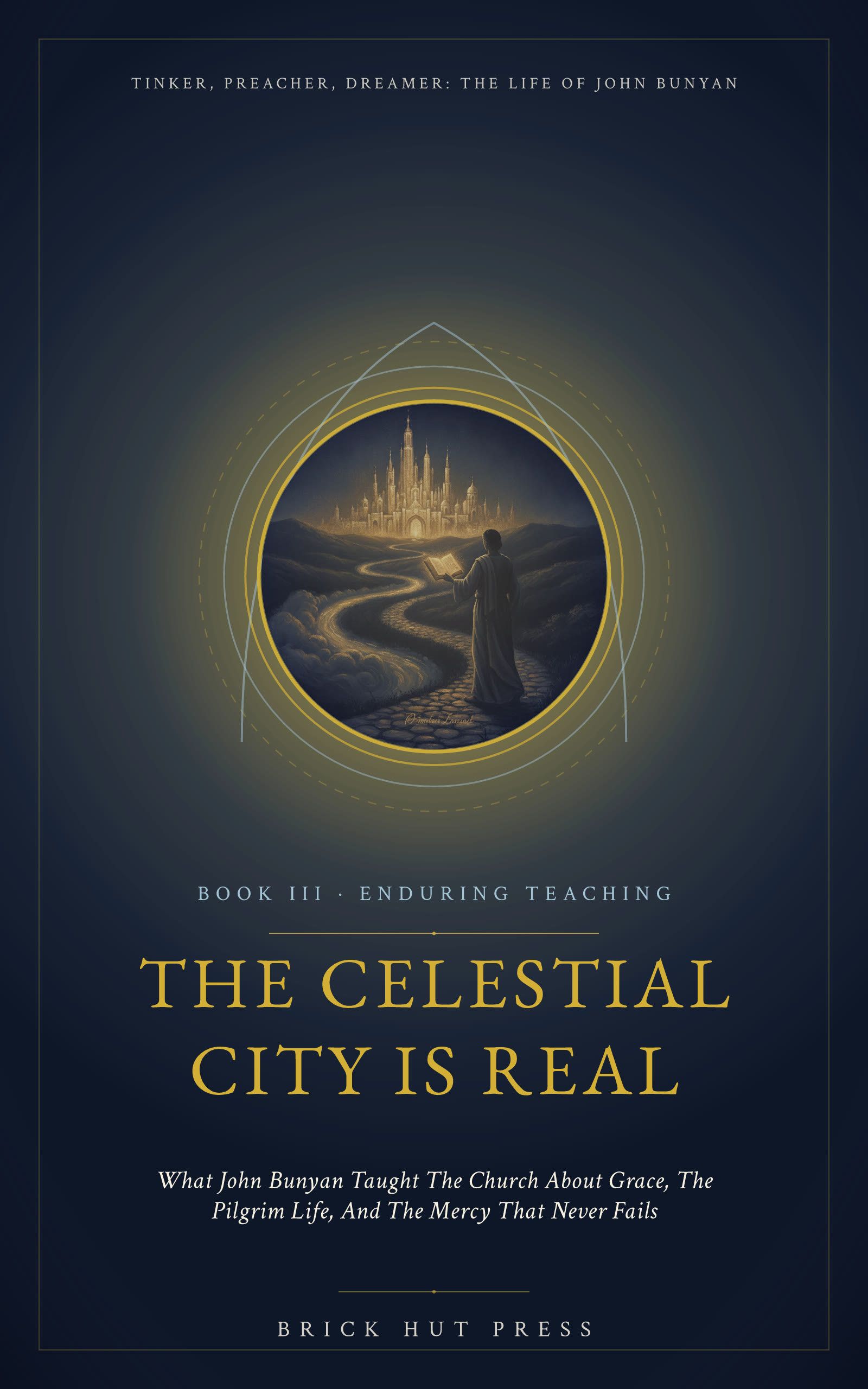
The Celestial City Is Real
He had no university degree, no wealthy patrons, no ecclesiastical titles.
The Tinker Who Shook England, And Still Guides Pilgrims Today John Bunyan owned almost nothing. He had no university degree, no wealthy patrons, no ecclesiastical titles. What he had was an unshakeable encounter with grace, and a voice so clear, so urgent, and so saturated with Scripture that kings and commoners alike could not ignore it. Imprisoned for daring to preach without a license, he wrote from a Bedford jail cell words that have never once gone out of print.
Read the full description
The Celestial City Is Real opens that voice to a new generation, unpacking the teaching, the theology, and the costly, courageous faith of the man who gave the world The Pilgrim's Progress . This is not merely a biography. It is an invitation, to sit at the feet of one of history's greatest Puritan pastors and let his hard-won wisdom on grace, prayer, suffering, and perseverance speak directly into your own pilgrim journey. If you have ever loved Christian and Faithful and Hopeful walking toward that shining City, this book takes you behind the allegory and introduces you to the man who believed every word of it with his life.
Not sure yet? Begin free.
The Tinker Who Saw Heaven, a complete book about this life, free, kept in your own library here, read and heard.
Begin reading, freeAbout this volume
This is the third and final volume of Tinker, Preacher, Dreamer, and it arrives at the place the first two books were building toward all along. The earlier volumes gave us the tinker's boyhood terrors, his conversion struggles at Elstow and Bedford, and the long years behind the door of the county jail. This volume opens inside the book that jail produced, and it stays there, walking the road Bunyan laid down for every reader who has ever felt a weight on his back and nowhere to set it. It is, in other words, a book about The Pilgrim's Progress, but more than that, it is a book about the doctrine inside the dream: what Bunyan actually believed about ruin, about rescue, and about the long plain path between the wicket gate and the gate of pearl.
The opening chapters take the burden seriously before they offer any relief. "The Ruin and the Remedy" and "Come and Welcome" sit with Bunyan's conviction that no man invents his own way out of the City of Destruction, that the cross must be seen before the burden falls, and that the welcome given at the gate is wider and freer than the guilty conscience dares to hope. This is Bunyan the evangelist of grace, the man who could not preach an inch of comfort he had not first earned in his own despair, and the volume does not let the reader skip past that cost to get to the consolation.
From there the book follows the road itself: "The Road That Does Not End" and "The Pilgrim in the Valley" take up the long middle of the Christian life, the part no one puts on a bookmark, where Doubting Castle and the Slough of Despond are not scenery but spiritual realities Bunyan had walked through in his own body. A chapter on prayer and another on "The Great Battle for the Soul" turn from narrative to instruction, drawing out what Bunyan taught in his lesser-known tracts and sermons about wrestling before God and standing against the Apollyon that meets every pilgrim somewhere in the valley. "Holy Living in an Unholy Age" places him where he actually stood, a Nonconformist preacher under a government that had already jailed him once for it, working out what faithfulness costs when the age itself is against you.
The later chapters widen the lens from the single pilgrim to the whole company of pilgrims. "The Church on Earth and the Church in Heaven" takes up Bunyan's ecclesiology, his conviction that the gathered church at Bedford was a true outpost of the city still to come. "The Tinker's Tongue and the University Men" sets his plain, common speech against the learned sermons of his critics and asks why it was the tinker's words, not the scholar's, that carried across three centuries and every language under heaven. "A Rainstorm and a Reconciliation" brings the volume back to something intimate and human, a moment of grace between people, before the book turns outward again to trace how far Bunyan's dream has traveled, translated into tongues he never heard, read by pilgrims he never met.
The volume closes where Bunyan himself closed, at "The City That Is Still Coming," not as a metaphor softened for modern ears but as the thing Bunyan actually believed was real: a city with gates, with a welcome, with trumpets sounding on the other side of the river. This book does not try to explain away that confidence or modernize it into something safer. It asks the reader to sit with it the way Bunyan's first readers did, as people who knew what it was to carry a burden and wanted, more than anything, to know where it could finally be set down. Anyone who has read the Progress as literature and wondered what the tinker actually believed, and why it cost him so much to believe it, will find in these chapters the man behind the dream, and the mercy he insisted never, finally, fails.

Lives that walk beside John Bunyan, chosen for their likeness, not their fame.