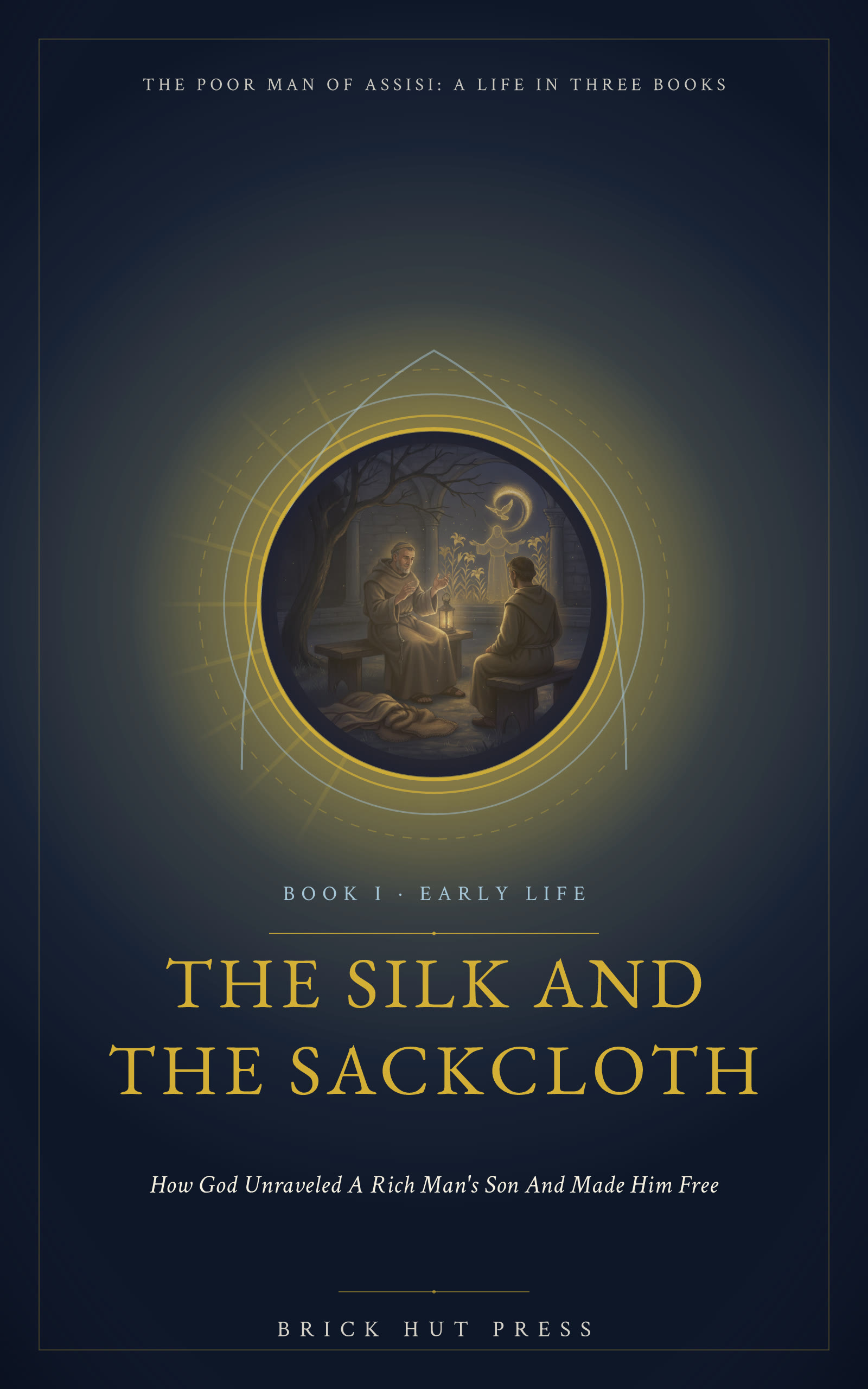
The Silk and the Sackcloth
He got something far stranger, far harder, and, if you stay with him long enough, far better.
He Gave Back Everything, and Found He Had Lost Nothing Francesco Bernardone was not supposed to be a saint. He was supposed to be rich. He was the merchant's golden son, quick with a joke, dressed in the finest cloth Assisi could offer, dreaming of glory on the battlefield and a name that would echo through the valley. He got none of that. He got something far stranger, far harder, and, if you stay with him long enough, far better.
Read the full description
The Silk and the Sackcloth is the story of how God dismantled a young man piece by piece: his ambition, his wealth, his reputation, his father's love, finally even his clothes, and how Francis of Assisi walked away from the bishop's square that day not broken, but astonishingly, inexplicably free. This is not a stained-glass account. It is warm, earthy, and unafraid of the darkness that precedes any real conversion. It is written for the faithful Catholic reader, and for every Christian who has ever looked at Francis and wondered whether that kind of joy is still possible, for someone like them, in a life like this.
Not sure yet? Begin free.
The Fire in the Rags, a complete book about this life, free, kept in your own library here, read and heard.
Receive the free bookAbout this volume
This is where the story of the little poor man begins, and it begins in a household that wanted for nothing. Volume One follows Francis of Assisi from the cradle to the first ragged company of brothers, and it does not hurry past the wealth. Pietro Bernardone's cloth shop, the fine dye, the long trade roads to France, the son raised to inherit all of it: these are given their full weight, because without them the unraveling that follows would make no sense. The volume opens with the strange, tender tradition of a birth completed in a stable, a detail the friars themselves treasured because they could not help but hear an echo in it, and it closes with brothers running to join a man the town had already written off as a fool.
Between those two points lies the boy who became "the king of the feasts," beloved in Assisi's streets for his wit, his generosity, his gift for making a room glad he had entered it. This volume does not treat that Francis as a false start to be gotten through. It treats him as the raw material God had chosen to work with, delight and vanity and courage all still undivided. The chapters on Perugia trace the ordinary path such a young man's ambitions might take: knighthood, glory, a war between hill towns. What happened instead, the captivity, the illness, the year of confusion that followed his return, is given room to be as strange and as slow as it actually was. Nothing is resolved too quickly here. The dark that came after Perugia is allowed to sit.
The turning is not staged as a single lightning stroke, though the book does not shy from the vivid moments the tradition has always cherished: the knight who turns his horse around on the road to Spoleto, the leper on the plain whom Francis kissed rather than fled, the voice that spoke to him from the broken crucifix at San Damiano. These scenes are rendered with the plainness the Franciscan sources themselves prefer, without embellishment beyond what has come down through the friars who first told them. What the volume takes seriously is the cost these encounters exacted from an ordinary household. Pietro Bernardone's fury is not softened into a minor obstacle. A father's grief and rage at a son who is dismantling the family's name and fortune in public gets its own chapter, because that grief is real and the book will not pretend the break was painless for anyone, least of all for Pietro.
It is in the bishop's square, stripped of the clothes his father gave him, that Francis becomes visibly what he had already become in secret: a man who belongs to nothing his family can reclaim. The chapters that follow, on Brother Lark and Brother Stone, on the morning the Gospel seemed to walk directly off the page and into his hands, on the first companions who came running to join him without being summoned, show a man discovering that poverty was not deprivation but a door. This is the volume for readers who want to understand not the finished saint of legend but the unraveling that made him, the rich man's son who had to lose almost everything he was given before he could be free to give himself away.
The three-book arc of this life begins here because it must. Later volumes will carry Francis to the leper colonies, to the Portiuncula, to the stigmata on La Verna, but none of that is intelligible without first sitting with the boy in silk who woke, slowly and at great cost, to sackcloth. Readers across traditions who keep his feast, Catholic, Anglican, Lutheran, and beyond, will find in this opening volume the same man they already love: not yet finished, but already unmistakably himself.
Lives that walk beside Francis of Assisi, chosen for their likeness, not their fame.