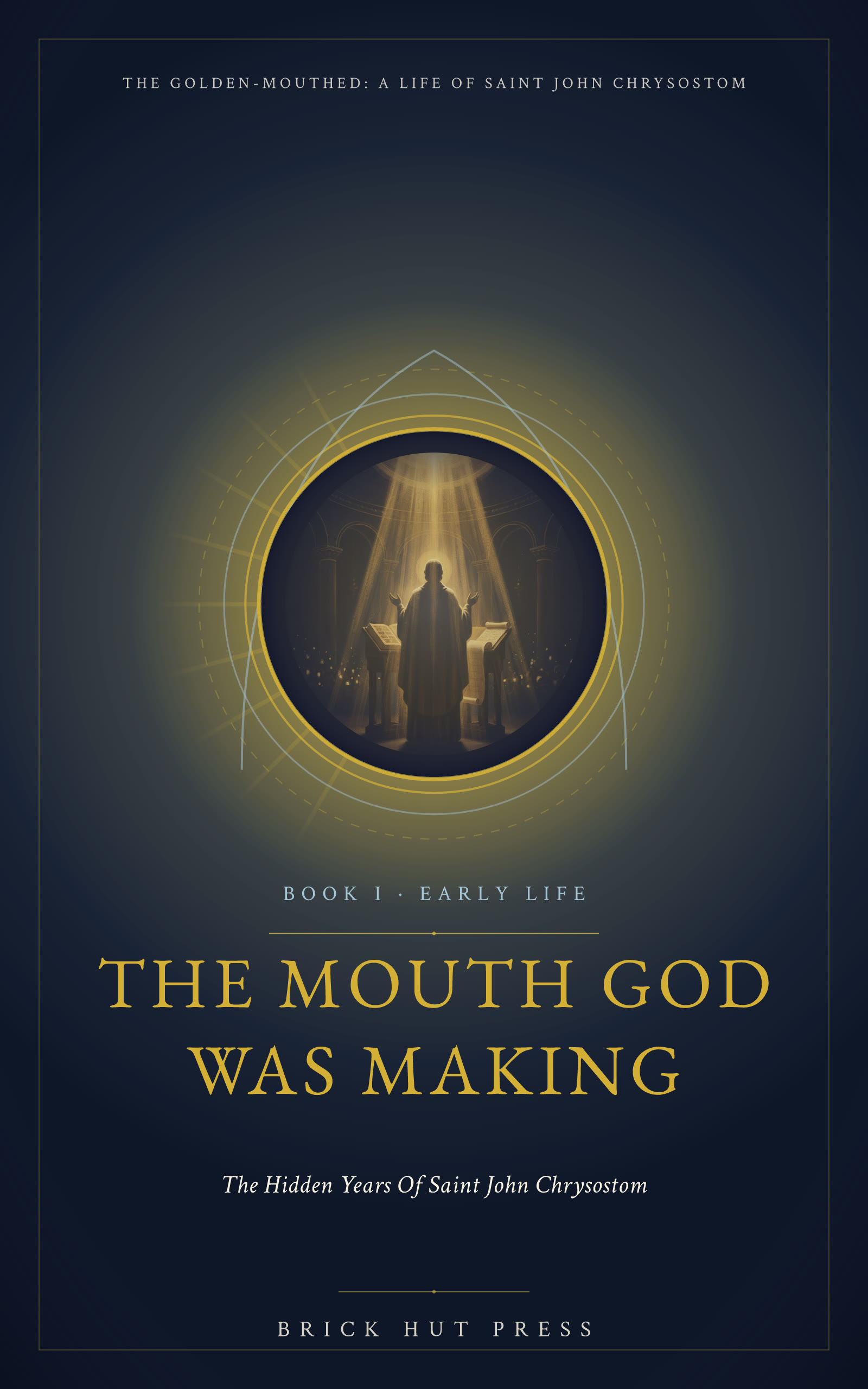
The Mouth God Was Making
In this Saint John Chrysostom biography, readers discover the rich soil from which this giant grew.
Before the golden mouth, there was a fatherless boy, a pagan schoolmaster, and two years of silence in a Syrian cave. In this Saint John Chrysostom biography, readers discover the rich soil from which this giant grew. The narrative follows him through the hidden years that formed his soul and voice. Long before his enduring legacy was established, early Church Father John Chrysostom was simply a fatherless boy growing up in Antioch.
Read the full description
He became a brilliant student of pagan rhetoric, studying under a pagan schoolmaster, yet he ultimately walked away from a legal career. He went into the desert and came back transformed. The life of this golden mouthed saint reveals how Providence was at work in every detour. The book explores his grief, his spiritual formation, his time in the desert, and his ultimate calling. It sets out to show the reader the profound hidden years of an Eastern Orthodox Church Father and saint, presenting him as a real person rather than just a name on a wall. A fatherless boy in Antioch: Read about his youth and the soil from which he grew. A brilliant student: Witness his education in pagan rhetoric and his departure from a legal career. The Syrian cave: Experience the two years of silence and desert formation that shaped his soul and voice. A whole human being: Encounter this giant as a real person shaped by grief, formation, and a divine calling. This volume is for readers who want to know a Church Father as a whole human being, not just a name on a wall.
Not sure yet? Begin free.
Come and Hear, a complete book about this life, free, kept in your own library here, read now; its narration joins free when it is finished.
Receive the free bookAbout this volume
Before Saint John Chrysostom ever climbed an ambo or earned the name history would give him, Golden-Mouthed, he was a boy in a widow's house in Antioch, and that house is where this first volume begins. The Mouth God Was Making does not open with sermons or councils or the great confrontations of his later years. It opens with Anthusa, twenty and widowed, refusing the second marriage the world expected of her, and with the son she raised alone in a city that, as the second chapter makes plain, could as easily ruin a promising young man as make one. Readers who come to Saint John Chrysostom already knowing the preacher of Constantinople, the scourge of the wealthy, the exile who died still dictating letters, may be surprised by how much of what he became was decided quietly, years before anyone outside Antioch had heard his name.
The volume follows him through the classroom of Libanius, the great pagan rhetorician whose training in eloquence John absorbed without absorbing his gods, a chapter that takes seriously both the debt and the distance, refusing to flatten either. It follows him to Diodore of Tarsus, the theologian who taught him to open Scripture in the plain, historical, almost stubbornly literal way that would mark his preaching for the rest of his life. And it follows him, crucially, to the night he chose not to climb: the moment when ambition, or the clear path to advancement that Antioch's Christian establishment seemed to be laying before him, was set aside for something harder to name and slower to arrive.
What follows is not triumph but formation, and the book is honest about how unglamorous formation can look. There are chapters here about learning to be small, about two years spent alone with almost nothing but a rock for a pillow and the Word for company, about a body that finally would not sustain the austerities his soul had chosen for it. This is the John Chrysostom before rhetoric became proclamation, a man whose health broke in the desert, who came back to the city changed and diminished and, in some way the book takes care to show rather than assert, more ready. The ascetic years are not treated as a detour from his real life's work but as the forge of it.
The volume closes where a public life properly begins: in the hands of Meletius, the bishop who ordained him, and in the five years John spent watching Bishop Flavian work before he himself was finally called to the ambo as priest. That final chapter, the priest steps to the ambo, is deliberately restrained. This is not yet the John Chrysostom of the great Antiochene homilies or the throne of Constantinople; those belong to volumes still to come. What this book offers instead is the patient, sometimes painful, always concrete story of how a widow's son from a provincial capital of the Roman East became the vessel later ages would call golden-mouthed, and it insists, chapter by chapter, that the mouth was made long before the world heard it speak.
Readers drawn to the great Doctors of the Church for their eloquence sometimes skip past the years that produced it, treating early life as mere prelude. This volume asks for patience with prelude. It sits with Anthusa's grief, with Libanius's classroom, with the silence of the mountains, because it takes seriously the conviction, Chrysostom's own, expressed later in his treatise on the priesthood, that nothing in a life devoted to God is accidental, least of all its beginning. Those who want to understand the sermons will do well to first understand the years in which no one was listening.
Lives that walk beside Saint John Chrysostom, chosen for their likeness, not their fame.