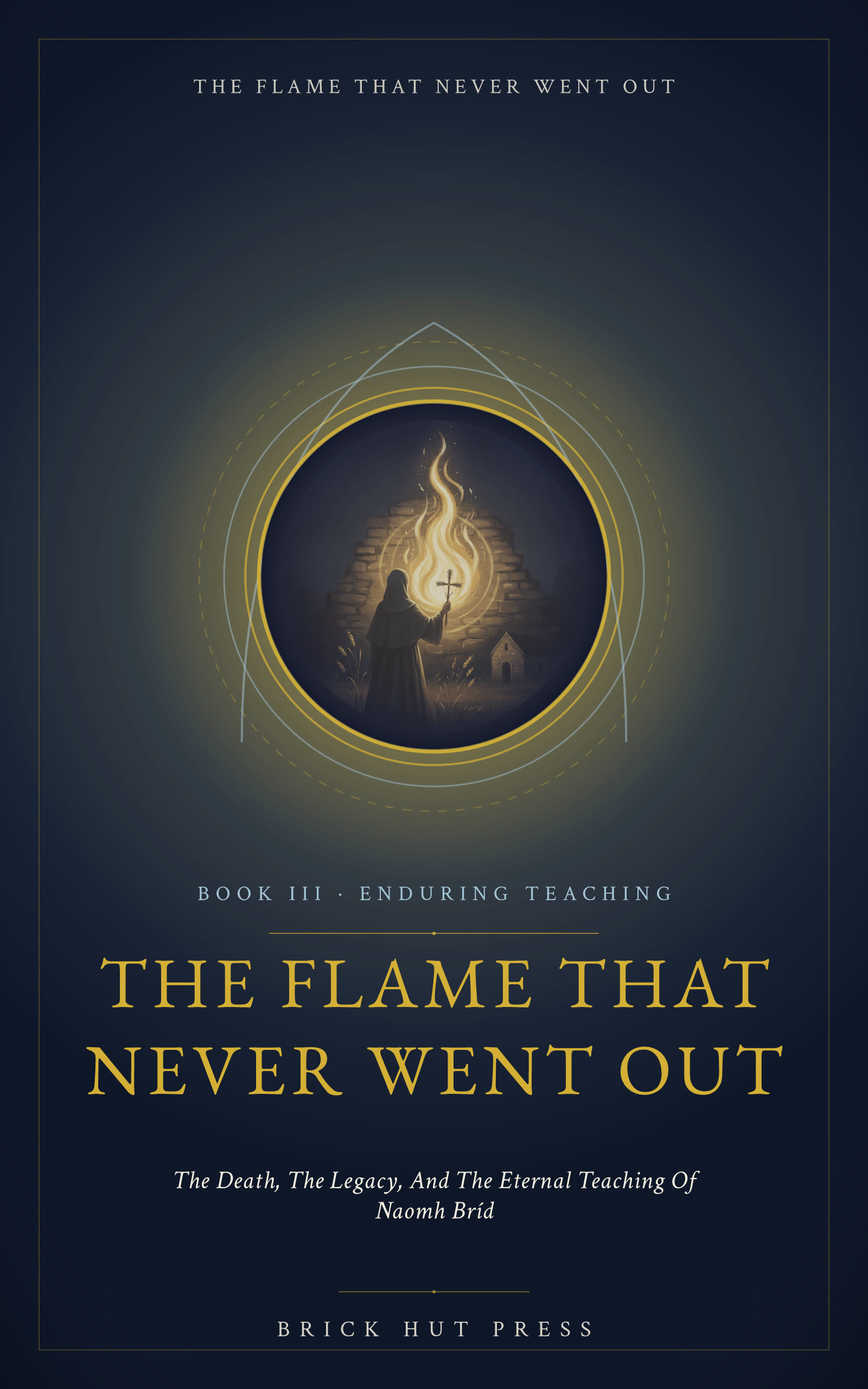
The Flame That Never Went Out
The sacred flame her sisters tended was extinguished by force, and yet it never truly died.
The Flame That Never Went Out, Because Some Saints Refuse to Be Forgotten More than fifteen centuries have passed since Brigid of Kildare drew her last breath at the monastery she built from nothing. The sacred flame her sisters tended was extinguished by force, and yet it never truly died.
Read the full description
It lived in the prayers whispered over Brigid's crosses plaited from rushes, in the holy wells bearing her name, in the hands of Irish mothers who pressed her image into the hearts of their children long after the language itself had nearly been taken from them. In 1993, the flame was physically re-lit. This book is the story of everything that happened in between, and everything it still means for us today. Whether you keep a Brigid's Cross above your door, light a candle on her feast day, or simply feel a pull toward this luminous woman that you have never quite been able to explain, The Flame That Never Went Out was written for you. This is not a dry hagiography. It is an intimate, soul-nourishing journey into the death, the legacy, and the living, breathing teaching of Naomh Bríd, patron of Ireland, mother of the Celtic Church, and one of the most quietly radical figures in the entire history of Christian faith.
Not sure yet? Begin free.
The Woman Who Wove Fire, a complete book about this life, free, kept in your own library here, read and heard.
Receive the free bookAbout this volume
The first two volumes of this series followed Brigid of Kildare from the threshold where she was born to the fullness of her governance at Cill Dara, the double monastery of monks and nuns that became, in her own lifetime, second only to Armagh. This third and final volume does something different, and something harder. It asks what happens to a flame once the hand that lit it is gone, and it answers, chapter by chapter, with the long and still unfinished story of a devotion that has never actually stopped.
The volume opens where it must: in the frost of a February morning at Kildare, in the hour before dawn when the word goes round the enclosure that the end is near. The chapter does not rush past this moment, nor does it dress it in more than the tradition itself supplies. It simply stays in the room, attentive to the detail that the Irish Church has always found significant, that Naomh Bríd is remembered to have died on the first of February, the same day kept as her feast, the same day, by long memory, on which she was born. From there the book follows what the ground received: the burial, the grief of the community she had governed, and the first stirrings of a cult that would outgrow Kildare before a generation had passed.
What follows is less a single narrative than a widening circle. The seventy houses that came to bear her name across Ireland and beyond are traced as evidence of how fast and how far her memory traveled. The relics receive their own long and sometimes painful chapter, the centuries of exile that scattered what remained of her physical presence across Europe, and the patient work, much later, of bringing some portion of it home. Readers who have wondered how a fifth-century abbess came to be venerated in places far from Leinster, and how her memory survived centuries in which so much else was lost, will find the mechanics of that survival laid out with care: the sisters who kept her alive, literally and otherwise, through the long middle centuries when her flame at Kildare was tended, extinguished, and tended again.
The book is frank that this is not only ancient history. A chapter given to Lá Fhéile Bríde in 1993 marks a modern turning point in the public keeping of her feast, and the chapter on the return of her relics brings the story into living memory, where the exile that began so long ago finds at least a partial homecoming. These chapters matter because they refuse to let Brigid become a figure locked in the fifth century. The mantle she is said to spread over the sick, the poor, and the traveling is treated as a present reality, not a folkloric flourish, and the volume takes seriously what she is understood to teach about giving: the open hand, the full table, the refusal to count cost against need.
The closing chapters turn from history toward instruction, in the quiet way this series has always preferred. The flame in the ordinary place and the rush cross above the door are read not as curiosities of Irish custom but as the visible residue of a teaching that found the sacred in hearth, threshold, and harvest rush. The book ends, fittingly, with Brigid under the title by which Ireland has long known her, the Mary of the Gael, now and always, a title the volume has earned rather than simply bestowed.
Readers of the first two volumes will find here the conclusion their sympathies have been built toward. Readers coming to Brigid for the first time will find a volume that does not require the earlier two to be moving, though it rewards having them. Either way, this is a book about what remains when the woman herself is gone: the houses, the relics, the sisters, the feast day, and the flame that, by every account the tradition has kept, has never actually gone out.

Lives that walk beside Brigid of Kildare, chosen for their likeness, not their fame.