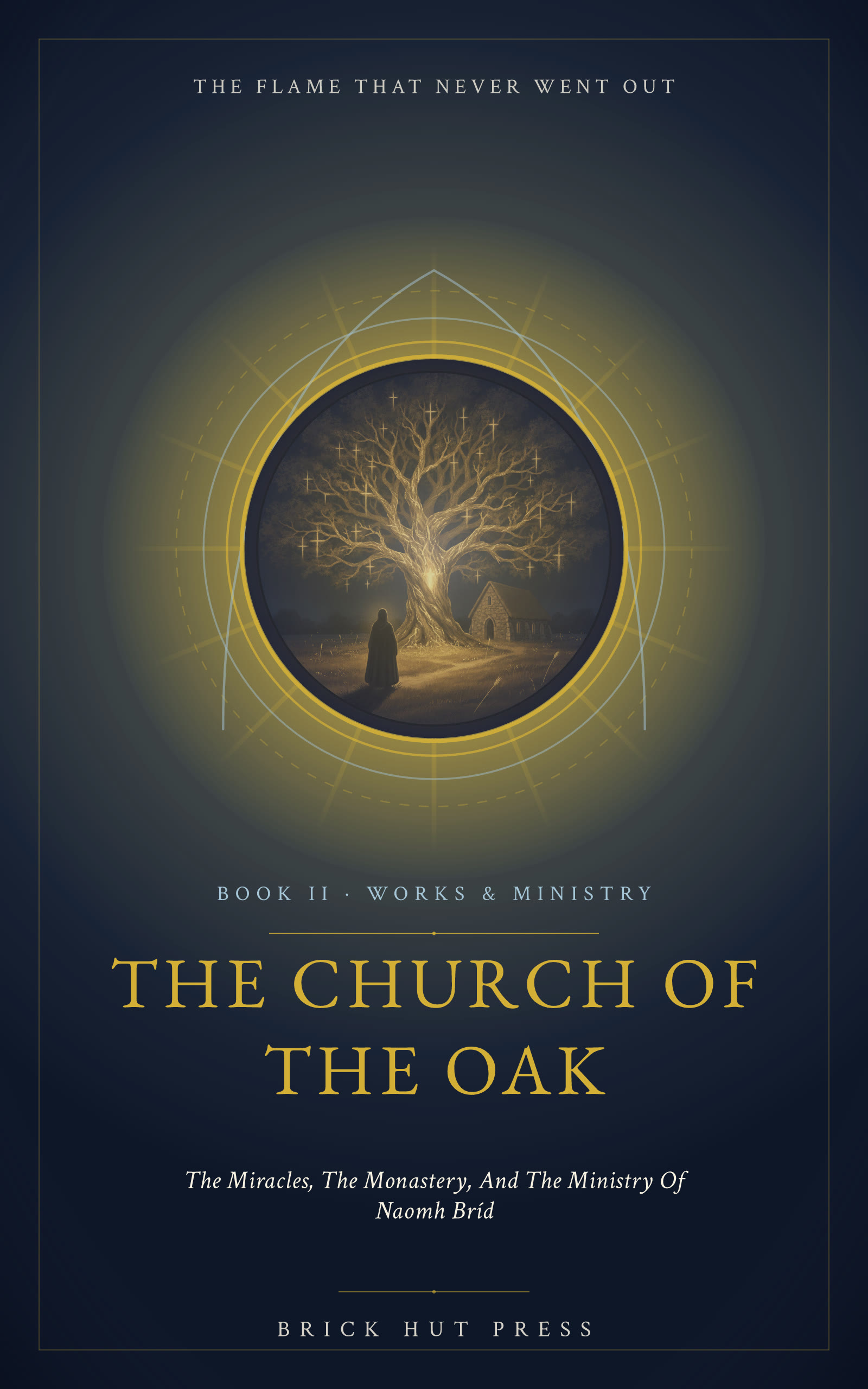
The Church of the Oak
She built a world, a living, breathing center of prayer, hospitality, healing, and holy fire that would outlast empires and outlove centuries.
She Lit a Flame Beneath an Ancient Oak, and Ireland Was Never the Same Under the spreading branches of a great oak in the heart of Ireland, Naomh Bríd did not simply found a monastery. She built a world, a living, breathing center of prayer, hospitality, healing, and holy fire that would outlast empires and outlove centuries. The Church of the Oak walks every mile of that world with her.
Read the full description
This is Brigid's story told from inside the tradition, with the warmth, the wonder, and the reverent familiarity of a storyteller who has always kept a rush cross above the door. If you have ever paused before a Brigid's Cross, felt the pull of the eternal flame at Kildare, or found yourself longing to know the woman behind the mantle, this book was written for you. More Than a Saint, A Living Tradition Brigid of Kildare stands at the great crossroads of Celtic Christianity and Catholic faith, beloved by women religious, Irish diaspora around the world, and lay seekers drawn to the ancient, earthy spirituality of the Celtic saints. Yet so much of her life, the miracles witnessed on dusty roads, the monastery she governed with fierce tenderness, the communities she gathered and the ministry she poured herself into, remains underexplored, half-told, or buried in scholarly distance. The Church of the Oak changes that. Drawing on hagiographical tradition and told with a storyteller's heart, this book restores the full arc of Brigid's active life to readers who are ready to love her more deeply.
Not sure yet? Begin free.
The Woman Who Wove Fire, a complete book about this life, free, kept in your own library here, read and heard.
Receive the free bookAbout this volume
The second volume of The Flame That Never Went Out opens where the first left off, with Naomh Bríd no longer a girl discerning her calling but a woman already known on the roads of Leinster, standing before a king on the open ground of the Curragh. From that single encounter, the cloak spreading itself across the plain until it covered land enough for a monastery, this book follows the long work of building what that land became: the Church of the Oak, Cill Dara, the foundation that would make her name inseparable from a particular patch of Irish earth and from everyone who ever came to it hungry, sick, or lost.
This volume is concerned less with Brigid's girlhood than with her governance, her hospitality, and the strange, steady fire of her sanctity once it had a hearth to burn in. Readers will walk with her through the founding of the double monastery under Bishop Conleth, an arrangement of men and women under one rule that was unusual even in an Ireland accustomed to unusual arrangements, and they will sit with her at a dying man's bedside as she weaves rushes into the cross that still bears her name, a small domestic miracle born out of nothing more than what lay on the floor. The chapters on bread and ale, on healing given and healing received, on her particular gentleness with wild creatures, are not gathered here as a catalogue of wonders for their own sake. They are offered as a portrait of a woman whose holiness showed itself in the ordinary transactions of feeding, mending, and making room, the kind of sanctity that a hungry traveler or a frightened mother could recognize without needing a theologian to explain it.
The book also takes seriously what it meant for Kildare to become a place, not just a person. There is a chapter on the roads Brigid walked across Ireland, tracing her as a figure in motion rather than a saint fixed in one abbey, and another on the scriptorium and the goldsmiths' workshops that grew up around her foundation, the beginnings of Kildare as a center of craft and learning that would outlast her own lifetime by centuries. Readers interested in how a single monastic settlement could become a seedbed for Irish art and manuscript culture will find that story handled with care here, grounded in what the tradition actually claims rather than inflated beyond it.
Two chapters give the volume its emotional center. One turns to Saint Dara, remembered as Brigid's daughter in God, and the old story of the gift of sight, a story that asks what it means to choose the unseen world over the visible one, and what kind of love could restore a vision only to have it set aside again. The other is the book's closing meditation on the title the Irish faithful gave her themselves, Mary of the Gael, a title earned not by decree but by centuries of mothers and travelers and the sick invoking her name in the same breath as the Blessed Virgin's, asking her to stand near them the way she stood near the dying, the hungry, and the kings she was not afraid to address plainly.
Throughout, the volume keeps faith with the way these stories have actually been carried, through the Vita Prima and the long oral memory of the Irish church, without pretending to a certainty the sources themselves do not offer. It is written for readers who already hold Naomh Bríd in reverence and want her monastery, her miracles, and her ministry drawn out with the same warmth and particularity that marked her own dealings with the poor at her gate. It assumes no distance from its subject, only the patience to sit with a saint who built a church around an oak tree and then filled it, year after year, with bread for the hungry and ale for the thirsty.

Lives that walk beside Brigid of Kildare, chosen for their likeness, not their fame.