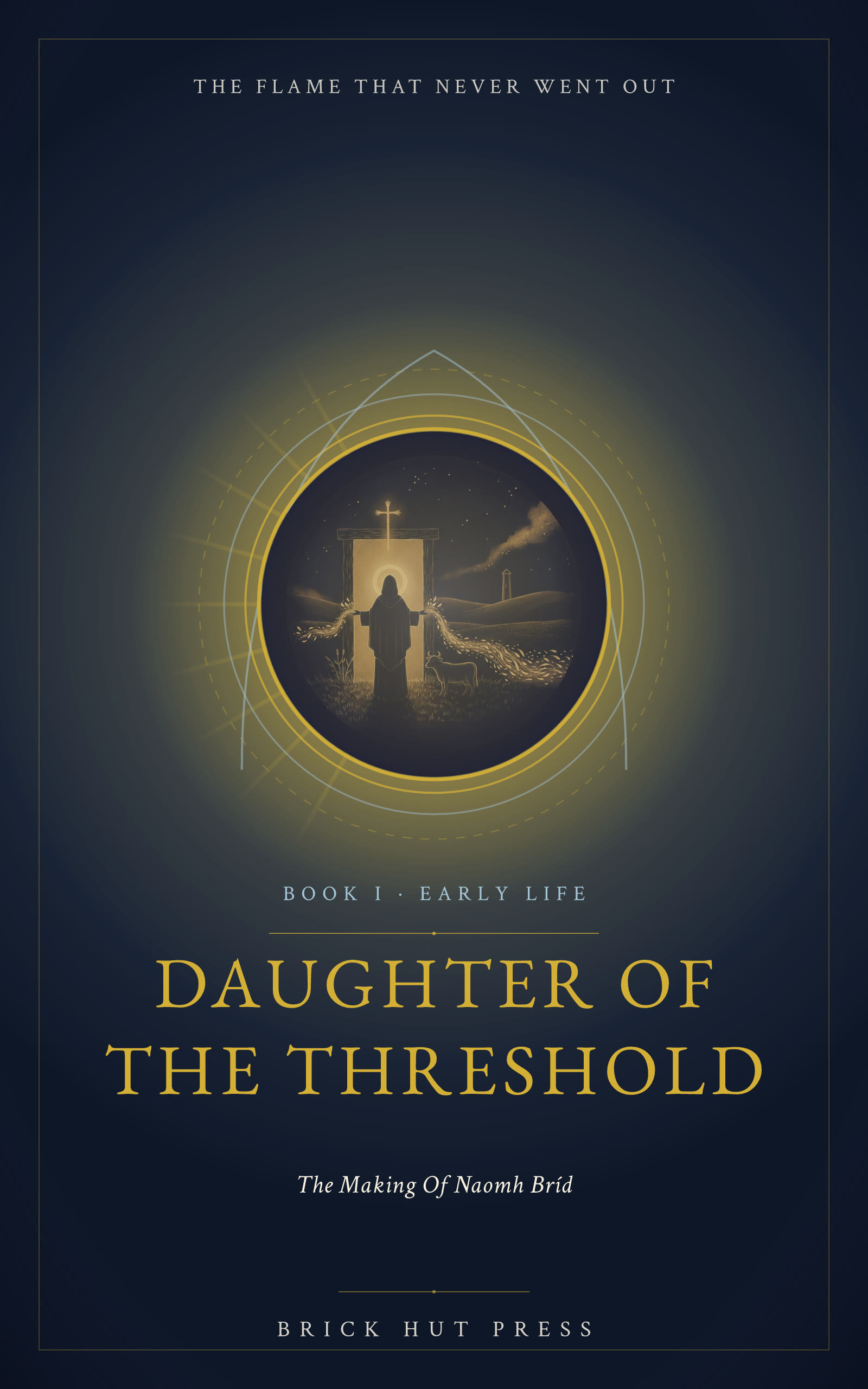
Daughter of the Threshold
The name on every Irish lip, every Celtic heart, every prayer whispered at the hearth is Bríd .
She Stood at the Edge of Two Worlds, and Chose Heaven Every year, on the first breath of February, hands twist rushes into a cross and hang it above the door. The name on every Irish lip, every Celtic heart, every prayer whispered at the hearth is Bríd . But behind the cross, behind the flame, behind the legend, there was a woman. A girl, first. Born on a threshold. Belonging fully to neither world, yet claimed utterly by God.
Read the full description
Daughter of the Threshold: The Making of Naomh Bríd is the story of that woman, rendered with reverence, historical imagination, and deep spiritual fidelity. This is not hagiography at arm's length. This is Brigid close enough to touch: her hunger, her defiance, her tenderness, her unshakeable conviction that the poor man at the gate was Christ Himself in disguise. From her borderland birth to the moment the veil descended and the flame was lit, every chapter breathes with the life of Ireland's most beloved saint.
Not sure yet? Begin free.
The Woman Who Wove Fire, a complete book about this life, free, kept in your own library here, read and heard.
Receive the free bookAbout this volume
Before the bell of Kildare ever rang, before the perpetual flame was tended by nineteen women across centuries, there was a bondwoman named Broicsech laboring in a doorway in Faughart, and a child who arrived neither inside the house nor outside it, caught in the grey light between roof-shadow and open sky. Daughter of the Threshold takes that single image, a birth at the seam of two worlds, and shows how it became the pattern for an entire life. This first volume of The Flame That Never Went Out does not rush toward the Kildare of legend, the oak grove and the convent and the fire that never dies. It stays, patiently and attentively, in the years before any of that was thinkable: a girl born to a slave mother and a chieftain father in Airgíalla, raised in a pagan Ireland still thick with oak-dark custom, who would grow into the woman the tradition calls Naomh Bríd.
The chapters move with the unhurried logic of a life taking shape rather than a legend being assembled. We meet Broicsech first, not as a footnote to Brigid's holiness but as a woman with her own bearing in the story, a slave who, the book argues, likely knew something of Patrick's mission even as it was still spreading through Ireland's kingdoms. We meet Dubhthach, Brigid's father, whose rage at his daughter's compulsive generosity, her habit of giving away whatever passed through her hands, milk, butter, his own sword hilt if it came to that, becomes one of the volume's most vivid and human threads. This is not a Brigid already enclosed in sanctity. This is a girl testing her father's patience and her own strange hunger to empty herself of everything she owns, long before anyone called that hunger a vocation.
The book takes seriously the world Brigid grew up in: the oak groves, the hearth-law, the uneasy overlap of druidic custom and the new Christian teaching arriving on Irish roads. It does not flatten this world into mere backdrop or obstacle. Chapters on her father's house and her father's fury sit alongside chapters on the prayer she apparently never stopped praying, suggesting a girl whose interior life was already disciplined and ardent well before she had the words of the Church fully available to her. The volume treats the road to Bishop Mel, and the veiling that followed, as a hinge point rather than a foregone conclusion, asking what exactly that veiling made possible for a woman of her birth and standing, and what it cost her to walk toward it.
The final chapters, the well and the widow and the cloaks, Brigid's slow becoming known before Ireland itself had settled into the shape that would bear her name, bring the volume to its close not with triumph but with threshold crossed into threshold. This is a book willing to sit with uncertainty where the historical record is thin, acknowledging openly where accounts differ and tradition does not waver, rather than smoothing every gap into easy certainty. It reads Brigid's childhood and young womanhood as formation, the long, often unglamorous labor by which a slave-born girl in fifth-century Louth became someone capable of carrying a nation's devotion.
For readers who know Brigid chiefly through the fire-keeping nuns of Kildare or the brave legends of her mantle spreading impossibly over the land, this volume offers the ground those legends grew from: a mother on a threshold, a father's exasperated love, an oak-dark world giving way, slowly and not without struggle, to something new. It asks the reader to begin where Brigid herself began, at the doorway, in the grey hour before the birds start, and to watch, chapter by chapter, how that in-between place became her whole life's vocation.
Lives that walk beside Brigid of Kildare, chosen for their likeness, not their fame.