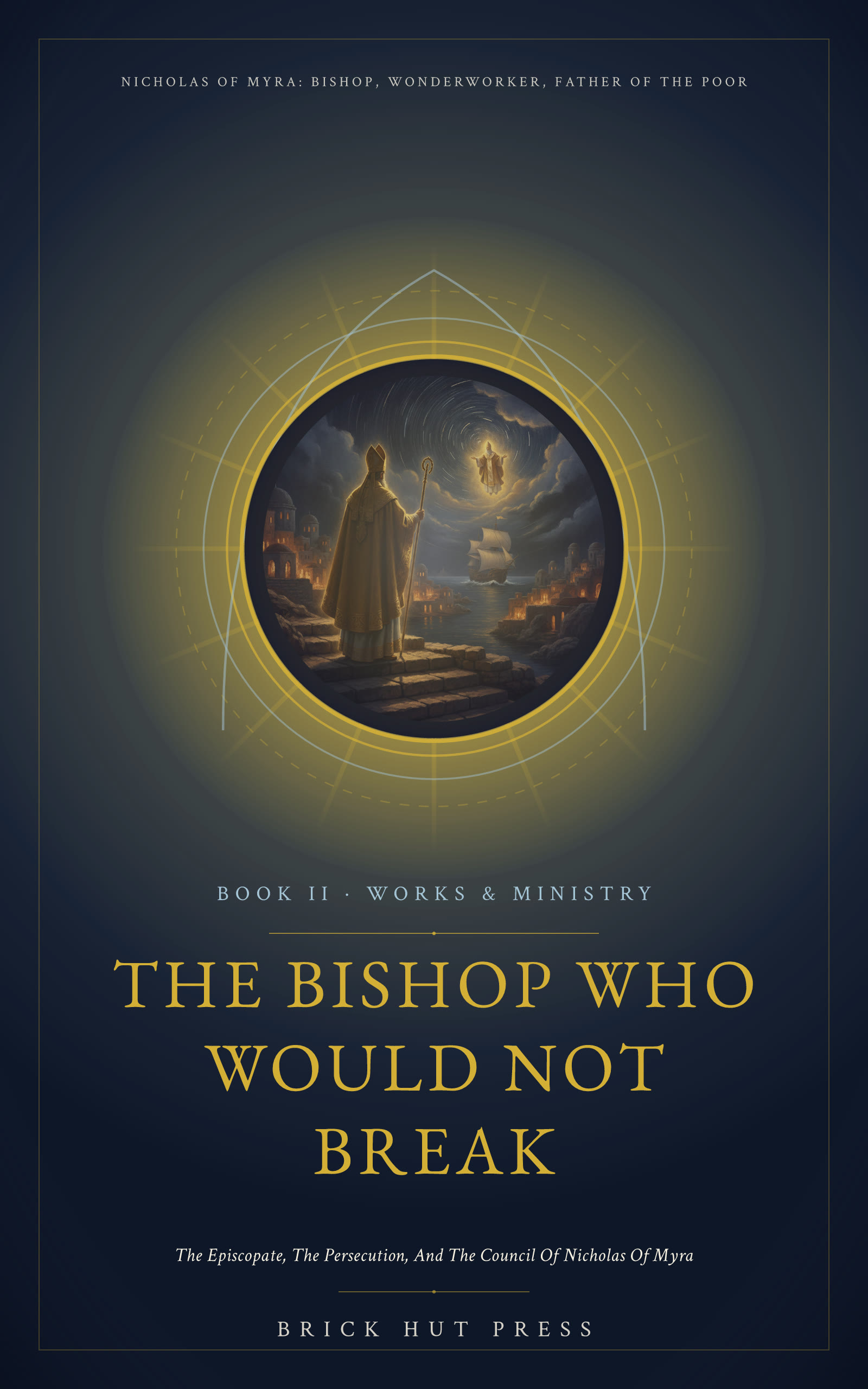
The Bishop Who Would Not Break
He Defied the World's Most Powerful Heresy.
He Survived the Emperor's Dungeons. He Defied the World's Most Powerful Heresy. He Never Stopped Feeding the Poor. You already know the name. You may have lit a candle to the saint, told his story to your children, or stood at his tomb in Bari.
Read the full description
But the man behind the feast, the bishop who endured Diocletian's persecution, who wept over a starving city, who pressed through imperial crowds to snatch condemned men from the executioner's blade, that man has been all but buried beneath centuries of legend and commercial myth. The Bishop Who Would Not Break restores him. This is the story of Nicholas of Myra as the Church has always known him: confessor, pastor, defender of the Apostolic faith, and father of the poor whose episcopate spanned the most dramatic decades in Christian history. From Diocletian's Dungeons to the Council of Nicaea Nicholas was not a kindly folk figure who scattered coins in winter. He was a bishop who bore the marks of Roman imprisonment on his body and who carried those marks into the great Council where the faith of every future generation would be defined. He had fed the hungry in famine, rescued the wrongly condemned, and shepherded a threatened flock through the last and worst of the imperial persecutions, all before he ever sat in a council chamber at Nicaea. The Bishop Who Would Not Break follows his full episcopate, from the sun-bleached docks of Lycia to the marble halls of empire, tracing each dimension of his ministry with historical care and spiritual depth.
Not sure yet? Begin free.
Gold in the Window, a complete book about this life, free, kept in your own library here, read and heard.
Receive the free bookAbout this volume
This is the volume where the office becomes the man. Book One brought Nicholas to the altar at Myra and set the hands of the church upon him; this second volume asks what a bishop's life is actually made of once the ordination is over and the years begin to accumulate. It opens not with drama but with the daily office, the pre-dawn hours, the oblation offered before the city wakes, because the editors of this series believe, as the tradition itself insists, that sanctity is built in unrecorded mornings long before it is tested in a crisis. Readers who come to Saint Nicholas only for the famous episodes will find them here in full, but they will find them anchored in something sturdier: the patient administration of a coastal see, the negotiations with dockworkers and grain merchants, the quiet judgments rendered in the basilica where imperial and ecclesial business overlapped.
The middle chapters carry the weight of the volume. A famine reaches Myra by sea, and the bishop who has spent years learning the harbor, the shipmasters, the granaries, uses that ordinary knowledge to keep a city fed when the bread runs out. Then Diocletian's persecution arrives, and the same steadiness that governed his daily rounds becomes the steadiness that keeps him from breaking under imprisonment and threat. This volume does not romanticize suffering; it treats the prison years as a continuation of the same fidelity described in chapter one, the same man, tested rather than transformed. When Constantine's edict changes everything, the narrative does not rush past the reversal. It lingers on what it meant for a persecuted bishop to walk free into a church suddenly permitted to exist in daylight.
Two of the most beloved stories in the whole Nicholas tradition receive careful, reverent treatment here: the rescue of the three officers condemned to die by the sword, and the deliverance of the three boys taken by the butcher. The volume does not strip these accounts of their strangeness or their mercy in the name of caution, nor does it inflate them beyond what the tradition itself has carried forward across the centuries. It presents them as the church has always presented them, as acts of a father defending the defenseless, and lets the reader sit with that inheritance.
The council chapters are the hinge on which the whole volume turns. Nicholas travels to Nicaea, into a room where the nature of Christ himself stood on trial before the assembled bishops of the world, and the volume takes seriously both the gravity of that gathering and the tradition's most startling memory of it, the blow that has echoed for seventeen centuries. It does not treat that moment as scandal or embarrassment but as the eruption of a shepherd's zeal for the flock he had spent a lifetime learning to protect, the same zeal that filled the granaries and calmed the sea.
The closing chapters turn gentler. A chapter in defense of sailors gathers the maritime devotion that made Nicholas the patron of every soul who has ever put to sea, and the volume then follows him into the evening of his life, unhurried, without melodrama, toward the burial at Myra that the last chapter's title insists was never really an ending. Buried in Myra, already everywhere: that phrase carries the whole argument of this volume, that a life given fully to the daily, unglamorous work of shepherding becomes, by a logic the church has always trusted, a life that belongs afterward to the whole world.
Taken as a whole, this second volume asks readers to hold together what is often separated: the plodding faithfulness of an ordinary bishop and the extraordinary events that made him beloved across East and West alike. It insists, gently and repeatedly, that these were never two different men.

Lives that walk beside Nicholas of Myra, chosen for their likeness, not their fame.