A Child Held by the Light
He wept over a father's shame he could not bear to watch.
Before He Became a Legend, He Was a Boy Broken by Loss, and Held by Grace His name fills Christmas carols and department stores, but the real Nicholas of Myra is almost entirely unknown. He was orphaned young. He wept over a father's shame he could not bear to watch. He pressed his face against a cold Palestinian wind and prayed over the same stones the apostles had pressed their feet upon.
Read the full description
Long before anyone called him a saint, he was a young man being quietly, painfully, irreversibly formed, held by a light he could barely see. A Child Held by the Light: The Making of Nicholas of Myra is the story of that formation. Not the legend. Not the jolly icon in red. The man. The orphan schooled by a faithful uncle-bishop in the green mountains of Lycia. The pilgrim humbled on Palestinian roads. The young heir who pressed a bag of gold through a darkened window so a father's daughters might live with dignity. This is the fire that lit the feast, and it burns far brighter than anything the secular world remembers.
Not sure yet? Begin free.
Gold in the Window, a complete book about this life, free, kept in your own library here, read and heard.
Receive the free bookAbout this volume
This is the volume that answers the question every reader of Nicholas of Myra eventually asks: how does a man become the kind of saint whose name is invoked at every harbor and every hearth, whose gifts still arrive unseen through windows on winter nights? A Child Held by the Light does not begin with a bishop already fully formed. It begins with a father in Patara sitting in the dark, doing arithmetic he cannot make come out right, and three daughters pretending to sleep while poverty opens a door no family wants opened. That scene, and Nicholas's answer to it in gold thrown through a window under cover of night, is the seed from which this whole volume grows outward.
The chapters that follow trace the shape of a childhood and young manhood lived along the Lycian coast, in a world of shipping families, limestone harbors, and the hard arithmetic of survival that the fourth century imposed on the fortunate and unfortunate alike. "Where the Mountains Meet the Sea" and "The House Where Everything Was Given Away" root the young Nicholas in Patara itself, in a household whose wealth becomes, almost immediately, something to be poured out rather than kept. But this is not a story of easy virtue rewarded. "The Fever That Took Everything" and "The Bishop Who Was Also an Uncle" bring loss into the frame early and without softening it: the deaths that leave Nicholas both orphaned and, strangely, provided for, under the care of an uncle whose office as bishop becomes the first shape his own vocation will later take.
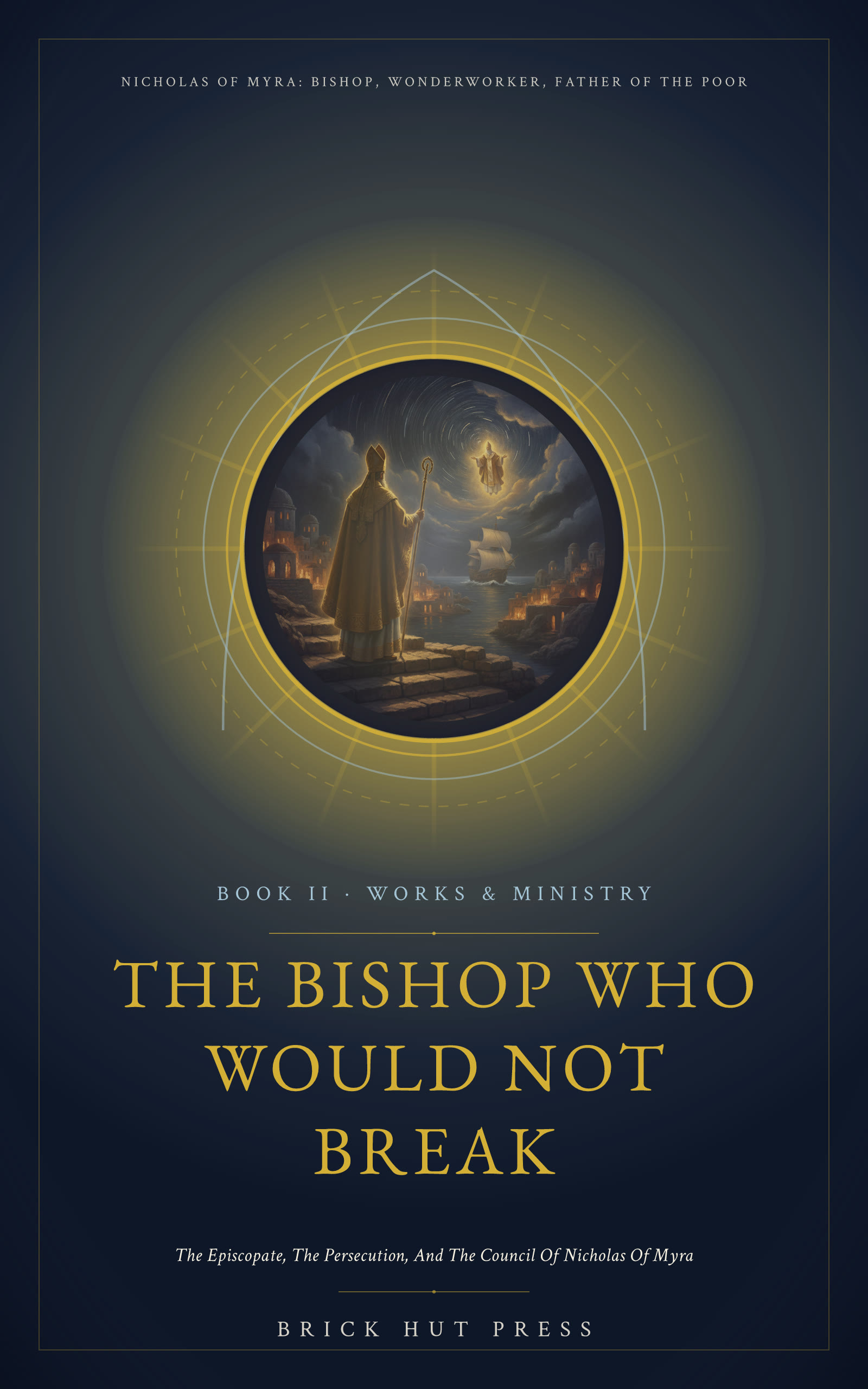
What distinguishes this volume from a simple hagiographic sketch is its willingness to follow Nicholas away from home before it lets him become the bishop the world remembers. "The Long Way Around: Egypt, Palestine, and the Desert" and "What Palestine Planted in Him" take the reader through the formation years, the pilgrimage south into the desert fathers' country and east toward the places where the Gospel had walked in the flesh. These chapters treat that journey as consequential rather than decorative: something is planted in Nicholas among the Egyptian ascetics and the Palestinian hills that will not fully flower until Myra needs it. "A Storm That Did Not Have the Last Word" gives the sea itself a role in this formation, the same Mediterranean that opens the book with its indifferent breathing becoming, later, a thing Nicholas learns he can call upon and be answered.
"Learning to Read What Cannot Be Unread" sits at the emotional center of the volume, a chapter title that promises no easy comfort: whatever Nicholas learns in these years, grief and Scripture both, is knowledge that will not let him go back to being the untested young man of Patara's harbor district. By the time the book returns, in "Night Work: The Gold and the Window," to the scene that opened it, the reader understands that act of secret generosity not as an isolated marvel but as the first fruit of everything that came before: the family loss, the desert silence, the pilgrim roads, the uncle's example of episcopal care.
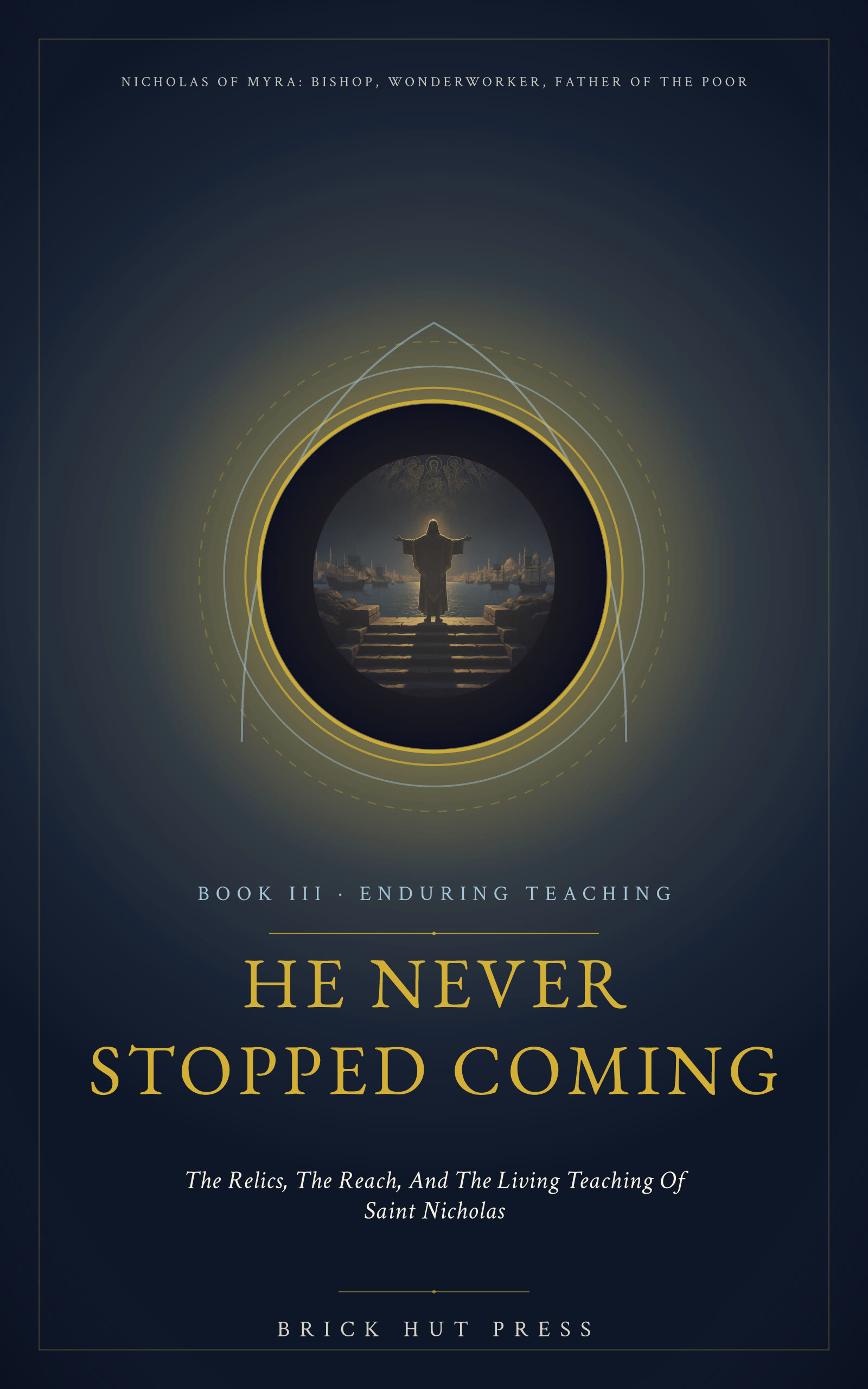
The volume closes at "The Cathedral at the Edge of Everything," Myra itself, the city where the young man from Patara will become the bishop the whole Church, East and West, still calls father of the poor and defender of the wronged. This is a book for readers who want to understand Saint Nicholas before the legends accumulated around him, who want to see the coastline, the harbor, the desert road, and the grief that made a man capable of throwing gold through a window in the dark and asking nothing in return. It is measured, unhurried, and faithful to the record it has, content to let the facts of a hard childhood do the work that embellishment does not need to do.
Lives that walk beside Nicholas of Myra, chosen for their likeness, not their fame.