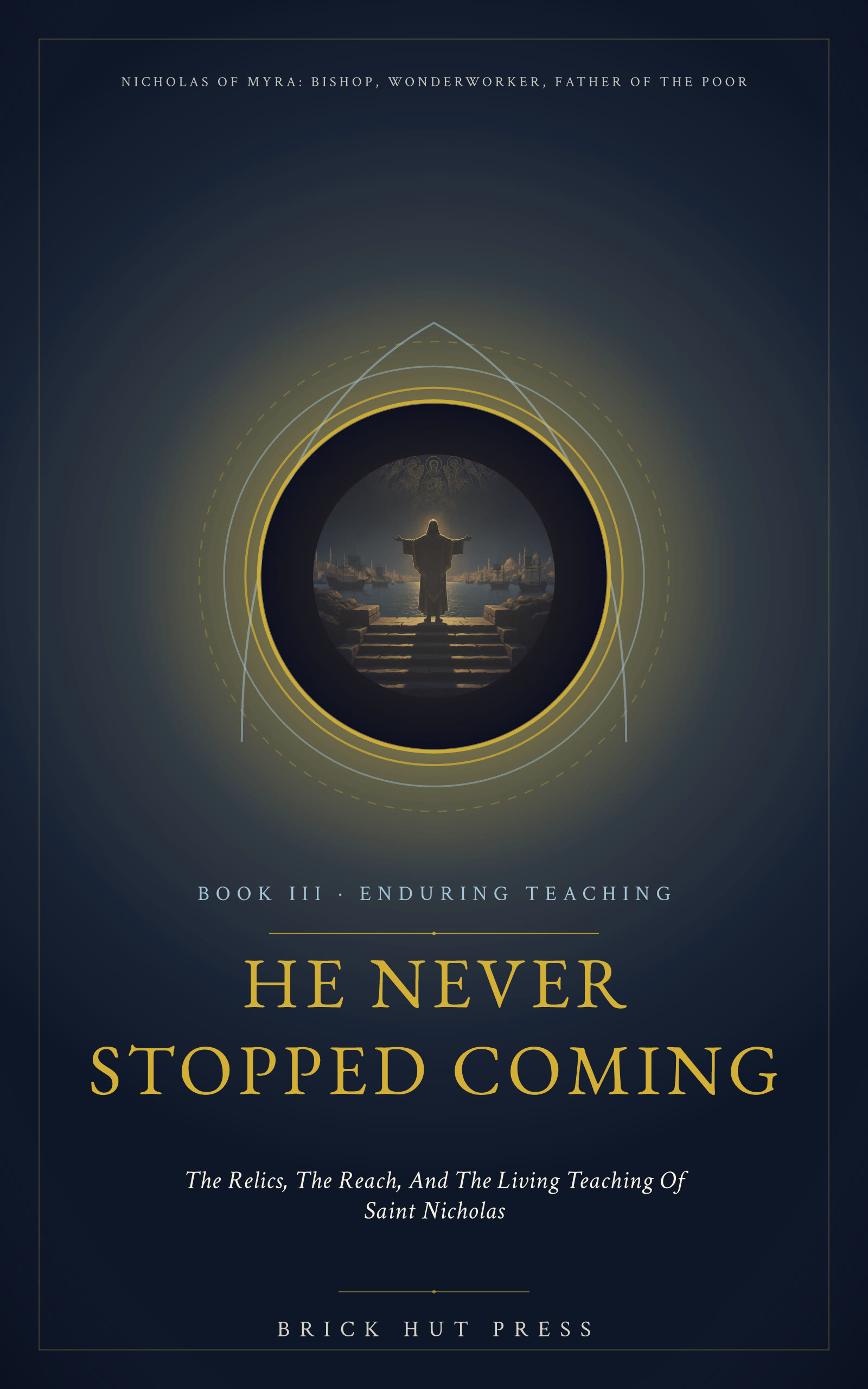
He Never Stopped Coming
His name was Nicholas of Myra, and he was anything but a myth.
The Saint Who Never Stopped Coming, Recover the Real Nicholas Behind the Legend Before the sleigh. Before the red suit. Before the mall and the marketing, there was a bishop who stood in a prison cell, fed starving children from his own stores, and walked into the most explosive theological council in Christian history without flinching. His name was Nicholas of Myra, and he was anything but a myth.
Read the full description
He Never Stopped Coming strips away fifteen centuries of legend to return you to the man: a confessor who bore the marks of persecution, a secret giver who pressed gold through a window in the dark, a shepherd who outlived his own death in relics, in myrrh, in answered prayers from the Adriatic coast to the frozen rivers of Novgorod. This is the Nicholas that Catholic, Orthodox, and every ecumenically minded Christian has always sensed was still out there, still at work, still coming. What You Will Discover Inside The suffering bishop: Nicholas's imprisonment under Diocletian, the cost of his faith, and why his survival shaped everything he became as a pastor and protector of the poor. Nicaea and the fire for truth: The historical and theological stakes of the Council of Nicaea, and what Nicholas's presence there reveals about the man's ferocious love for orthodox Christianity. The extravagant mercy: The famous dowry gifts, the rescued children, the sailors pulled from storms, examined not as folklore but as windows into a coherent, radical theology of generosity. The translation of the relics: How the bones of a fourth-century bishop crossed the Adriatic to Bari in 1087, why that event electrified medieval Christendom, and what the still-flowing myrrh continues to mean for pilgrims today.
Not sure yet? Begin free.
Gold in the Window, a complete book about this life, free, kept in your own library here, read and heard.
Receive the free bookAbout this volume
This is the third and closing volume of a three-part life, and it begins where a life ordinarily ends: at the grave. Volume One gave you the boy of Patara, the young bishop of Myra, the deeds of mercy that made his name a byword while he still walked the harbor roads. This book takes up what happened after the sixth of December, 343, when a provincial tomb on the Lycian coast became, almost overnight and without anyone's permission, a place where people came to be healed. The opening chapters follow that current as it widens: the anonymous scribes and hagiographers who first wrote him down, the slow, unplanned migration of his cult east to west, the fixed tradition of the sailors of Myra who reached toward him first among the seafaring poor of the ancient world. From there the book stays close to the ground, chapter by chapter, tracing how a local devotion became a civilizational one.
The heart of the volume is geographical and material as much as it is spiritual. There is a full chapter on the building of the basilica, the stone rising course by course over the site of his ministry, and another on the myrrh, the holy oil that has flowed from his relics since their translation and that the Eastern Church has never treated as legend but as ongoing, witnessed fact. A further chapter follows the relics themselves west to Bari, the ships, the reasons a Mediterranean world in flux wanted this particular saint under its own roof, and what that translation meant for both the Adriatic city that received him and the Anatolian one that lost him. None of this is treated as folklore to be politely summarized. The book takes seriously that Nicholas's afterlife, if that word can even apply to a saint the Church holds to be living, has been as consequential as his lifetime, and it asks the reader to sit with the strangeness and the grace of a man who, as the title has it, never stopped coming.
Two chapters widen the lens considerably, and readers coming to Nicholas mainly through Christmas custom will find them especially rewarding. One follows his singular status in Russian devotion, where he is honored with a closeness that borders on kinship, called to and depended upon by peasant and tsar alike in a way few other saints outside the Theotokos have ever been. The other traces the long, sometimes comic, sometimes moving passage from Sinterklaas to Santa Claus, showing how the bishop of Myra survived translation into Dutch folk custom and then American commerce without ever quite losing the thread back to the man in the sarcophagus at Andriake. The book does not scold the modern Santa Claus, but it does want the reader to see the seam, the place where legend and liturgy touch, so that a childhood memory of stockings and a grown reader's memory of the feast day can be recognized as branches of the same tree.
Practical chapters ground the book in the present tense of devotion. There is guidance on keeping his feast, on the customs of December sixth as they are lived in homes and parishes now, and a chapter that walks the reader physically through the stones of Myra and Bari, a pilgrim's chapter as much as a historian's, meant for those who might one day stand where the fishermen once stood. The volume closes not with an ending but with a claim the whole book has been building toward: that his teaching, drawn from the deeds more than from any treatise, has not aged, has not needed correction or modernization, because it was never complicated to begin with. Give, protect the defenseless, come quickly to whoever has no one else.
Read alongside its two companion volumes or read on its own, this book is written for anyone who has ever wondered why a fourth century bishop from a small Roman province still has a claim on the imagination of half the world, and who wants an answer that takes both the myrrh and the modern Christmas seriously, in the same reverent breath.

Lives that walk beside Nicholas of Myra, chosen for their likeness, not their fame.