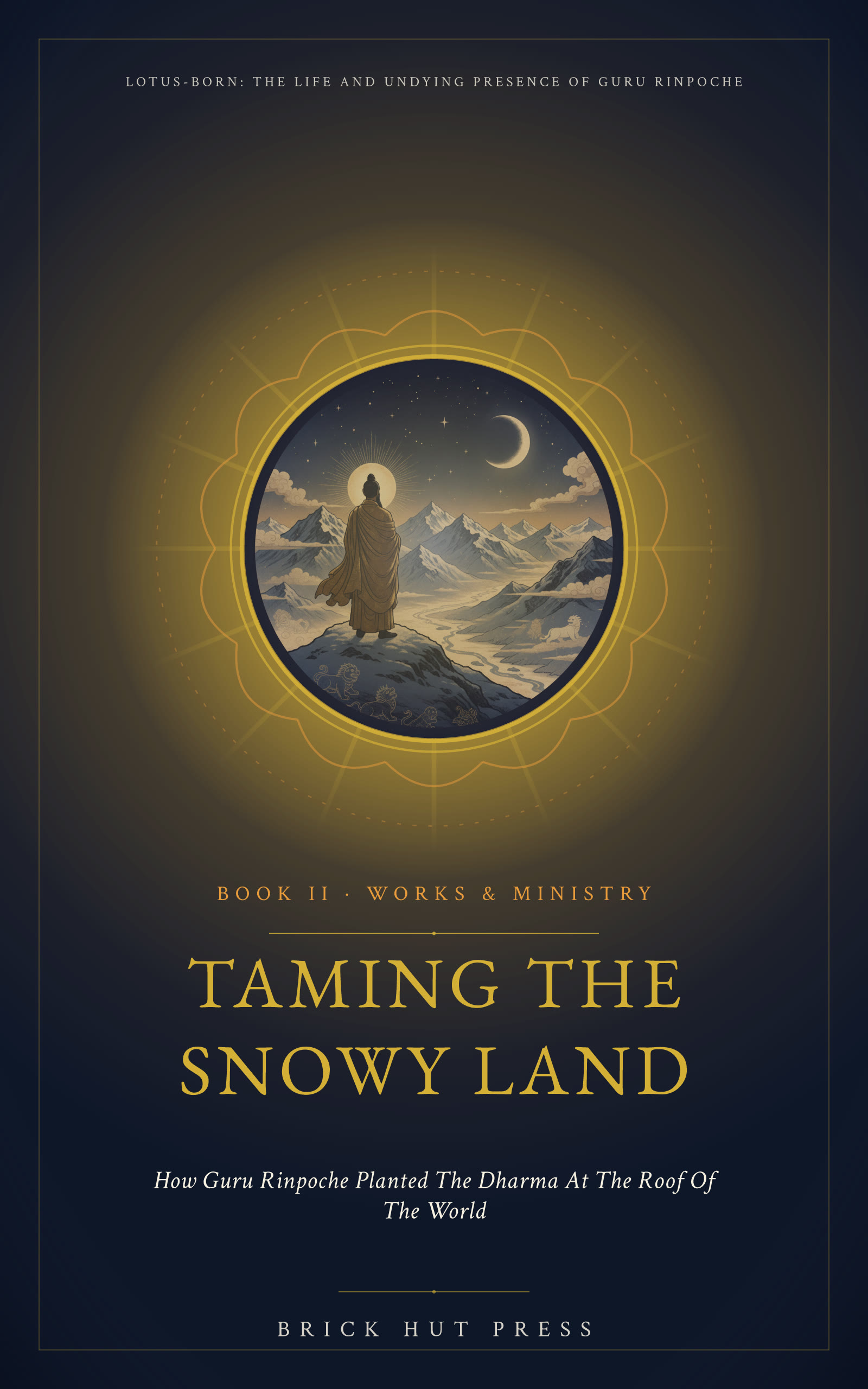
Taming the Snowy Land
Demons held the high plateau in their grip.
The Lotus-Born Came, and Nothing in Tibet Was Ever the Same A king prayed at the edge of desperation. Demons held the high plateau in their grip. And then, from a lotus blossom on a sacred lake, the one the world would come to call Guru Rinpoche arrived.
Read the full description
Taming the Snowy Land tells the story of Padmasambhava, the Lotus-Born master who transformed a fierce, spirit-haunted wilderness into the very roof of the Dharma world, with the warmth of a trusted spiritual friend and the luminous precision of a master thangka painter bringing each scene to vivid, consecrated life. This is the Nyingma tradition's own great story, told as it deserves to be: whole, strange, tender, and utterly alive. From the founding of glorious Samye, Tibet's first monastery, raised against impossible odds, to the hidden terma teachings sealed inside stone, sky, and the mindstreams of future disciples, every chapter honors the full depth of what this extraordinary being accomplished. Whether you have chanted his mantra ten thousand times or are only now sensing that something immense lives within his name, this book meets you where you are and carries you further than you thought you could go.
Not sure yet? Begin free.
The Second Buddha Among Us, a complete book about this life, free, kept in your own library here, read and heard.
Begin reading, freeAbout this volume
This is the volume in which the Dharma stops knocking at Tibet's door and walks inside to stay. Readers who have followed the first book in this series already know Guru Rinpoche as the lotus-born master of Oddiyana, tamer of charnel grounds, keeper of powers no ordinary teacher possesses. Here he comes to the Roof of the World itself, summoned by a king whose faith has just been tested in the cruelest way a builder's faith can be tested: a temple raised by human hands and struck down by hands that are not human at all. Taming the Snowy Land opens on that wreckage at Drakmar, with Trisong Detsen standing in the cold dawn refusing to accept that the local spirits have the final word, and it carries that refusal all the way to Samye rising where nothing had stood, to Chimphu cave where disciples receive teaching like lightning, to the last breath of instruction given at Gungtang before a departure that, the book insists from its very title, was never quite a departure at all.
The chapters move with the patience of a chronicle and the charge of a vision. We watch the spirits at the border, the deities and demons who guard Tibet's passes and peaks, be met not with armies but with a master who understands their pride and their fear well enough to bind them by oath rather than by force. We sit in on the meeting at Tra Duk, where protocol, power, and prophecy collide the moment Guru Rinpoche and the king first take each other's measure. We watch something rise where nothing had stood: Samye, Tibet's first true monastery, built not merely of timber and stone this time but of consecrated ground that the local forces no longer contest. And we meet the first monks of the Snowy Land, the men who will carry ordination into a country that has never before had a native Sangha, the seed from which centuries of Tibetan Buddhism will grow.
The heart of the volume belongs to transmission itself, and the book treats this with real tenderness. Chimphu, the cave above Samye where lightning enters the disciples, is given its own chapter because this is where the Vajrayana stops being imported and becomes indigenous, where Tibetan minds first hold tantric realization as their own. Yeshe Tsogyal receives a chapter titled simply for what she was: the one who could hold it all, the consort and scribe whose memory and devotion become the vessel for teachings too vast for ordinary transmission. The great translation project that follows, the slow forging of a Tibetan voice equal to the Sanskrit and Oddiyana originals, is treated as its own kind of miracle, no less important than the subduing of demons. And the chapter on the debate that was never really a debate takes up one of the most quietly consequential confrontations in the whole story, where argument is not won by logic but settled by something closer to recognition.
The volume closes on two of the most cherished threads in the entire Padmasambhava tradition: the hiding of the termas, the treasures of teaching concealed across every valley, every pass, every stone of the Tibetan landscape for future generations not yet born to find, and the last teaching at Gungtang, where Guru Rinpoche's parting words to his assembled disciples set the tone for everything that follows in later volumes of this series. The departure that was not a departure closes the book the way the tradition itself closes this chapter of the story: not with absence, but with a promise of presence that outlasts any single lifetime.
Grounded throughout in the dBa' bzhed and in Dudjom Rinpoche's authoritative history, this volume treats Guru Rinpoche's Tibetan years as Vajrayana practitioners have always understood them: not as legend layered over history, but as the founding act of a living transmission that Tibetan Buddhists still draw from today. Read in sequence with the volume before it, Taming the Snowy Land answers the question every serious student of this tradition eventually asks: how did the Dharma take root at the roof of the world, and why has it never since let go.
Lives that walk beside Padmasambhava, chosen for their likeness, not their fame.