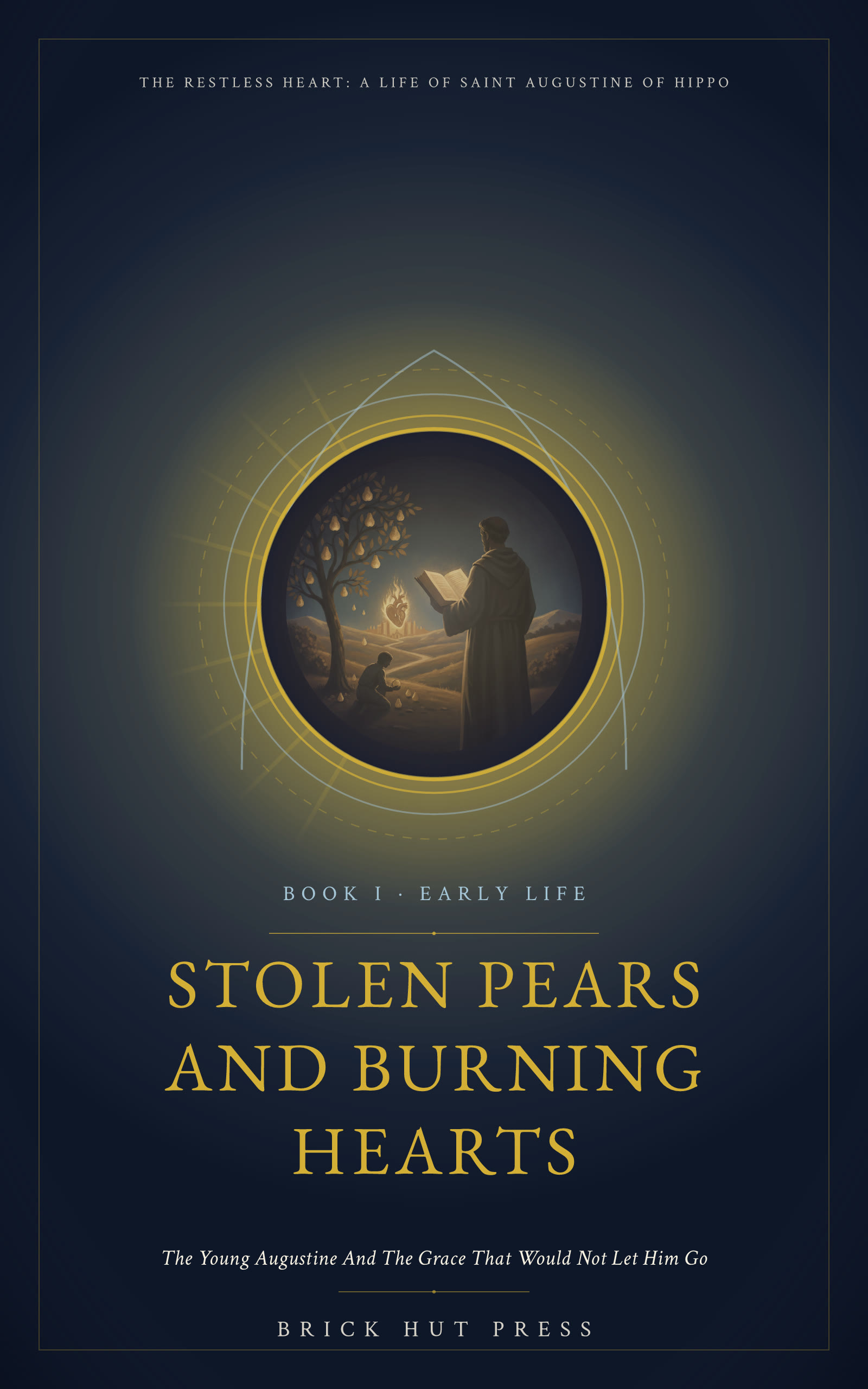
Stolen Pears and Burning Hearts
A thief, a lover, a seeker, and a man in full flight from the God who refused to stop pursuing him.
He Confessed Everything, But Do You Know the Whole Story? Before Augustine became the greatest Doctor of the Church, he was a thief, a lover, a seeker, and a man in full flight from the God who refused to stop pursuing him. Stolen Pears and Burning Hearts tells that story, not as hagiography, but as lived, breathing, aching human experience.
Read the full description
If you have ever stood at the crossroads of faith and doubt, desire and discipline, brilliant ambition and hollow restlessness, Augustine's early life will feel less like ancient history and more like a mirror. Rooted in the Confessions and warm with intellectual passion, this volume in the BrickHut Sanctuary: Sacred Lives series traces Augustine's journey from a boyhood prank in a Tagaste pear orchard through the smoke and fire of Carthage, the seductive logic of Manichaeism, the cold clarity of Neoplatonism, and finally to that extraordinary garden in Milan, where grace simply would not let him go. Here is the restless heart that gave Western Christianity some of its most enduring words, shown in all its contradiction, hunger, and ultimate surrender.
Not sure yet? Begin free.
The Garden and the Flame, a complete book about this life, free, kept in your own library here, read and heard.
Receive the free bookAbout this volume
This is the volume where Augustine of Hippo is still becoming Saint Augustine, and Brick Hut Press has chosen to begin the story exactly where the young man himself insisted it be understood, not as a chronicle of dates but as a confession already in motion, addressed to God before it is addressed to us. Stolen Pears and Burning Hearts takes up the first three decades of a life that would reshape Western Christianity, and it does so with the patience the subject deserves: a boyhood in Thagaste, a mother who would not stop praying, a mind so brilliant and so restless that it could weep real tears over a fictional queen and steal fruit it did not even want, simply to know what it felt like to do wrong for wrong's own sake.
The chapters move the way Augustine's own memory moves, circling rather than marching. We meet Monica first in her full force, not as a footnote to her son's greatness but as a woman keeping watch through years when there was little visible reason for hope. We sit with the schoolboy who found Virgil more moving than his own catechism, and we stand at midnight beneath the pear tree, watching a small theft become, in Augustine's own reckoning, a parable of the will's strange love affair with sin itself. From there the volume follows him to Carthage, "singing all around" with its theaters and its ambitions, and then into nine long years among the Manichees, a season this book treats seriously and without caricature, as a real search for an answer to the problem of evil that Augustine could not yet solve any other way.
The middle chapters carry him across the sea to Rome, through illness and disappointment, and finally to Milan, where the volume lingers longest and most tenderly. Here is the voice from the pulpit, Bishop Ambrose's, opening a door in scripture Augustine had assumed was permanently shut. Here is Plotinus, read by lamplight, teaching him to look for God as something other than a body occupying space. And here, at last, is the garden, the child's voice heard over a wall, the line from Paul that closed like a lock turning. The book does not rush this scene, nor does it try to explain it away as psychology dressed up as miracle. It simply lets the reader stand where Augustine stood, in that particular garden, on that particular afternoon, and feel the weight of a will finally coming to rest.
What follows is not a triumphant sprint to sainthood but a quieter unfolding: the months of retreat at Cassiciacum, learning, as the chapter title has it, to rest; the fire and water of the Easter vigil where the long argument with God is answered not in words but in a sacrament. And the volume closes, fittingly, not with Augustine at all but with his mother, at the window in Ostia, in the vision she and her son shared together before her death, a scene this book treats as the true hinge of the whole story, the moment the watcher's long vigil is finally rewarded.
Readers across the traditions that claim Augustine, Catholic, Anglican, Lutheran, and beyond, have long turned to the Confessions as the first great map of a restless soul finding its way home. This volume does not summarize that map so much as walk it, slowly, with attention to the ordinary textures of fourth-century Roman Africa and Italy: the schoolrooms, the theaters, the dinner tables, the arguments with friends who could not follow where his mind was going. It is written for the reader who wants to meet the young man before the miter, the sinner before the saint, and to understand why he could never tell his own story except as a prayer.
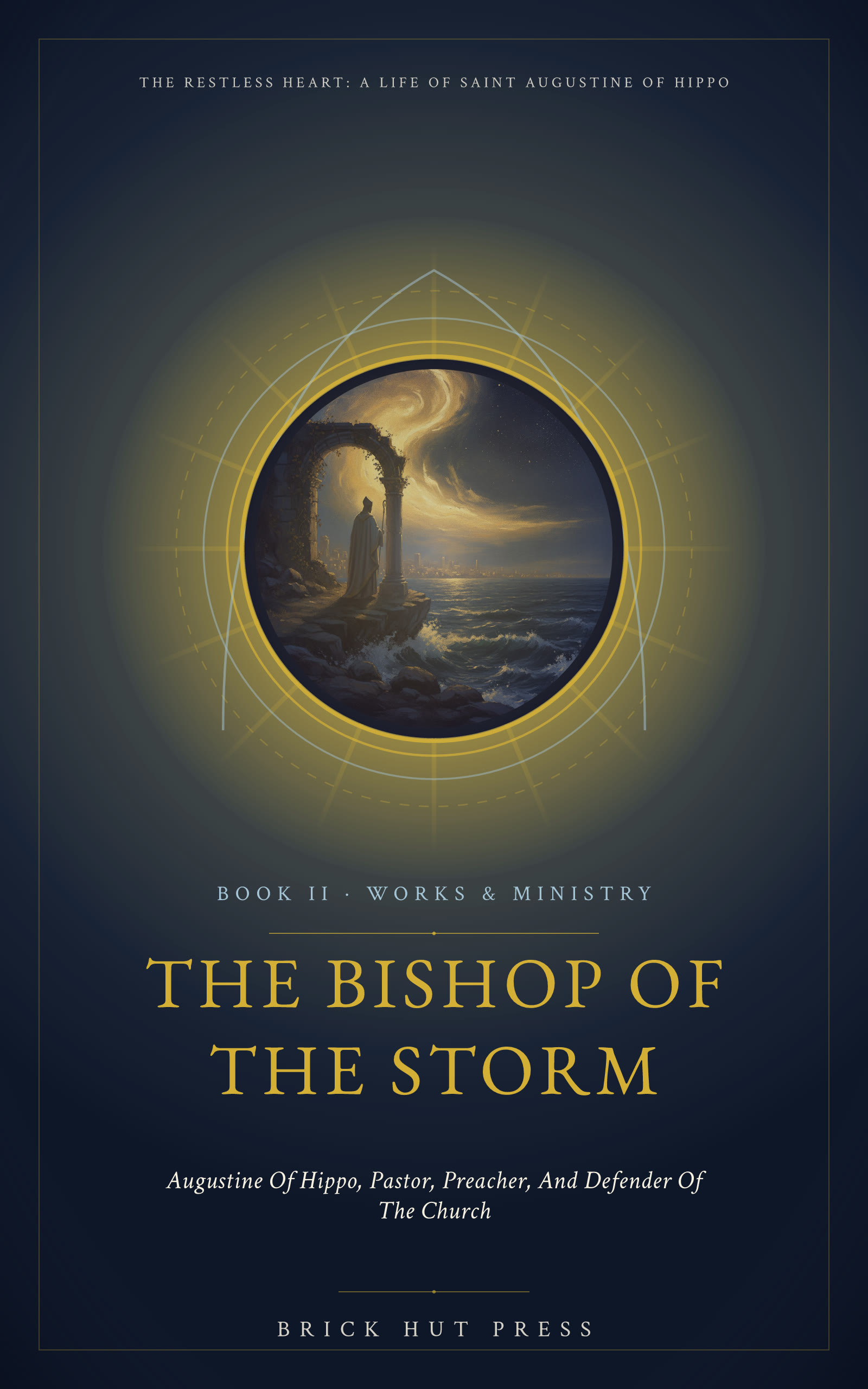

Lives that walk beside Augustine of Hippo, chosen for their likeness, not their fame.