Joy to Hear
Before he became the beloved poet-saint of Tibet, before the songs that still open the heart after nine centuries, Jetsün Milarepa was a man who had done the unthinkable.
He Killed Thirty-Five People. Then He Became a Saint. If you believe your past is too heavy for the path, Milarepa's story is the answer you have been waiting for. Before he became the beloved poet-saint of Tibet, before the songs that still open the heart after nine centuries, Jetsün Milarepa was a man who had done the unthinkable. Stolen inheritance. Deliberate sorcery. Thirty-five lives taken in an act of calculated revenge.
Read the full description
Joy to Hear begins in that wreckage, and follows him, step by devastating step, all the way to liberation. This is not a distant scholarly biography. Written from inside the living tradition, warmly and without academic remove, Joy to Hear tells the sacred life of Milarepa the way it was always meant to be heard, as a refuge, a teaching, and a flame held up in the dark for every practitioner who has ever wondered whether the door is still open for someone like them. Drawing on Milarepa's own songs and the deep well of Kagyu transmission, this book is sacred biography in the fullest sense: a life that instructs, purifies, and liberates as it is read.
Not sure yet? Begin free.
One Lifetime, Burned Clean, a complete book about this life, free, kept in your own library here, read and heard.
Receive the free bookAbout this volume
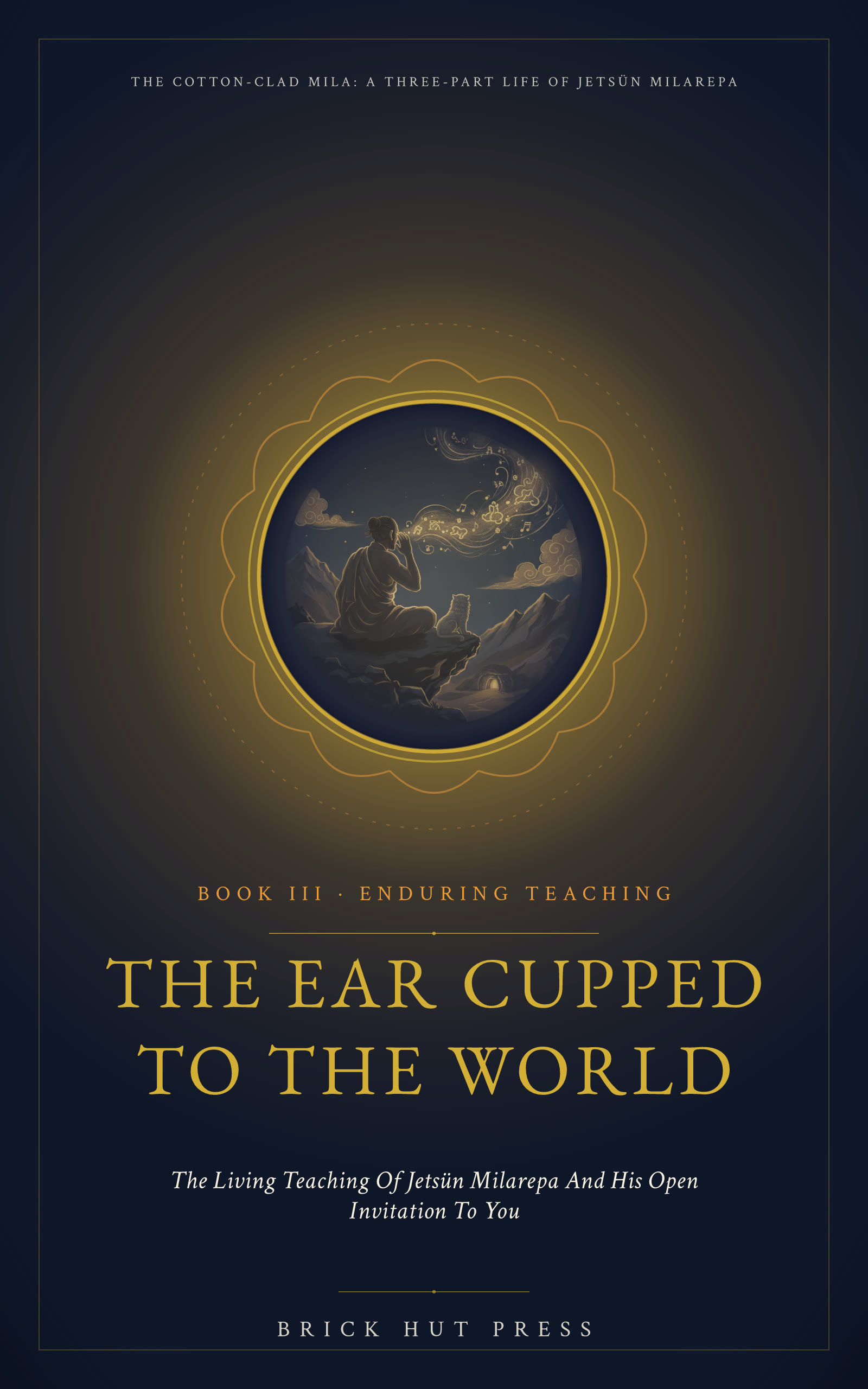
This is the beginning of Jetsün Milarepa's life, and it opens, deliberately, without shadow. Volume One of The Cotton-Clad Mila asks its reader to sit first in the warm house at Kya Ngatsa, among the barley beer and the dried curd and the laughter of an uncle pitched too loud, before it lets anything darken. That patience is the volume's argument: that we cannot understand the sorcery, the vengeance, or the anguish that follow unless we first feel, as fully as Mila Sherab Gyaltsen felt it, the completeness of a father's joy in a healthy son. The name Thöpaga, Joy to Hear, is not decoration. It is the measuring stick against which everything Kya Ngatsa loses will later be weighed.
That loss comes with terrible speed and terrible ordinariness: a will, a document meant to protect a widow and her children, becomes instead the instrument of their ruin. Chapters two through five trace how an aunt and uncle strip a grieving household of its land, its animals, its grain, its standing among neighbors who had so recently brought gifts to its gate, until a mother who once had everything to give her children has nothing left but a question that will not let her rest. This volume does not flinch from what a mother can ask of a son when she has been reduced to that. It sits with her request as she made it, without softening it into something more palatable to modern ears, because the tradition itself does not soften it, and a reverent life owes the reader the true shape of the grief before it explains the path out of it.
What follows is the sorcery, and the volume treats it with the same unhurried seriousness it gave the birth. The teacher in the dark, the storm that broke over a house full of wedding guests, the calling of the scorpions one time more than was asked: these chapters do not present black magic as a lurid detour on the way to the real story. They present it as the real story, the necessary and terrible education of a man who would later need to know, in his bones, what harm is, before he could renounce it absolutely. Thirty-five dead in a collapsed house is not a number the volume passes over quickly. It lingers, because Jetsün Milarepa himself never stopped carrying it, and a biography that rushes past it does no honor to the man who spent the rest of his life answering for it.
The chapters that carry the taste of ash through every closed door, through the long season when nothing his hands touched seemed to hold, follow the sorcerer's guilt into something closer to despair, and the volume treats this stretch as the hinge of the whole life. This is not misery for its own sake. It is the ground being cleared, door by door, until the only door left is the one that leads toward a teacher who has not yet appeared on the page. The volume's final chapters, the name that keeps returning, the dream that arrives before the meeting, the first glimpse of the translator, are written with the restraint the moment deserves: they do not announce the guru's arrival before it happens, and they do not let the reader mistake anticipation for arrival.
Readers who come to this life expecting only the miraculous cotton-clad yogin of the high snows will find here the man before that man, the boy of Kya Ngatsa, the sorcerer of the storm, the son who did what a mother asked and then had to live inside the consequence. This volume asks for that patience because Jetsün Milarepa's own liberation, which later volumes will trace through years of solitary practice, only means what it means against the darkness this one refuses to skip. It closes not at a resolution but at a threshold, with the translator glimpsed but not yet met, leaving the reader exactly where the tradition wants a new practitioner to stand: certain that something is about to change, and not yet told how.

Lives that walk beside Jetsün Milarepa, chosen for their likeness, not their fame.