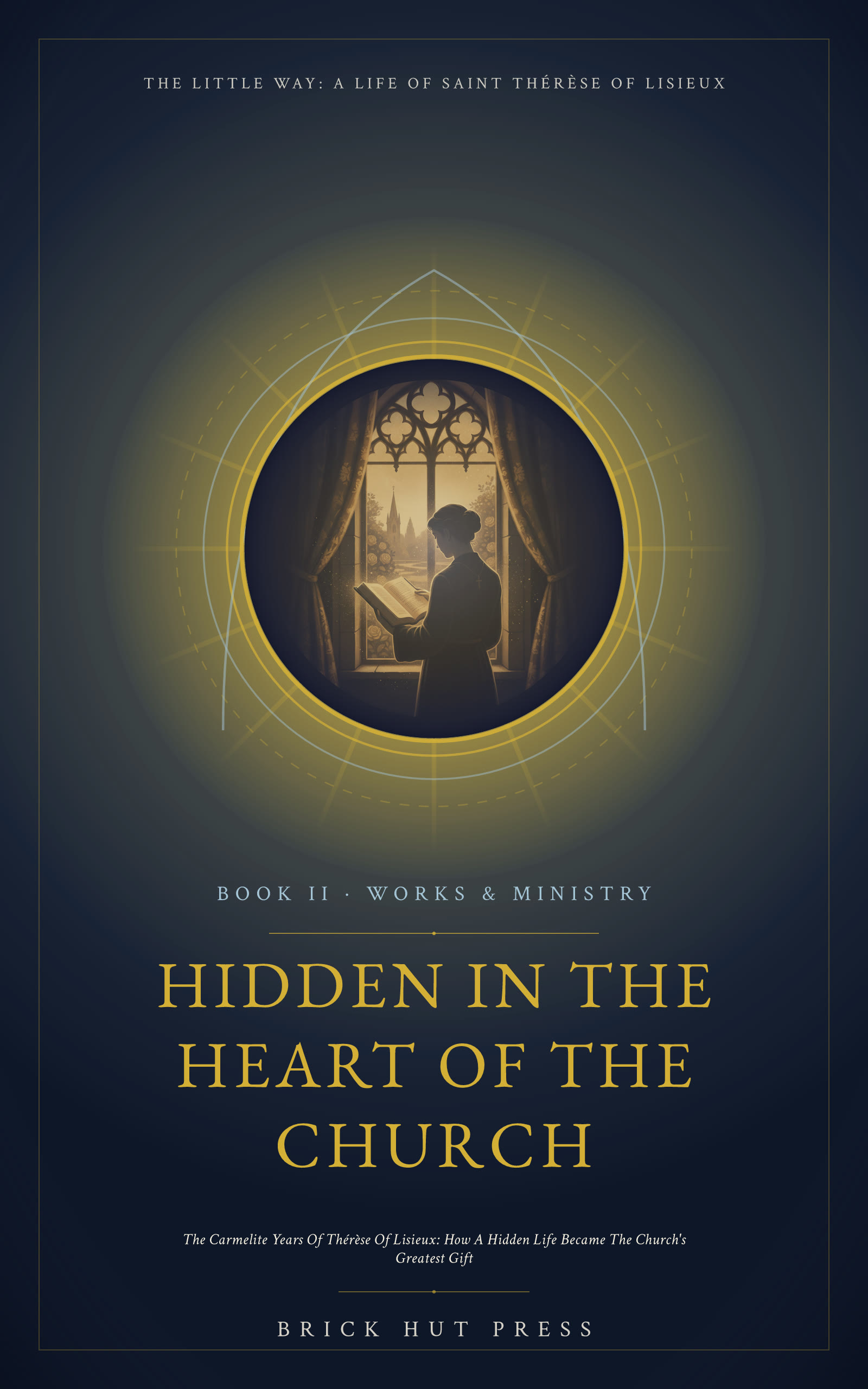
Hidden in the Heart of the Church
The Church Called Her a Doctor.
She Felt Too Small for Holiness. The Church Called Her a Doctor. What happens when a teenage girl enters a cloister and disappears from the world, and yet, from that hidden place, rewrites the Church's entire understanding of holiness?
Read the full description
Hidden in the Heart of the Church: The Carmelite Years of Thérèse of Lisieux answers that question with intimate depth, tracing every year of Thérèse's nine years behind the walls of Carmel in Lisieux, from her arrival as a fifteen-year-old postulant to her death at twenty-four, burning with love and stripped of every consolation she had ever leaned on. This is not a devotional biography that polishes Thérèse into a porcelain saint. This is the real woman, nursing a father who lost his mind to illness while she could not leave the cloister to hold his hand, enduring a superior whose coldness cut like a blade, walking through years of spiritual darkness so dense she could no longer feel that heaven existed at all. And yet: she persevered. She wrote. She loved. Three notebooks scratched out under obedience became Story of a Soul, and the world has never been the same.
Not sure yet? Begin free.
My Vocation Is Love, a complete book about this life, free, kept in your own library here, read and heard.
Receive the free bookAbout this volume
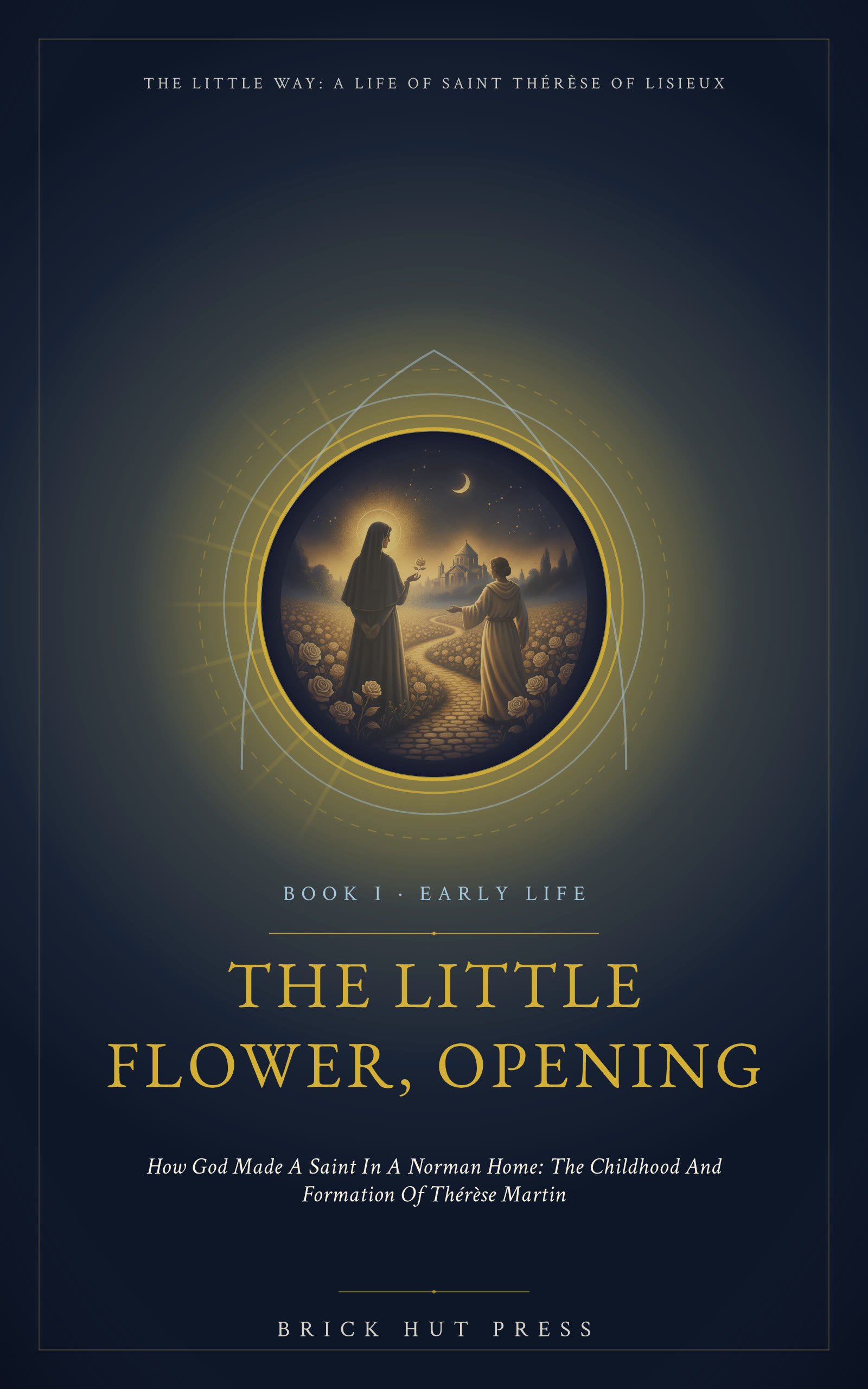
This is the volume in which the door closes, and stays closed, and the real life begins. Book 1 carried Thérèse Martin from Les Buissonnets to the threshold of Carmel, through the audience with the Pope and the long waiting that followed. This volume opens on the other side of that grille, in the cold, cramped, unglamorous reality of the cloister she had wanted since childhood, and it asks the question every reader eventually asks about the saints: what happens after the door closes, when the desire that carried you there has nowhere left to go but into the daily grain of ordinary life?
The chapters that follow trace that grain with unusual patience. There is the frost of that first winter, harder than anything the Martin sisters had known at home. There is Mother Marie de Gonzague, whose difficult love becomes, in this telling, a genuine instrument of grace rather than an obstacle to be endured. There is the last visit of Louis Martin, failing in mind and body, and the strange gift his suffering became to a daughter who had once idolized him without qualification. The volume gives full weight to the day of her profession, September 8, 1890, read here as a wedding in the fullest sense the Carmelite tradition intends, and to the community of sisters, imperfect and beloved, whom she did not choose and could not leave, the actual raw material of her sanctity.
At the center of the book sits the office that made her, against every expectation, a teacher: her work as novice mistress, entrusted with souls not much younger than herself, and the slow crystallization there of what she would come to call her Little Way. Readers who know only the phrase without its origin will find here the specific young women, the specific failures and corrections, out of which that teaching was hammered. Alongside it stands her longing for the foreign missions, a desire the cloister could never let her fulfill in body, and the letters to missionary priests that became, instead, her strange and lasting form of apostolic reach. The Act of Oblation to Merciful Love, offered before the Blessed Sacrament in June 1895, appears here not as a pious formality but as the hinge on which the rest of her short life turns.
What follows that offering is the part of the story most books soften and this one does not. The blood on the pillow, discovered on Good Friday of 1896, opens directly onto the darkness that overtook her faith in the very months she might have expected consolation, a trial the volume calls a wall, following her own language for it. This is not incidental suffering appended to an otherwise sweet story; it is treated as integral to the Little Way itself, the proof that her confidence in Merciful Love was tested in the one place confidence is hardest to hold, against the silence of God. Readers who come to Thérèse expecting only roses will meet here a woman who wrote her way through unbelief without once pretending it away.
The volume closes with the writing of the three notebooks that became Story of a Soul, composed under obedience, in fragments, for different sisters and different purposes, and finally unified into the single voice the world would come to know. It ends, as her earthly life ended, with the last word she is remembered for, spoken in extremity and meant, the whole book insists, for every reader who ever doubted that an ordinary life, hidden and unnoticed, could still become a gift to the whole Church. This is a volume for readers who already love her, and for readers who have only ever met the roses, and want now to meet the wall.
Lives that walk beside Saint Thérèse of Lisieux, chosen for their likeness, not their fame.