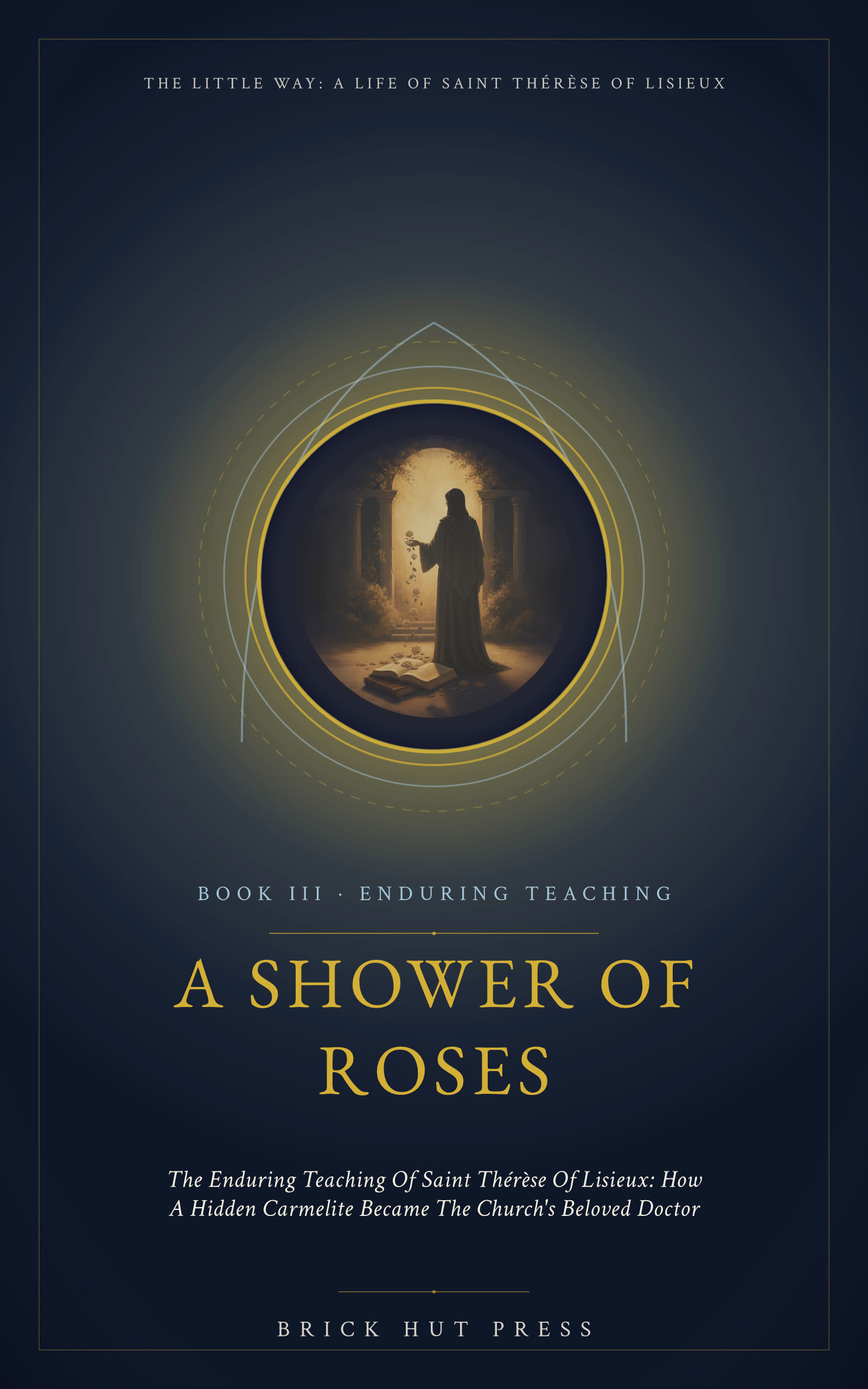
A Shower of Roses
Saint Thérèse of Lisieux never preached from a pulpit, never led an army, never founded a hospital.
She Died at Twenty-Four in an Obscure French Convent, and Then She Promised to Spend Her Heaven Doing Good on Earth. She kept that promise. Saint Thérèse of Lisieux never preached from a pulpit, never led an army, never founded a hospital. She scrubbed floors, bore hidden humiliations, and wrestled with a darkness of faith that would terrify most of us.
Read the full description
Yet Pope John Paul II declared her a Doctor of the Universal Church, one of only four women in two thousand years to receive that title. A Shower of Roses asks the question that matters most: why does this hidden Carmelite still speak so powerfully to modern souls? And more importantly, what does her Little Way mean for your life, right now, exactly as you are? This is not a biography for the shelf. It is an encounter. Drawing on Thérèse's own words, her letters, her poems, and the testimony of those she has touched across generations, A Shower of Roses unfolds the full depth of the Little Way, a spiritual path built not on heroic achievement but on radical confidence in God's mercy, offered to souls who feel too small, too broken, or too ordinary for holiness. If you have ever sat in spiritual aridity and wondered whether God still sees you, Thérèse has something urgent to say to you.
Not sure yet? Begin free.
My Vocation Is Love, a complete book about this life, free, kept in your own library here, read and heard.
Receive the free bookAbout this volume
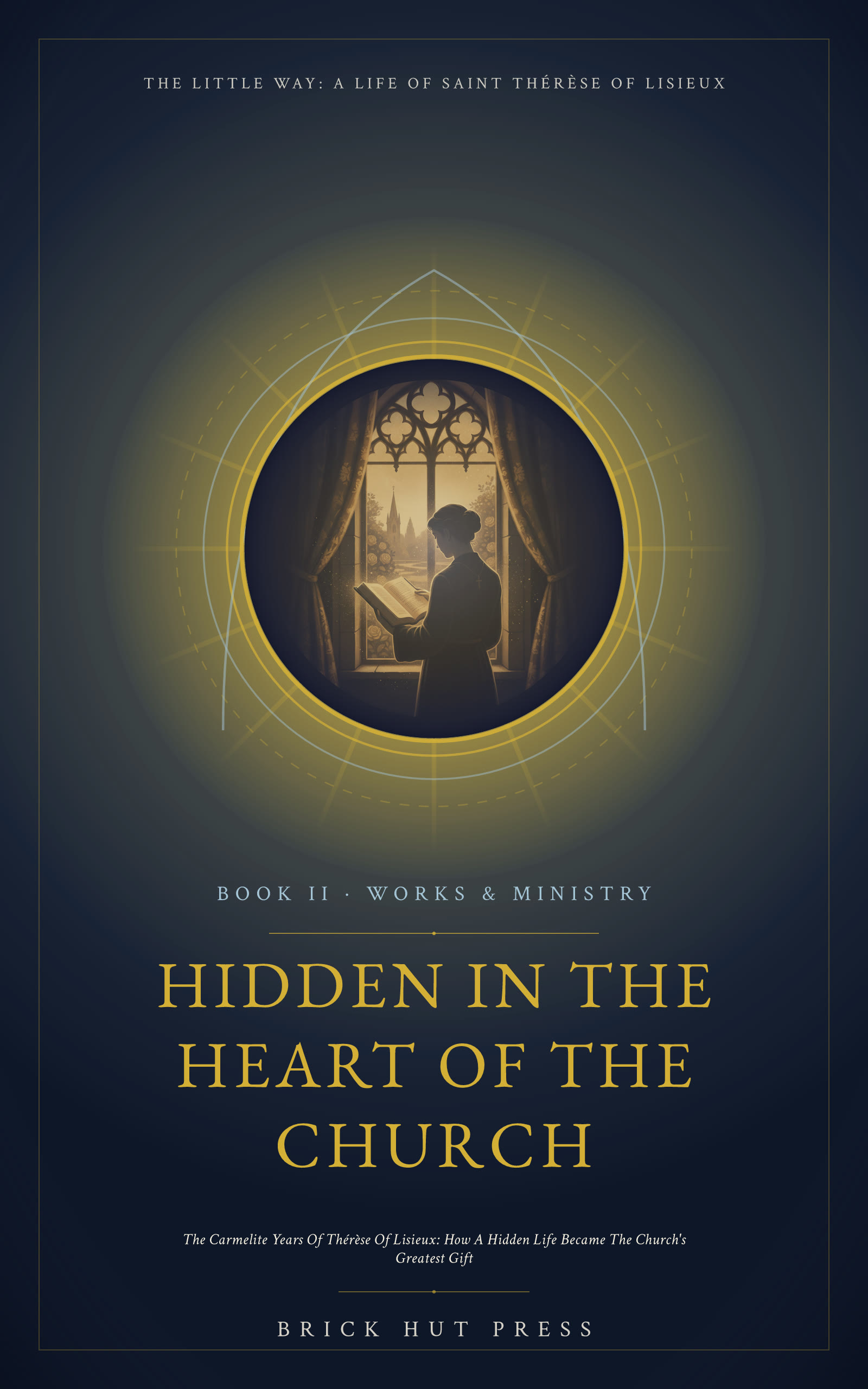
This is the third and closing volume of a three-part life, and it takes up Saint Thérèse of Lisieux where the first two left off: not at her deathbed, but at the strange, almost improbable afterlife of a small book of convent notebooks that her prioress and sister, Mother Agnes of Jesus, sent out into the world in grey-blue wrappers in September 1898. The volume opens with a plain question that it refuses to treat as merely rhetorical: how did Histoire d'une Âme, written under obedience by a cloistered Carmelite who had barely left Normandy, become a book carried in soldiers' breast pockets and read on five continents within twenty years? That question sets the terms for everything that follows. This is not a book about how Thérèse lived, but about how her hidden life came to matter to the whole Church, and eventually to be declared, by Rome itself, a doctrine fit to teach it.
The middle chapters trace that unfolding with real attention to sequence and cost. "The World Comes to Lisieux" and "Raised to the Altars" follow the practical and spiritual work of canonization, the labor of turning a private notebook into a public witness without flattening what made it true. The book does not shy from the difficulty in this: sanctity recognized by crowds is not the same thing as sanctity lived in a cell, and this volume asks what canonization cost the sisters who had known her only as a sister, not yet as a saint pictured on holy cards. From there the book turns to teaching proper. "The Elevator and the Staircase" lays out spiritual childhood in the plain terms Thérèse herself used, an elevator of trust replacing the exhausting staircase of merit, and "Confidence: The Nerve of the Little Way" takes seriously how bold, even audacious, that trust actually is when pressed against a soul's real weakness.
"Suffering as Communion" is perhaps the volume's most demanding chapter, reading the darkness of Thérèse's final illness not as a lapse in her faith but as the place where her teaching was tested and held. Paired with "Her Vocation Was Love," which recovers her vision of the Church as one living body in which hidden, unseen love has as much force as any pulpit or mission field, these chapters build toward the theological center of the whole book: that littleness is not a lesser spirituality but a complete one, sufficient for saints and for ordinary souls who will never leave their own small rooms.
The later chapters follow her forward into the world she promised to keep helping from heaven. "Roses Reported" gathers the long, ongoing history of intercession attributed to her without asking the reader to treat every account as settled fact, only as testimony worth taking seriously within a tradition that has always trusted such testimony cautiously and gratefully at once. "Doctor of the Church: What the Title Really Means" is the volume's hinge chapter, explaining plainly why a woman who wrote no treatises, held no office, and died at twenty-four was named alongside Augustine and Aquinas, and what the Church means when it calls someone a doctor of souls rather than of systems.
The book closes where it must: with "The Little Way Is Wide Enough for Everyone" and "She Is Still Spending Her Heaven," chapters that turn from history back to invitation. This volume assumes no prior familiarity with the earlier two, though readers of the full trilogy will feel the arc complete itself, the girl of Alençon and the young professed of Lisieux giving way at last to the saint whose littleness became, against all reasonable expectation, one of the most widely taught spiritualities in the modern Church. It is written for anyone who has heard her name attached to roses and wants to understand why theologians, not only devotees, take her so seriously.
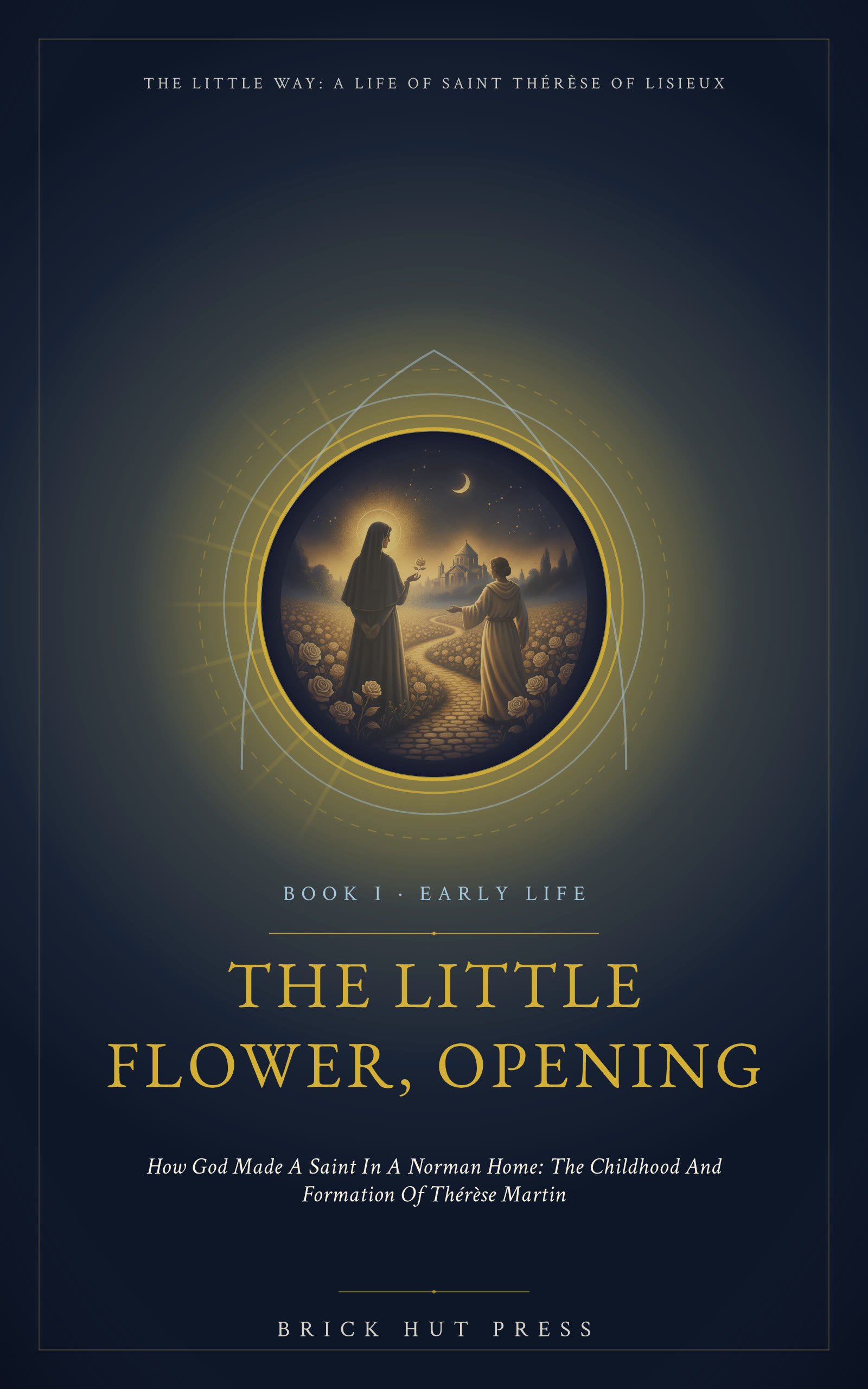
Lives that walk beside Saint Thérèse of Lisieux, chosen for their likeness, not their fame.