Viriditas
Yet her voice remains startlingly, urgently alive.
She Heard the Living Light, and the Church Has Never Been the Same Eight centuries have passed since Hildegard of Bingen set her visions to parchment, composed music that still moves listeners to tears, and wrote letters so bold they corrected popes and emperors alike. Yet her voice remains startlingly, urgently alive.
Read the full description
Viriditas: The Eternal Legacy of Saint Hildegard of Bingen is a devotional biography that does not simply remember a medieval abbess, it places her living inheritance directly into your hands. At the heart of Hildegard's teaching is viriditas, the greening power, that mysterious life-giving force she understood as God's own creative breath woven through every created thing. She saw it in healing herbs, in sacred song, in the soul's longing for God, in the very structure of the cosmos. This book follows that luminous thread through the full sweep of her remarkable life: her childhood oblation, her decades of hidden formation, the volcanic emergence of her prophetic voice, and the fearless pastoral mission that made her one of the most consequential women in the history of the Church. For readers drawn to female mystics, Benedictine spirituality, creation theology, sacred music, and the healing arts , this is the devotional companion you have been searching for.
Not sure yet? Begin free.
The Feather and the Fire, a complete book about this life, free, kept in your own library here, read and heard.
Receive the free bookAbout this volume
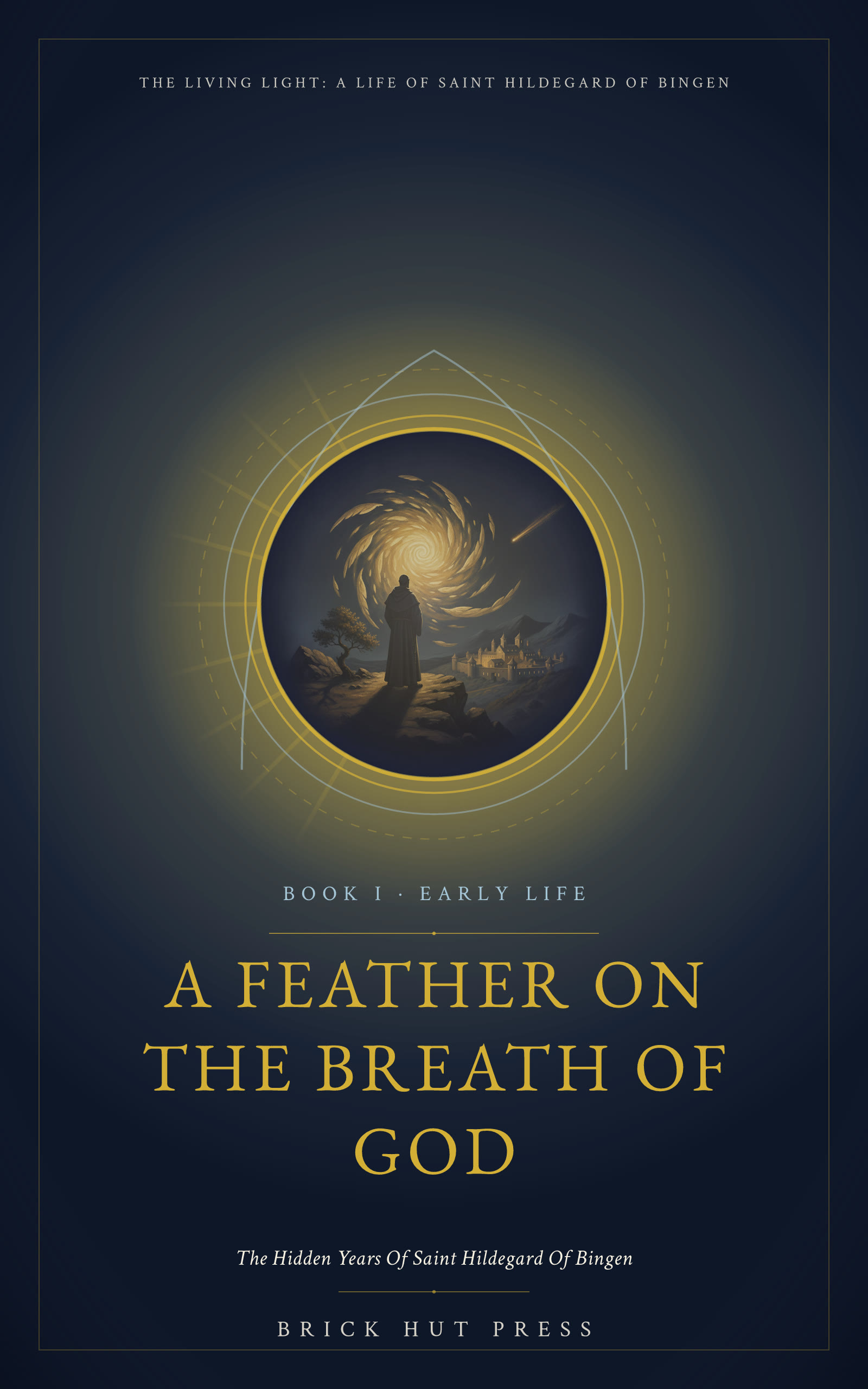
This is the closing volume of a three-part life, and it opens not with triumph but with a grave. Saint Hildegard of Bingen is nearly eighty years old, weeks from the interdict crisis that will mark her final trial, and the chapter that begins Viriditas asks its reader to sit with her in that hardest of positions: caught between obedience to the visible Church and obedience to the Living Light that had guided her since childhood. Readers who have followed her through the first two volumes, the flight from Disibodenberg, the confrontation with an emperor, the long fight to be heard, will recognize the pattern and feel its final variation land with real weight. This is not a book about a woman vindicated easily. It is a book about what it cost her to be right, and what the Church, in time, came to understand she had been right about.
The volume's opening quarter (The Bone in the Churchyard, When the Silence Was Lifted, The Feast of September, What the Witnesses Said) stays close to the ground of that last crisis and the years immediately after, tracing how the interdict was resolved, how her community kept faith through it, and how the earliest witnesses to her life described her before her memory could be shaped by anyone else's agenda. From there the book turns outward and upward, into the substance of what she left behind. The Cosmos as God's Robe and Viriditas: The Name for Everything take up her cosmology and her signature word, that green vitality she saw running through creation, through the body, through the soul's healing, refusing any sharp line between the physical world and the sacred one. Music as the Memory of Paradise and The Whole Person, Healed follow that same conviction into her compositions and her medical writing, showing a mind for which song and physic were never separate from theology but expressions of it.
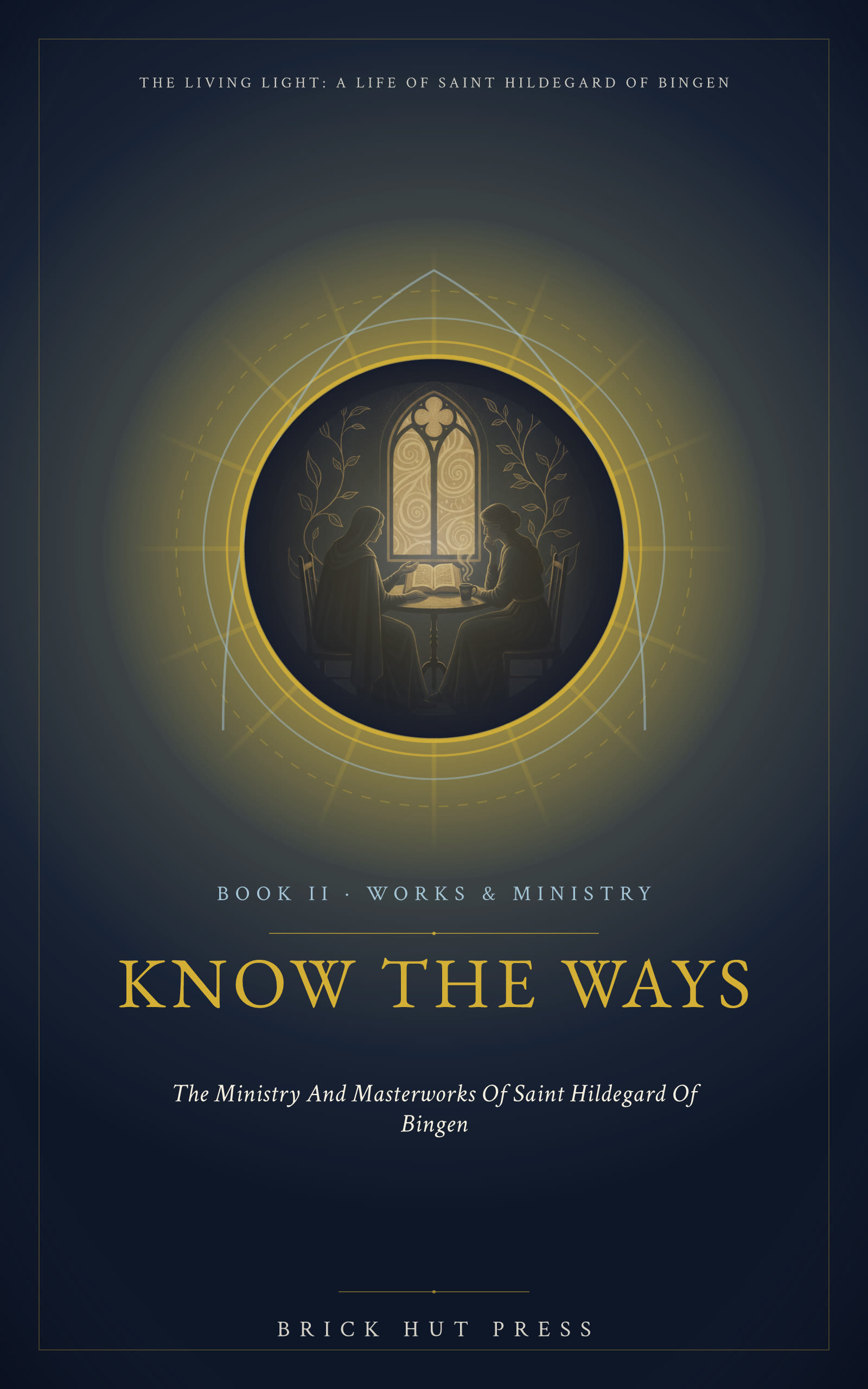
The book's middle turn, Letters to the Living, is where Hildegard's voice becomes most direct. Her correspondence reached popes, emperors, abbots, and troubled strangers who wrote to her because they had nowhere else to take their questions, and this chapter lets that voice speak largely for itself, unfiltered by later commentary. It is a reminder that for all her visionary reputation, she spent much of her life as a working correspondent, a counselor consulted across every rank of medieval society, answering in her own hand.
The last third of the volume steps back from her lifetime to ask what became of her memory. The Sibyl in Eight Centuries of Hands traces how her image was used, claimed, and sometimes distorted by the centuries that followed, an honest reckoning with how sanctity gets reshaped by those who inherit it. Doctor of the Universal Church arrives as the volume's hinge toward the present, following the long road to her formal recognition as a Doctor of the Church, a title held by only a handful of women, and asking what the Church meant by finally naming, in her own words and worldview, a teacher for the whole body of the faithful. The closing chapter, A Feather, Still Falling, borrows her own image of herself, carried by the breath of God rather than by her own strength, to close the life without closing the question of her meaning.
Taken as a whole, this third volume does not attempt to settle Hildegard of Bingen into a single tidy legacy. It follows her from the churchyard at Rupertsberg to the altars of the universal Church, honoring both the difficulty of her last years and the astonishing reach of what she left standing: a cosmology, a music, a medicine, a correspondence, and a title that took eight centuries to arrive. Readers who want the full shape of a life that never separated vision from labor, or sanctity from a woman's plain hard work, will find here the volume that completes it.
Lives that walk beside Hildegard of Bingen, chosen for their likeness, not their fame.