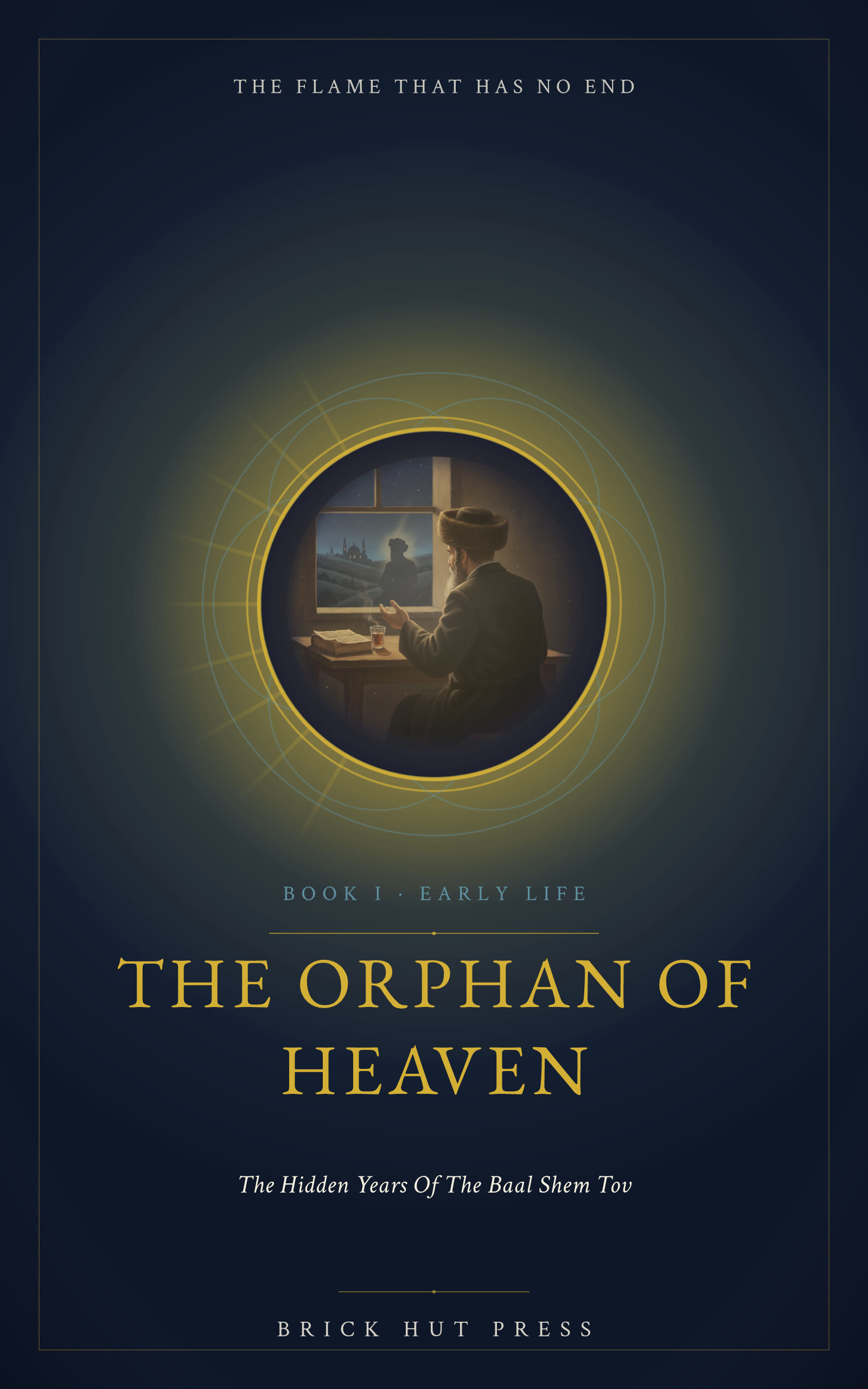
The Orphan of Heaven
Before the World Knew His Name, Heaven Already Did He was orphaned before he could walk. He wandered forests that no one mapped. He prayed on mountaintops where no one could hear him, except the One Who hears everything. And in those hidden decades before the world discovered the Baal Shem Tov, the Baal Shem Tov was already becoming himself.
Read the full description
The Orphan of Heaven: The Hidden Years of the Baal Shem Tov is the story almost never told, the long, quiet, luminous preparation of Yisrael ben Eliezer, the holy Besht, during the years when his greatness belonged only to Heaven. Told in the voice of a Hasidic storyteller who carries these tales the way a flame carries light, carefully, reverently, warmly, this book walks beside young Yisrael through the forests of Podolia, into the solitude of the Carpathian mountains, through the humble stations of a behelfer and a hidden tzaddik, and into the slow, breathtaking unfolding of a neshamah like none other in Jewish history. This is not biography in the conventional sense. It is something older and truer: sacred narrative, offered as a gift of love to every soul that has ever felt drawn to the light of Chassidut.
About this volume
Before there was the Baal Shem Tov who healed the sick, taught the unlettered how to pray with joy, and reshaped the inner life of a people, there was simply a boy without parents, wandering the edges of a Podolian village that did not yet know what it was raising. The Orphan of Heaven begins there, not with wonders, but with absence: a dying father's last words, a mother soon gone as well, and a child left to the charity of neighbors who fed him without quite seeing him. This volume asks a question worth sitting with before the fame arrives: what does a soul carry when it has nothing else? Eliezer's blessing to his young son, to fear nothing but the Holy One, and to love every Jew without qualification, is the thread this book follows through ten chapters of hiddenness, patience, and quiet formation.
Readers who come to the Besht already knowing the later chapters of his life, the circle of disciples, the teachings that would become the wellspring of Hasidus, may be surprised by how unhurried this volume is willing to be. It lingers in the forest with a boy who preferred trees to schoolroom benches, not because he scorned learning but because something in him needed silence before it could receive words. It follows him into the humble work of shepherding other people's children, watching over sleeping villages as a paid watchman, tasks the world would call menial and this book insists on taking seriously, because the Besht himself never treated smallness as an obstacle to holiness. Chapters on "What the Mountains Teach" and "The Watchman Who Never Slept" trace a spiritual education that had no yeshiva, no visible teacher, no credentials, only attentiveness, solitude, and a hidden discipline that the surrounding town could not have named even if they'd noticed it.
The volume does not pretend the young Yisrael ben Eliezer was recognized in his own day. Quite the opposite: it dwells honestly on his marginality, on a community that saw an unlearned orphan where later generations would recognize a soul already burning. The chapter on Chana, the woman who alone seemed to perceive something in him that others missed, and the account of his brother's household and the uneasy gate he had to pass through to reach it, both attend to the ordinary human textures of being overlooked, the small mercies, the small humiliations, the slow accumulation of a life that had not yet declared itself. This is a book willing to dwell in not-yet, trusting that the reader already knows where the story leads and can therefore afford patience with where it begins.
By the time the volume reaches its final chapters, a rebbe almost missed, a name being learned rather than possessed, and the turning point of Chai Elul, when tradition marks a soul's passage into its thirty-sixth year, the reader has watched something forming that no one in Okop or the surrounding villages could yet call by its true name. The book takes seriously the teaching that concealment is not absence but preparation, that a candle's wick is shaped in darkness before it is ever lit. Chai Elul closes this volume not as a triumphant unveiling but as a threshold: the last hidden year giving way to whatever comes next.
This is a volume for readers who want the ground beneath the light, who understand that reverence for a master is deepened, not diminished, by attention to his most unformed years. It does not rush to the miracles or the Baal Shem Tov's public teaching; that is the work of later volumes in this telling. What it offers instead is an unhurried, respectful accounting of how an orphan carrying his father's dying blessing became, through forests and night watches and unnoticed kindnesses, the vessel that a flame was waiting to enter.
Not sure yet? Begin freely.
A Seat at His Fire, a complete portrait of this life, free, kept in your own library here. The door into all 3 volumes.
Receive the free book →