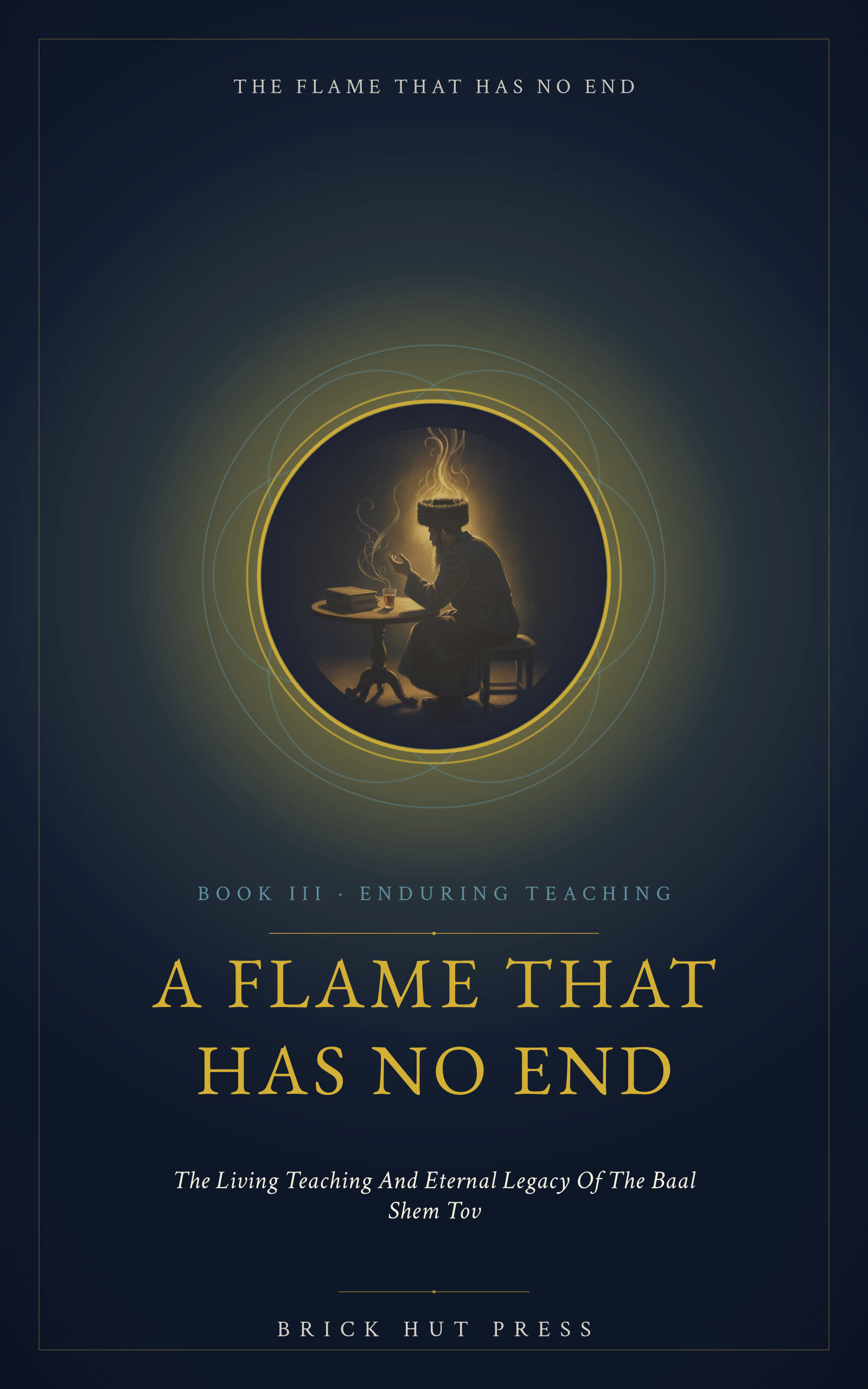
A Flame That Has No End
A Fire That Burns Beyond Time, The Teachings of the Baal Shem Tov, Alive for Every Generation The Baal Shem Tov did not simply teach. He ignited. From the villages of Podolia to the courts of the greatest Hasidic masters, his words opened a door that has never closed.
Read the full description
A Flame That Has No End brings you into the living presence of the Besht, not as a figure sealed inside history, but as a rebbe whose voice still reaches across every generation to the soul that is truly listening. This book is for every Jew who has felt the pull of Chassidut and wondered: What did he actually teach? How do I carry it? Written with deep learning and genuine warmth, it gathers the Baal Shem Tov's essential teachings on God's presence, on prayer, on joy, on the hidden sparks waiting inside ordinary moments, and shows how hundreds of disciples carried that sacred fire into every corner of the Jewish world. Whether you stand within a Hasidic dynasty or are only now discovering the path of Jewish mysticism, this book meets you exactly where you are.
About this volume
This third volume opens where the second could not follow, into the room the morning after, when the Baal Shem Tov's disciples sat on overturned benches in Medzhybizh and discovered that a teacher's death does not end his teaching but transforms its address. This is a book about what happens after: how a flame that could not be housed in one body found other vessels, other mouths, other generations, and did not go out. Readers who have followed the Besht from his hidden years to his emergence as a master of souls will find here the harder, quieter question that every living tradition must answer, not "who was he" but "what remains."
The chapters move outward from that room in widening circles. Early on, the volume takes up the teachings themselves, not as doctrine but as a way of seeing, "Everything Is Full of God," "The Sparks Beneath Your Feet," "Cleaving: The Love That Does Not Let Go", showing how the Besht's core insight, that no place and no soul is empty of divine light, became a practice of daily devotion rather than a philosophical claim to be argued. From there the book turns to institution and transmission: what it meant for a rebbe to stand as a bridge between heaven and earth, how Shivhei ha-Besht carried his voice into print and legend at once, and why, in this tradition, the story itself, not the moral extracted from it, is understood to be the teaching.
The middle chapters trace the actual historical unfolding that the Besht's death set loose: the Maggid of Mezritch carrying the flame north into new territory, and from him the astonishing proliferation the book calls "A Thousand Rebbes, One Root", the branching of Hasidic courts across Podolia, Volhynia, Poland, and beyond, each with its own melody and manner, all tracing lineage back to one candle in one small town. The volume does not shy from the resistance this movement provoked; "The Fires That Tried to Put Him Out" sits honestly with the opposition of the Mitnagdim and the controversies that nearly extinguished what had barely begun, treating that conflict as part of the story rather than an embarrassment to be smoothed over.
The closing chapters turn from history to something closer to faith's own claim about itself. "He Is Still Interceding" takes seriously, on its own terms, the conviction held by generations of Hasidim that a tzaddik's death does not end his capacity to plead on behalf of those who call upon him, a belief this volume presents with the gravity it holds within the tradition, neither defended by outside argument nor apologized for. "Shavuot: The Reunion That Never Ends" returns to the festival where the book began, reading the coincidence of the Besht's passing on the anniversary of Sinai as something the Hasidic imagination has always understood as more than coincidence. The final chapter, giving the volume its title, gathers these threads into a meditation on what continuity actually means when a movement outlives its founder by centuries.
This is not a chronicle of miracles performed but an account of a fire's afterlife, how a teaching about finding God in a blade of grass, a stranger's kindness, an unlettered villager's prayer, became a living inheritance carried forward by the Maggid, by a thousand courts, by Hasidim today who still tell his stories at the third Shabbat meal. Readers who want to understand not only who the Baal Shem Tov was but why he has never quite finished being present will find that question given its full weight here, treated with the seriousness the tradition itself brings to it.
Not sure yet? Begin freely.
A Seat at His Fire, a complete portrait of this life, free, kept in your own library here. The door into all 3 volumes.
Receive the free book →