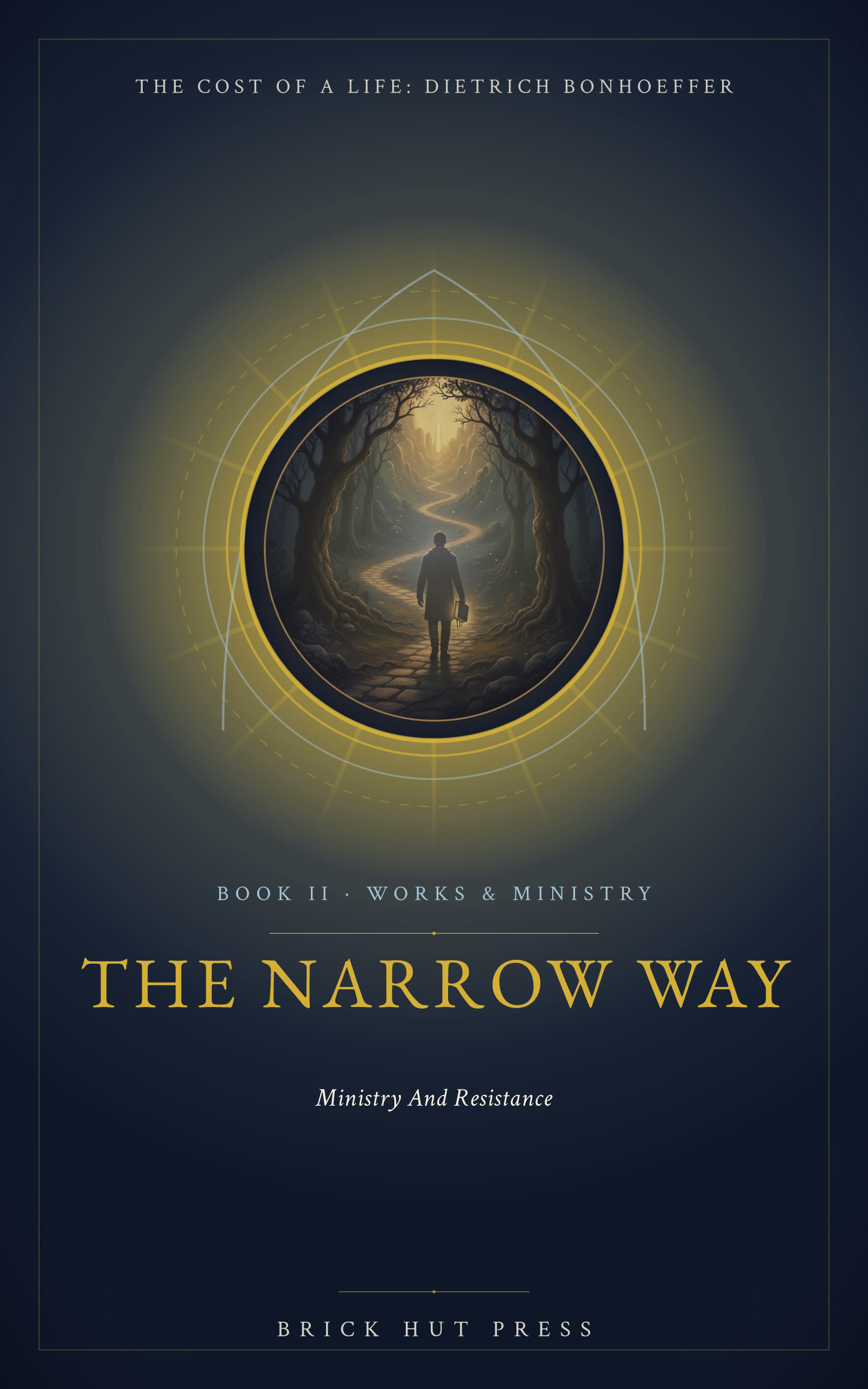
The Narrow Way
In January 1933, a young German theologian stepped to a radio microphone and warned his nation what happens when a people surrender their conscience to a leader.
When the Microphone Goes Dead, Do You Keep Speaking? In January 1933, a young German theologian stepped to a radio microphone and warned his nation what happens when a people surrender their conscience to a leader. Before he finished, the broadcast was cut. Dietrich Bonhoeffer kept speaking anyway, and he never stopped, not from London, not from an underground seminary, not from a Gestapo prison cell.
Read the full description
The Narrow Way: Ministry and Resistance walks beside him through the decade faith stopped being theoretical and became a matter of life, death, and absolute obedience to Christ. This is not another biography cataloguing dates and doctrines. It is an immersive, soul-level encounter with a man who understood that cheap grace is no grace at all, and who paid the full cost of the other kind. For Lutheran, Anglican, and ecumenical readers who sense that following Jesus was never meant to be comfortable, this book arrives as both a mirror and a summons. What You Will Discover Inside The radio broadcast that changed everything, and what it reveals about the Christian's obligation to speak when institutions go silent Costly grace vs.
Not sure yet? Begin free.
Come and Die, a complete book about this life, free, kept in your own library here, read and heard.
Receive the free bookAbout this volume
This second volume of The Cost of a Life opens with a young man alone at a microphone, two days into a chancellorship that will reshape everything, and it does not let the reader look away from that radio studio for the rest of the book. Where Volume One traced the making of a theologian, The Narrow Way traces what happens when that theology has to be lived under a regime that wanted the German church for itself. The arc here runs from Berlin to London and back again, from the fracture of the Confessing Church to the improvised seminary at Finkenwalde, and finally into the corridors of military intelligence and the cell at Tegel where Dietrich Bonhoeffer's thought took its final, most searching turns.
The volume does not treat Bonhoeffer's resistance as a sudden swerve from pastoral life into politics. It shows the two as one fabric. "The Church That Said Yes" sits beside "Come Back and Lead Us" for a reason: readers will see how the German Christian movement's capitulation, and the ecumenical friendships Bonhoeffer built in exile, together pressed him toward a return he did not have to make. London gave him safety and a pulpit among fellow pastors and ecumenical contacts; the book is honest that leaving that safety was a choice, made in correspondence and prayer, not in a single dramatic scene. Finkenwalde follows, and here the book slows down, because this is where Bonhoeffer's most enduring pastoral work took shape: an illegal seminary, a discipline of common prayer and confession, and the sermons and lectures that would become the material of "The Cost He Was Naming." Readers who know only the phrase "cheap grace" will find here the community, the daily rule, and the specific German church crisis out of which that phrase was carved.
The middle chapters turn harder. "The Gestapo Closes the Door" and "The Double Agent" cover the years when the seminary was shut down and Bonhoeffer's path bent toward the Abwehr, into a role that asked him to hold together, without contradiction he could name easily even to himself, the vocation of a pastor and the necessities of a conspirator. The book does not resolve this tension with easy comfort; it lets the reader sit with a man who believed in truth-telling and also carried false papers, who prayed the Psalms daily and also helped plan the overthrow of a government. "Ethics," the chapter on his unfinished major work, is treated as theology written under literal fire, drafted in snatched hours between missions and meetings, and the volume is careful to show how the conditions of its writing shaped its unfinished, fragmentary character rather than treating that incompleteness as a flaw to be smoothed over.
Then the volume turns tender. "Maria: Love at the Edge of Everything" gives full weight to Bonhoeffer's engagement to Maria von Wedemeyer, a relationship that began in the ordinary rhythms of family friendship and grew into something neither of them could have timed worse, given what was coming. This chapter refuses to treat Bonhoeffer as a figure too austere for love; it shows a man planning a wedding and writing letters full of longing while also, somewhere in the same weeks, being watched by the Gestapo. The volume closes at Tegel prison, where the theology takes its most famous and most searching form. This is not yet the story's end; readers who know how it concludes will feel that weight in every page, but this book keeps its discipline, staying inside the cell, inside the correspondence, inside the thought as it was actually being worked out in 1943 and after.
What this volume offers, finally, is a portrait of costly obedience rendered without sentimentality. It takes seriously the specific German crisis of church and state, the specific friendships and failures of the ecumenical movement, and the specific daily disciplines of Finkenwalde, rather than flattening Bonhoeffer into a symbol. Readers who want to understand how a Lutheran pastor became a conspirator, and why he never stopped being a pastor while doing so, will find that question held with patience here, chapter by chapter, letter by letter.
Lives that walk beside Dietrich Bonhoeffer, chosen for their likeness, not their fame.