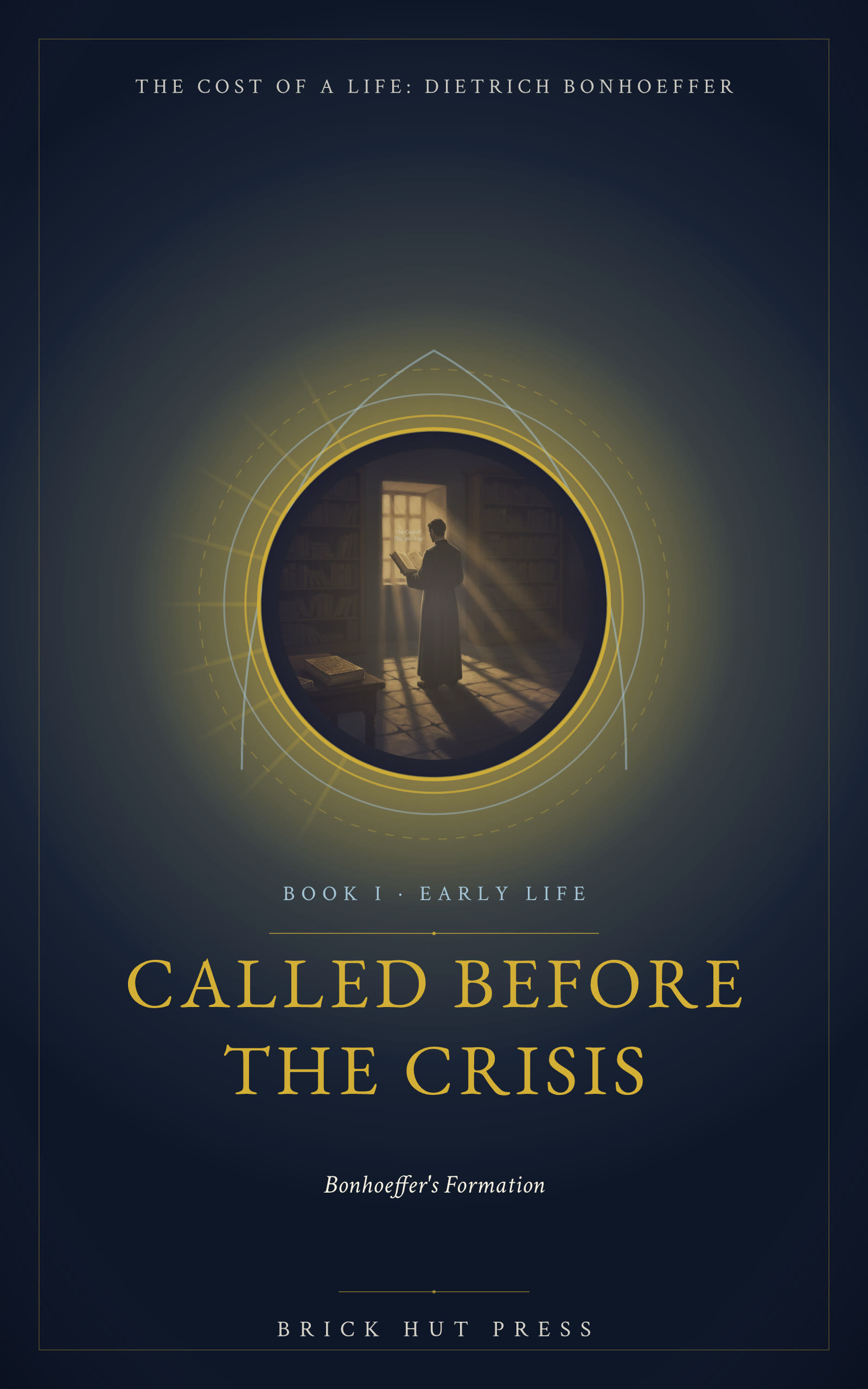
Called Before the Crisis
A true Dietrich Bonhoeffer biography reveals that he was already formed long before they arrived.
Dietrich Bonhoeffer did not become courageous because of the Nazis. A true Dietrich Bonhoeffer biography reveals that he was already formed long before they arrived. Called Before the Crisis recovers his years of quiet, costly preparation, showing how a man learns to follow Christ completely before the world demands to know if he will. The narrative sets out to show how a brilliant, piano-playing son of a secular Prussian household heard a call that no one expected.
Read the full description
He answered that call and followed it with everything he had. Through a careful exploration of Bonhoeffer's early life formation, the text traces his path from a Berlin childhood through his time in Barcelona and Harlem. It is here that the theologian and martyr truly began to take shape, long before the world forced his hand. Readers will discover the foundation of his character in this detailed life of Bonhoeffer. The book explores the quiet moments and the costly preparation that readied him for his ultimate test. A secular beginning: How a brilliant, piano-playing son of a Prussian household heard an unexpected call. Years of preparation: The path from a Berlin childhood through Barcelona and Harlem. Costly discipleship: How a man learns to follow Christ before the world demands to know if he will. As a profound Protestant martyr biography, this work illuminates the quiet obedience that precedes public courage. This volume is essential reading for anyone asking what faithful discipleship costs.
Not sure yet? Begin free.
Come and Die, a complete book about this life, free, kept in your own library here, read and heard.
Receive the free bookAbout this volume
Before Dietrich Bonhoeffer became the name attached to a plot, a prison, and a gallows at Flossenbürg, he was a boy at a piano in Grunewald, one of eight children in a house where argument and music ran together like two currents of the same river. This first volume of The Cost of a Life does not begin with the crisis that made him famous. It begins where any honest account of a life must begin, in the rooms and cities that formed him before he had any way of knowing what would be asked of him.
The chapters here follow a young man's mind and conscience as they take shape, one encounter at a time. We meet the household of Karl and Paula Bonhoeffer, a family fluent in Bach and Latin and unafraid of a dinner-table argument, and we meet Sabine, the twin sister whose different way of seeing the world sharpened his own. We watch a thirteen-year-old announce, almost offhandedly, that he intends to give his life to the church, a decision that puzzled brothers who had already chosen physics and law, and that Dietrich himself would spend the rest of his short life making good on. Tübingen gives him his first serious taste of Luther; Rome gives him something larger and more disorienting, a vision of the church as a body stretching far past the borders of Germany and German Protestantism, a question he would carry home and never set down.
That question finds its first real answer in Sanctorum Communio, his doctoral work on the church as a community God himself makes and holds together, not an institution assembled by human agreement but a reality created and sustained from beyond it. Readers who know Bonhoeffer only through Letters and Papers from Prison or The Cost of Discipleship will find here the seedbed of both books, worked out by a young theologian still in his twenties, already asking what it means for Christ to exist as community among actual, fallible people.
But doctrine alone does not make this volume. Barcelona sends him to an ordinary parish, where the gospel had to be preached to sailors, shopkeepers, and children with no patience for abstraction, and where he learned that theology which cannot survive a pulpit in a foreign port is not yet finished theology. Harlem does something else to him entirely. In the pews of Abyssinian Baptist Church, and in friendship with Frank Fisher, a fellow student who told him truths about America and about the church that the seminar rooms of Berlin had never required him to hear, Bonhoeffer encountered a Christianity tested by suffering he had not personally known. This volume treats that encounter with the seriousness it deserves, neither rushing past it nor claiming more for it than the record supports, letting it stand as the formation it plainly was.
What emerges by the volume's close is not yet the resister, not yet the conspirator, not yet the prisoner writing on scraps of paper smuggled past his guards. It is the man those later chapters would require, a Lutheran pastor shaped by Prussian discipline and Roman vastness, by academic rigor and Harlem's plain testimony, arriving home with a question that would not leave him alone: what does it cost to belong to the church Christ actually makes, rather than the one convenience would prefer? Called Before the Crisis answers no more than its title promises. It shows the forming, not yet the cost. But readers who want to understand why Bonhoeffer later refused the comfortable path, why the crisis found in him someone already prepared to meet it, will find the answer patiently laid out here, chapter by chapter, city by city, conviction by conviction.
This is a volume for readers who want to sit with Bonhoeffer before history made him a martyr, when he was still a young man deciding, against easier options, exactly what kind of pastor and theologian he meant to become.
Lives that walk beside Dietrich Bonhoeffer, chosen for their likeness, not their fame.