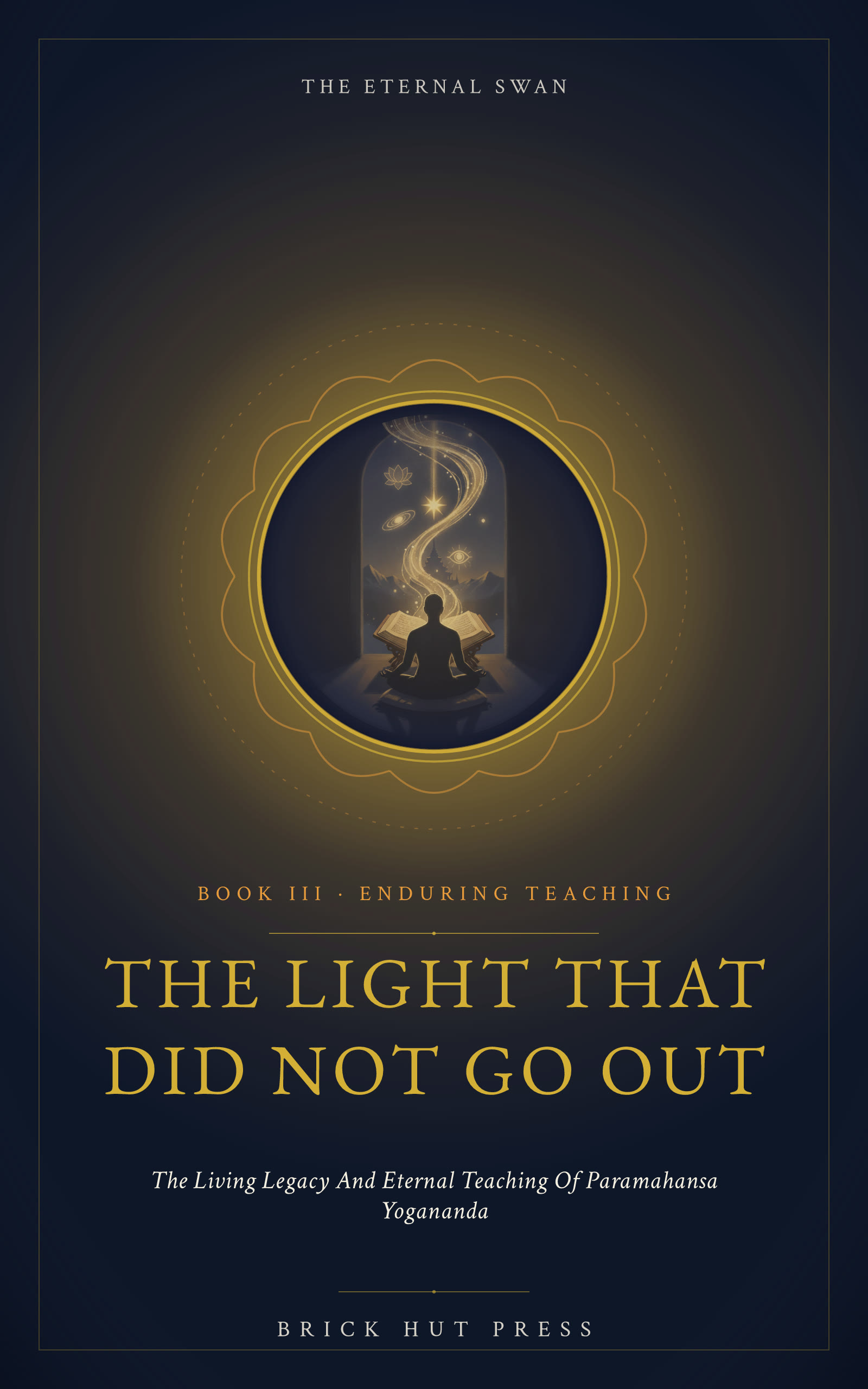
The Light That Did Not Go Out
Paramahansa Yogananda opened one.
He Left His Body in 1952. He Never Stopped Teaching. Some masters close a chapter when they depart. Paramahansa Yogananda opened one. From the incorruptible mystery of his mahasamadhi to the living encounters devotees report across generations, his light did not diminish, it deepened. This book exists for those who already know that truth in their bones, and who hunger for a richer, more intimate understanding of the Guru who changed everything.
Read the full description
The Light That Did Not Go Out is not an introduction to Yogananda. It is a sacred immersion, written for dedicated seekers and practicing devotees of the Self-Realization Fellowship and Yogoda Satsanga Society tradition, for those walking the Kriya Yoga path, and for every sincere soul whose life has been quietly or dramatically transformed by his teachings. If you have read Autobiography of a Yogi and felt that a single volume could never hold what you needed, this book was written for you.
Not sure yet? Begin free.
The Eternal Swan, a complete book about this life, free, kept in your own library here, read and heard.
Receive the free bookAbout this volume
The third and closing volume of this life opens where the first two must end and where, in the deepest sense, this story insists on beginning again: at the Biltmore Hotel, on the evening of March 7, 1952, when Paramahansa Yogananda read his poem "My India" to a ballroom of dignitaries and closed disciples, then completed his earthly life in the manner his students would come to call mahasamadhi, a yogi's conscious exit from the body. This volume does not treat that night as an ending. It treats it as the hinge on which the whole of his mission turned outward, from one man's realization into a teaching, an order, and a worldwide sangha that continues, by every account his students offer, to grow.
The early chapters stay close to the physical and metaphysical facts his community has held sacred for seventy years: the extraordinary reports of his body's non-decay in the days following his passing, verified at the time by the mortuary that received him, and the question of what, exactly, he left behind in that room and in the world. From there the volume turns to the teaching itself. A full chapter is given to Kriya Yoga, the "airplane route to God" as he called the technique passed to him through his guru Sri Yukteswar Giri, back through Lahiri Mahasaya, to the deathless Mahavatar Babaji who commissioned its return to the world in this age. Readers wanting to understand what actually happens in the practice, and why his lineage regards it as an accelerated path rather than a slower devotional road, will find the chapter builds its case patiently, in his own framework and on his own terms.
Because Yogananda insisted throughout his life that he had come not to found a new religion but to reveal the underlying unity beneath all true ones, the volume gives real space to "One Truth in Many Temples," tracing how his vision of Sanatana Dharma's eternal principles met and, in his understanding, harmonized with the Christian teaching he loved as deeply as his native Hindu tradition. This is followed by the literary legacy: the chapter on Autobiography of a Yogi and its long afterlife as a doorway through which millions have first encountered him, alongside a companion chapter on the poems, songs, and prayers that make up the quieter, less-quoted register of his written voice. A further chapter surveys his practical counsel, the "yoga for every hour" he offered on marriage, work, friendship, illness, and the small disciplines of daily living, for readers who know him first as a teacher of how to live rather than only as a figure of legend.
The book's later movement turns to succession and continuity: the leadership of Sri Daya Mata, who carried the organization he founded through the decades after his passing, and the broader story of how his teaching reached temples, meditation groups, and individual seekers across six continents. A chapter on encounters with him in the years since his passing, gathered from those in his community who report his continuing presence in meditation and dream, is offered here in the spirit his own students hold it: not as proof demanded of the skeptical reader, but as testimony honestly recorded.
The volume closes, fittingly, with "The Only Question He Ever Asked," returning the reader to the single inquiry his entire life and teaching pressed toward. Read alongside the first two volumes of this life, or read on its own by those who come to him first through his legacy rather than his early years, this book offers a clear, careful, and reverent account of what Paramahansa Yogananda's students believe he left behind, and why they believe the light he lit has not gone out.
Lives that walk beside Paramahansa Yogananda, chosen for their likeness, not their fame.