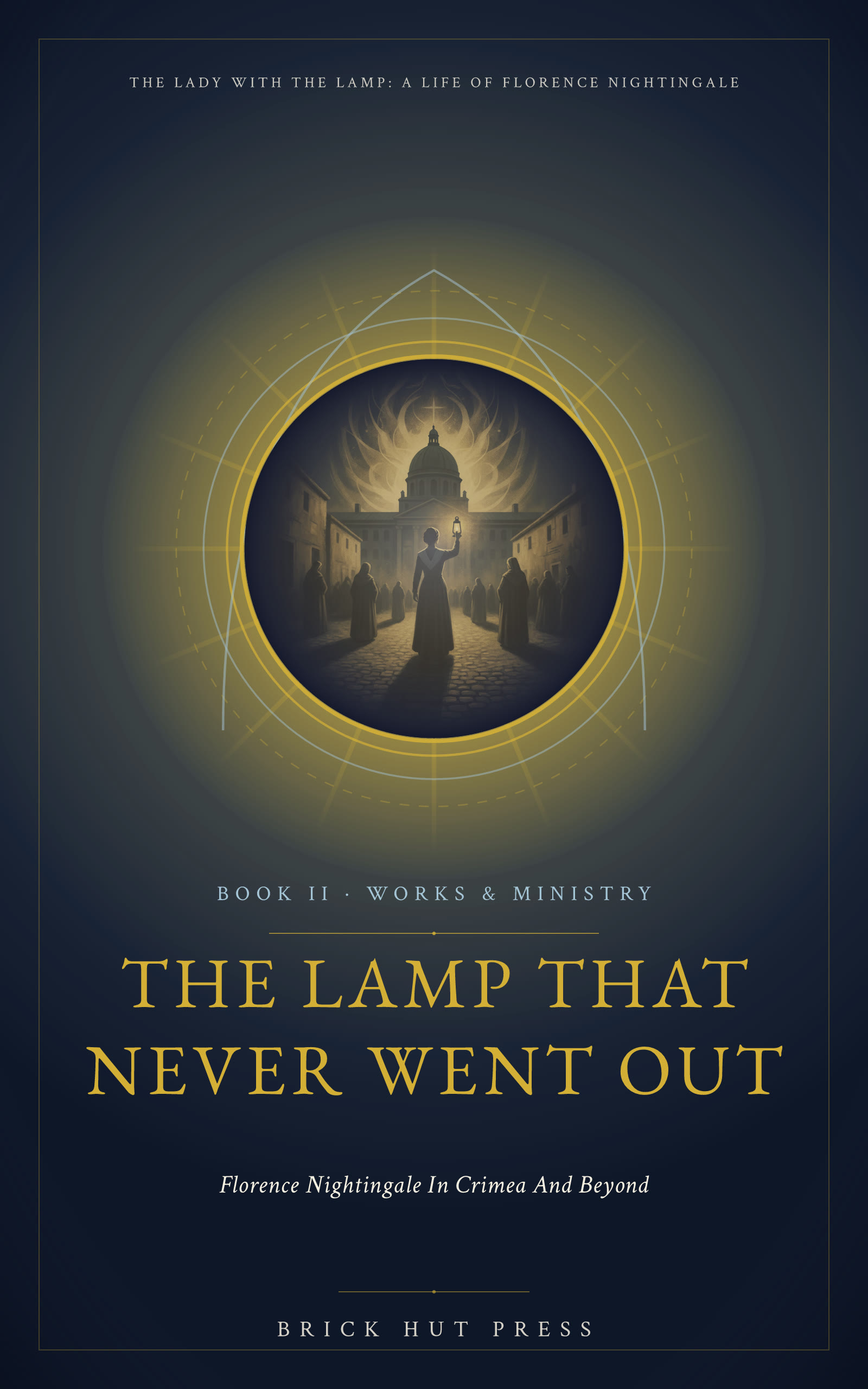
The Lamp That Never Went Out
Florence Nightingale walked into the military wards at Scutari with thirty-eight nurses, a stubborn faith, and a fury for the suffering she found there.
She Carried a Lamp Into Darkness. She Never Put It Down. Florence Nightingale walked into the military wards at Scutari with thirty-eight nurses, a stubborn faith, and a fury for the suffering she found there. What she built in those blood-soaked corridors was not only modern nursing. It was proof that one person, fully surrendered to God, can reshape the world.
Read the full description
This devotional account follows her from the killing fields of Crimea to the correspondence that reformed medicine across India, revealing a soul whose fierce practical courage was never separated from a life of prayer, contemplation, and unbreakable divine call. If you have ever heard a call you were afraid to follow, if you have ever wondered whether holiness looks more like kneeling in a chapel or rolling up your sleeves on a difficult ward, this book was written for you. Nightingale lived both realities at once. She is the patron saint of action and contemplation together, and her story carries a word for every nurse, every caregiver, every faithful servant who suspects that God is asking something costly of them.
Not sure yet? Begin free.
Before the Lamp Was Lit, a complete book about this life, free, kept in your own library here, read and heard.
Begin reading, freeAbout this volume
This second volume of The Lady with the Lamp opens where the legend actually begins: not in a London drawing room but on the deck of the Vectis, and then in the stone corridors of the Barrack Hospital at Scutari, where thirty-eight women and their superintendent stepped into a catastrophe that numbers had warned them of and nothing had prepared them for. Readers who know Florence Nightingale chiefly as an image, a lamp carried down a darkened ward, will find that image here, but they will find it earned rather than assumed. The book takes seriously the question of what the soldiers actually saw when she passed among them at night, and why that sight mattered enough to travel home in letters and become, within her own lifetime, a national icon she herself regarded with some unease.
The chapters that carry us through Scutari are unflinching about what she found there: the overcrowding, the fever, the administrative paralysis that cost more lives than Russian guns did. But this volume is equally interested in what she did with what she found, which is where it distinguishes itself from a simple war narrative. Chapter four, on the statistics that saved lives, shows her turning grief into evidence, building the case that would eventually force reform not through appeals to conscience alone but through tables, charts, and the discipline of a mind that trusted facts as a kind of moral argument. This is the Nightingale who matters to history as much as the one who matters to sentiment, and the volume holds both together without letting either eclipse the other.
The arc does not end with the war. Having followed her through the furnace of Crimean fever, which nearly killed her and left her health permanently altered, the book turns to the quieter, harder years that followed: the homecoming without a parade, the Royal Commission she drove from a sickroom she rarely left, the founding of the Nightingale Training School at St. Thomas's in 1860. Here the volume makes a case that deserves wider telling, that her greatest institutional legacy was built not in a hospital ward but in the discipline of training nurses as a respectable, rigorous profession, a reform whose effects reached far beyond any single ward or war.
Perhaps the most striking chapters are the ones that show her reforming a continent she never set foot in. Her correspondence on sanitary conditions in India, conducted entirely from England, reveals a woman who had learned to work through influence, documentation, and sheer persistence rather than physical presence, a shape of ministry that asks us to reconsider what nursing and reform could mean when divorced from proximity. The chapter on Sidney Herbert, the friend and ally whose death weighed on her for the rest of her days, adds a note of cost that keeps the volume from becoming merely triumphant. Reform, this book insists, was never free, and she knew it better than anyone.
The volume closes with the Order of Merit, the nation's late and imperfect word of thanks, and in doing so it asks readers to sit with the distance between public honor and private sacrifice. For those who have followed her calling from its first stirrings in an earlier volume, this is the record of that calling tested in fire and carried, afterward, into rooms and correspondence far from any battlefield. For readers new to her story, it offers a portrait grounded in sources, attentive to the Anglican conviction that service to the suffering is service to Christ, and respectful of a life whose witness the Evangelical Lutheran Church in America has seen fit to commemorate alongside her own. It is a volume about a lamp, yes, but more lastingly about the hand that carried it long after the ward had gone dark and the war had ended.
Lives that walk beside Florence Nightingale, chosen for their likeness, not their fame.