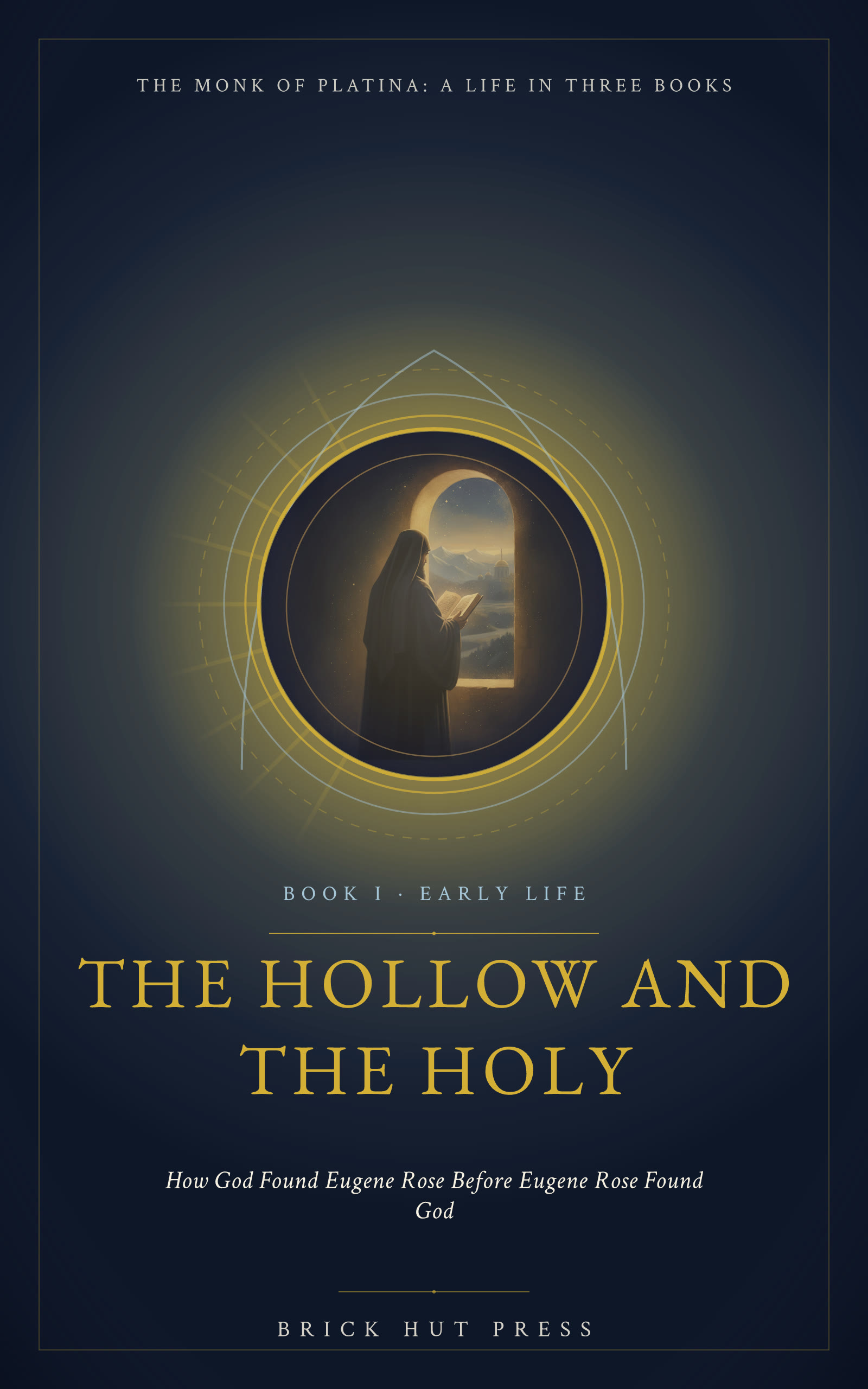
The Hollow and the Holy
He drank from every well the modern world offered and came up empty every time.
Eugene Rose was brilliant, broken, and utterly lost, a young philosopher drifting through the ruins of Western thought, consuming Nietzsche and Camus and finding only beautiful dead ends. He drank from every well the modern world offered and came up empty every time. And then, through a path no one could have predicted, the hollowness itself became the doorway. This is not a saint-card biography.
Read the full description
The Hollow and the Holy is the full, unvarnished road, from the aching existential despair of a gifted young man who could see through every lie, to the luminous Orthodox monk the world would come to know as Fr. Seraphim Rose. It is the story of how God pursued one soul through philosophy, poverty, and silence, and refused to let him go. The making of a seeker: From a boyhood lived at the wrong temperature to a Pomona degree that led nowhere, the intellectual and spiritual forces that left Eugene Rose searching The philosopher at the edge: Through Nietzsche, the Beats, and the comfortable emptiness of San Francisco, a gifted mind stared into the abyss, and the abyss looked back The collision with the Faith: A man with a prayer rope. An archbishop in an airport. The waters of Holy Chrismation. The ancient Church broke through every defense and reached the man beneath the philosopher. The formation of a son: Before he could become a spiritual father to others, Eugene Rose had to learn what it meant to be a son, a labor the bookshop on Geary Boulevard both demanded and shaped For those who came to Orthodoxy not through cradle comfort but through crisis and searching, Eugene Rose's journey is your journey. His road was not clean. It was costly, courageous, and crowned with grace.
Not sure yet? Begin free.
The Stranger Who Became a Father, a complete book about this life, free, kept in your own library here, read and heard.
Receive the free bookAbout this volume
This first volume of The Monk of Platina begins where every honest life must begin, not with sanctity already visible, but with an ordinary American boyhood that gave no outward sign of what it carried. San Diego in the 1930s, a Protestant mother, a quiet father, citrus groves and Pacific mornings: nothing here foreshadows a hieromonk. What this volume asks its reader to see is something harder to narrate than a miracle, and in some ways more instructive, the slow, unglamorous work of God moving through a mind before that mind has any name for what is moving it. Eugene Rose did not find the Church first. He found dissatisfaction, then beauty, then despair, and only after all three had done their work did he find Orthodoxy waiting at the end of a road he had not known he was walking.
The chapters trace that road with patience. We watch a boy who "felt the wrong temperature" in his own life, sensing an absence he could not diagnose, and then a young man for whom beauty itself became an argument, not a decoration on top of belief, but a genuine avenue toward the question of God. Pomona College gave him academic honors and a map of Western thought that, the volume argues, led nowhere he could actually live. The thesis he wrote there, examined here as more prayer than argument, shows a mind already straining past the categories it had been given. This is not a volume interested in flattening Eugene Rose's intellectual seriousness into a simple conversion narrative; it takes his early philosophical searching as real searching, and treats his eventual arrival at faith as an answer earned rather than assumed.
The middle chapters follow him into San Francisco, into the world of the Beats, into an encounter with a teacher who had made a comfortable home out of emptiness itself, and then into the abyss that such comfort could not, finally, hold back. This is the volume's most demanding stretch, and it does not rush past the darkness. "The Abyss Looks Back" is not a chapter title chosen for effect; it names a real crisis, one the book takes seriously as the necessary clearing-away before anything could be built. Readers who want the story of Seraphim Rose's later severity and clarity as a monk will find its roots here, in a young man who went further into despair than most, and who therefore had firsthand knowledge of what he would later spend his life warning others against.
What follows is the turn, quiet, almost domestic in its details, and all the more moving for that. A man with a prayer rope. An archbishop, of all places, encountered in an airport. The waters of holy chrismation, received not as the end of a search but as the beginning of a different kind of searching, one now oriented toward obedience rather than argument. The volume's penultimate chapters, on learning to be a son before he could be a father, and on the bookshop on Geary Boulevard where this new life first found daily shape, refuse to let the conversion stand alone as a climax. They show it becoming a life, ordinary, laborious, rooted in a particular San Francisco street before it ever moved toward Platina.
This is a volume for readers who want to understand not the finished monk but the man being formed toward monkhood, and who are willing to sit with an unresolved and searching Eugene Rose for the length of a whole book before any monastic robe appears. It takes seriously both the intellectual honesty of his early wandering and the reality of the darkness he passed through, and it refuses to shortcut either. Those who come to Father Seraphim already reverencing him as a spiritual father will find here the account of how that father was, himself, first found, slowly, unglamorously, and only after God had been at work long before Eugene Rose noticed.
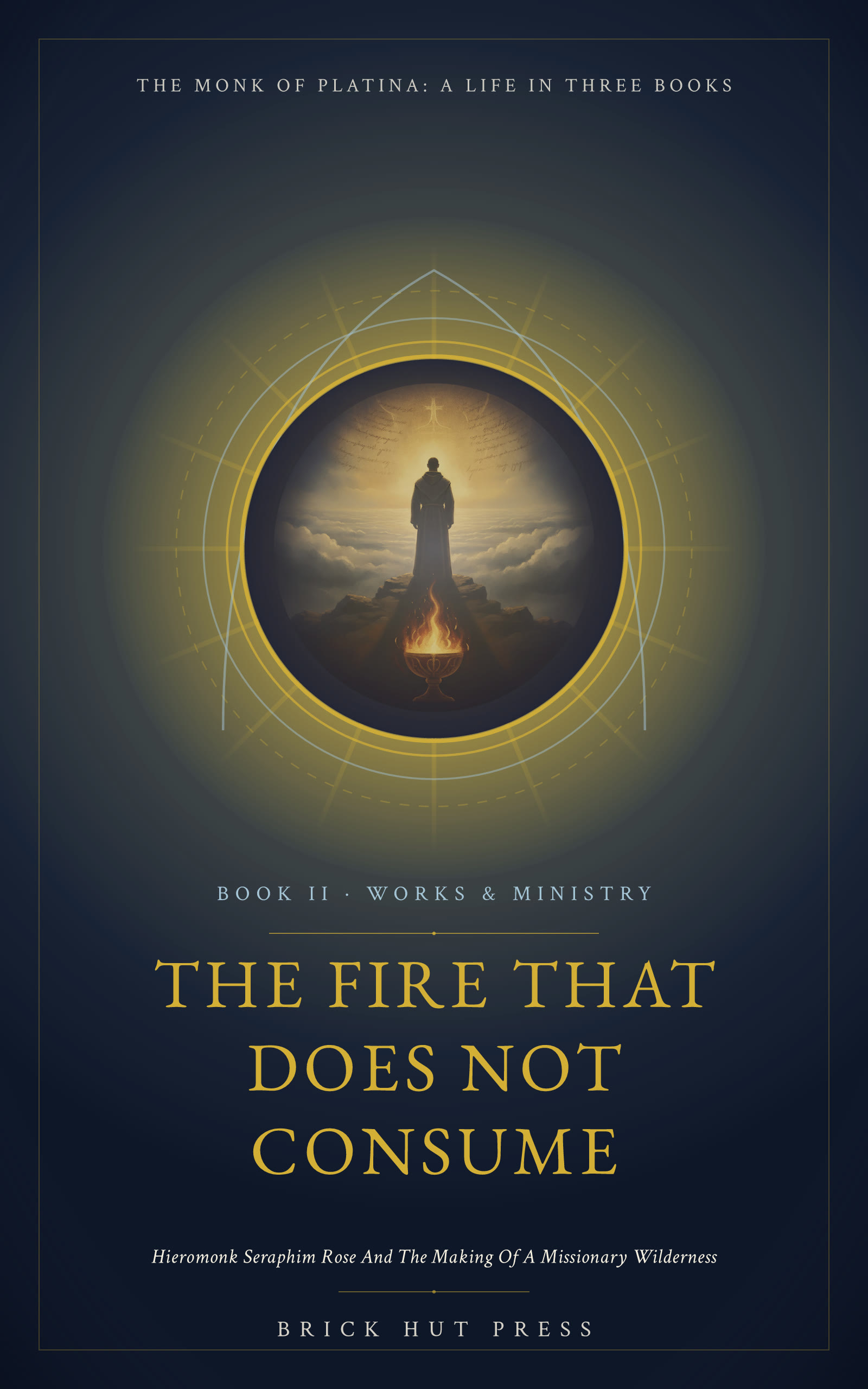
Lives that walk beside Hieromonk Seraphim Rose, chosen for their likeness, not their fame.