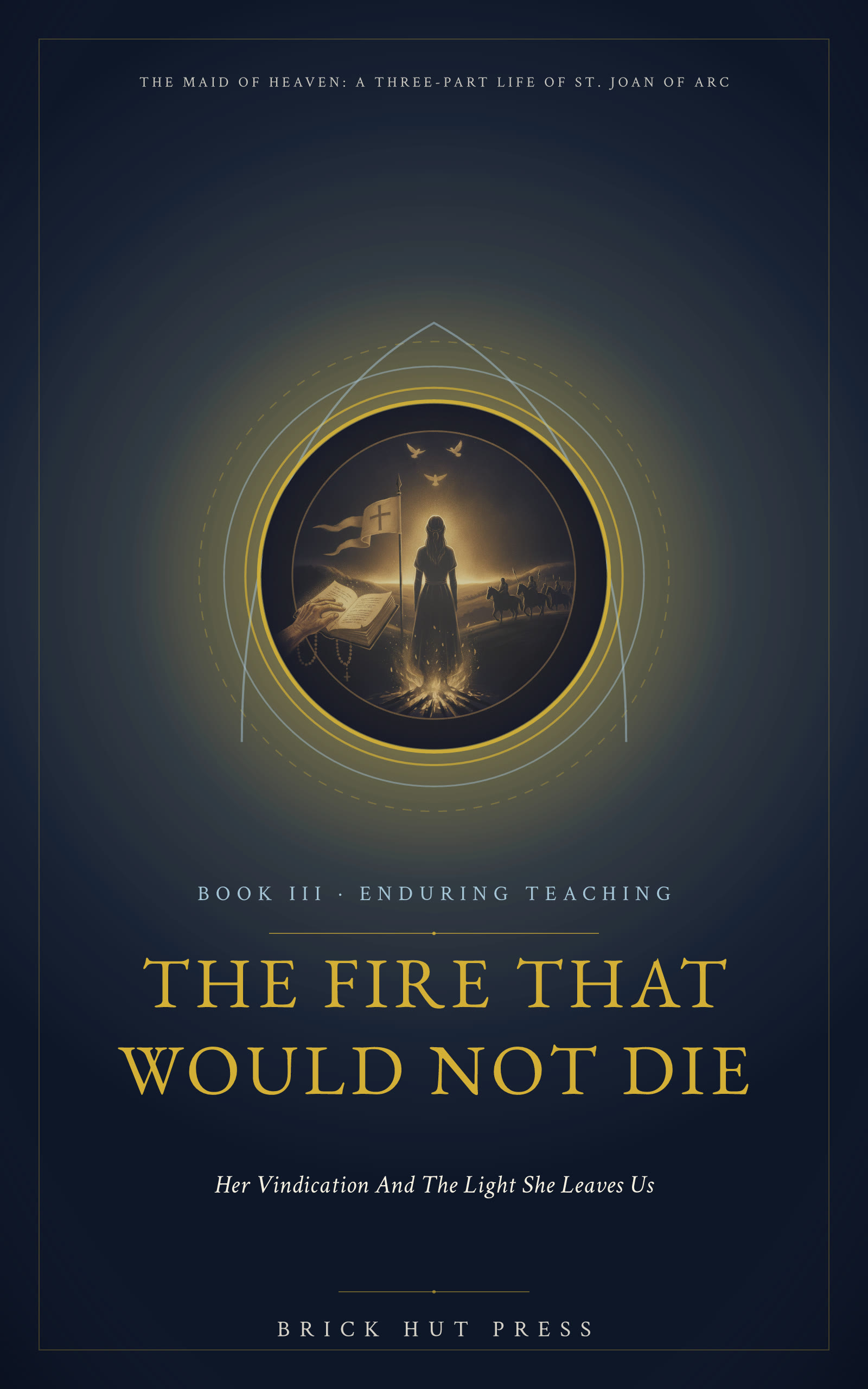
The Fire That Would Not Die
But The Fire That Would Not Die does not stop at history.
The Fire That Would Not Die begins where most accounts of Joan of Arc end, at the stake in Rouen. What followed was not silence. It was a reckoning. This volume traces the full aftermath: a mother's pilgrimage to Rome, the witnesses who came forward to speak the truth, and the nullification that overturned every false charge and restored Joan's name before God and history.
Read the full description
Five centuries of devotion, beatification, canonization, and an unbroken flame that no court and no century has managed to extinguish, all of it is here, told with clarity and reverence. But The Fire That Would Not Die does not stop at history. It enters the interior life that made Joan who she was: the spirituality of a soul who heard Heaven and obeyed, the sacraments she received as armor, the courage she lived rather than merely claimed, and the words she spoke that still carry grace. Here is the patron of the impossible, and what her life presses upon every faithful soul who has ever stood at an impossible threshold. The story of Isabelle Romée's journey to Rome and the witnesses who came forward to demand justice The nullification trial, Heaven's verdict set down in writing Five centuries of a flame: Joan's path from condemnation to the altars of the Church The sacraments, the voices, and the interior life that sustained her mission The courage and the words she leaves as living inheritance The God who spoke to a shepherd girl from Domrémy has not gone silent. Joan's vindication is not simply a historical verdict. It is a promise. Book Three of The Maid of Heaven: A Three-Part Life of St.
Not sure yet? Begin free.
The Maid Who Was Not Afraid, a complete book about this life, free, kept in your own library here, read and heard.
Receive the free bookAbout this volume
This is the third and final volume of a life told deliberately in three movements, and it opens where the second could not follow her, into the ash, the silence, and the slow, stubborn refusal of that silence to hold. Readers who have walked with the Maid of Heaven through her call at Domrémy and her fire at Rouen will find here not an epilogue but a reckoning: the twenty-five years in which a condemned peasant girl became, in the Church's own solemn language, a saint whom no court could keep buried. The book begins with Geoffroy Thérage's shaking hands and Jean Tressart's stricken words at the Vieux Marché, and it asks the reader to sit inside that unplanned confession before moving forward, because everything that follows, the mother's journey, the witnesses, the parchment verdict, grows out of that first crack in the silence.
The heart of this volume is a story of patient, unglamorous fidelity: Isabelle Romée, an old woman by then, making her way to Rome to beg for her daughter's name back, and the long procession of witnesses, soldiers, priests, childhood neighbors, men who had once judged her, coming forward decades later to say plainly what they had seen and known. Chapter by chapter, the book follows this process to its written conclusion in the Nullification, the document in which the Church declared in ink what the crowd at Rouen had already sensed in ash: that heaven's verdict and man's verdict were not the same thing. This is not court procedure rendered dry. It is treated here as a spiritual event in its own right, a vindication that mattered not because Joan needed defending but because the Church needed to see clearly again.
From there the volume widens its view across five centuries, tracing how a flame that armies and inquisitors could not extinguish kept finding new keepers, soldiers, poets, ordinary petitioners, until it reached the formal road to the altars, through beatification and at last canonization. This is where the book does something the earlier volumes could not: it lets Joan step fully into her place as Patron of the Impossible, a title earned not by legend but by the plain historical fact that a cause everyone called hopeless was carried, against every reasonable expectation, to completion. The chapter on impossible causes sits comfortably beside the chapter asking how God speaks to the small, the two questions the whole life keeps circling back to.
The second half of the volume turns from vindication to formation, and here the book changes register, becoming less a chronicle than a companion. Chapters on her interior life, on the courage she actually lived rather than the courage later ages projected onto her, and on the sacraments as the armor she wore beneath her armor, invite the reader to ask not only what happened to Joan but what her life asks of anyone trying to hear a call clearly and follow it faithfully. A chapter gathered around her own recorded words, spare, direct, unadorned, lets her speak in her own voice one more time before the book closes, a corrective to five centuries of words put in her mouth by people who never sat in that square.
The volume ends, fittingly, not with a monument but with a candle, an image the book has been building toward from its first page, when the crowd's whispering refused to die with the fire. Readers who want the trial transcripts alone, or a purely military study of the campaigns, will find those better served elsewhere; this book's task is different. It is written for those who want to understand how the Church came to say, in its own solemn and considered way, what an executioner and a secretary already suspected on the day of her death, and what that recognition asks of a believer standing at the far end of five hundred years still watching the light.
Lives that walk beside St. Joan of Arc, chosen for their likeness, not their fame.