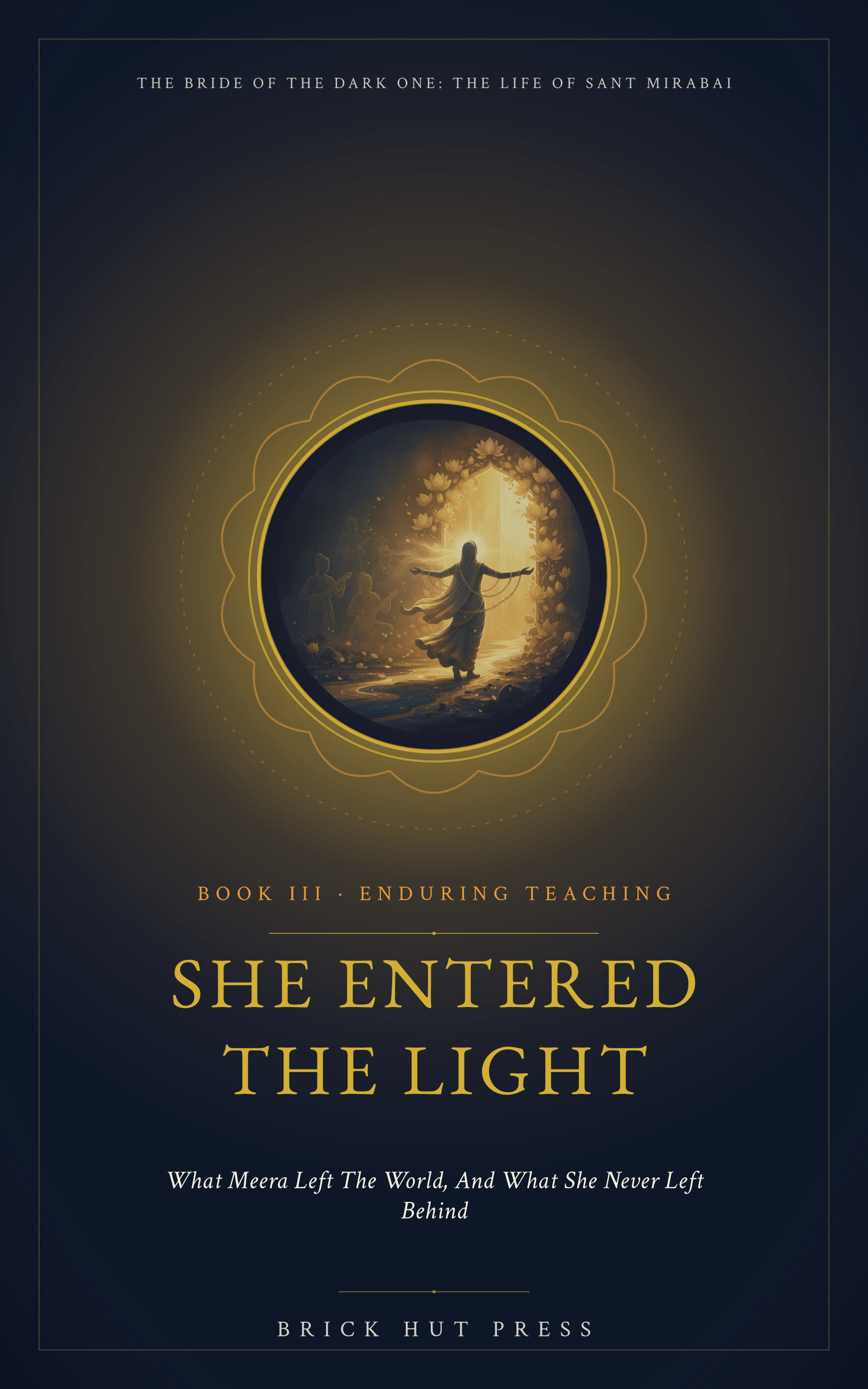
She Entered the Light
Her devotees called it a homecoming.
She Did Not Disappear. She Arrived. Five centuries ago, a Rajput princess walked barefoot into the sanctum at Dwarka, and did not walk back out. The world called it a mystery. Her devotees called it a homecoming. She Entered the Light traces every pada sung in longing, every moment of fearless surrender, and the living presence Sant Mirabai left woven into the devotional world she never truly left behind. The eyewitnesses remembered. The poet Nabhadas already knew.
Read the full description
Priyadas lit the lamp of her story, and the Guru in Punjab kept her padas alive. Across five centuries, her songs traveled from Merta to every corner of the world, and scholars could not stop weeping while they translated them. This book stands inside that unbroken current. The merging at Dwarka: where the Lord stood waiting, and what the tradition has always understood it to mean The theology of Madhurya Bhava, the soul-bride's relationship with the Divine, as Meera embodied it Viraha-bhakti : the spirituality of longing, and the ache that opens the door to God Her teaching on freedom, why no palace wall is tall enough to contain a soul given entirely to Krishna How her padas traveled from Merta to the world, and why they have never stopped moving The witness of the tradition: Nabhadas, Priyadas, and the Sikh lineage that preserved her voice The Bride who became a mirror, and what that mirror still reflects for every devotee Meera did not leave the world behind. She left a door open. Her padas are still singing. The Lord she ran toward is still waiting, for her devotees as much as He waited for her. She has not gone anywhere.
Not sure yet? Begin free.
Where Her Anklets Still Ring, a complete book about this life, free, kept in your own library here, read and heard.
Receive the free bookAbout this volume
This third volume brings the story of Sant Meera Bai to its far shore. Where earlier books followed her through Merta and Chittor, through the courts that could not hold her and the roads that carried her toward Krishna's own country, this volume opens at Dwarka, at the Ranchorji temple by the Arabian Sea, and asks what it means that this is where her earthly life closed, not in retreat, but in arrival. The opening chapters sit with the eyewitness memory the tradition has kept of those final days, and with the dawn ritual that temples still open with her name, before turning to trace how her story was first written down: through Nabhadas, who already knew of her when he composed his roll of the bhaktas, through Priyadas, who lit the fuller lamp of her biography, and through the Sikh guru's court in Punjab where her padas were gathered and preserved. This is a volume as much about transmission as about her end, about the specific human hands and specific manuscript traditions that made sure a Rajasthani princess singing to Krishna in the sixteenth century could still be sung today.
At the center of the book stands a serious engagement with what Meera actually taught, not as biography but as theology. The chapters on madhurya bhava and viraha-bhakti take up the bridal mode of devotion on its own terms, the conviction, ancient in Vaishnava practice but lived by Meera with unusual completeness, that the soul's proper posture before Krishna is that of the beloved awaiting the Lord, and that longing itself, ache itself, is not an obstacle to union but the very door through which it opens. The volume does not flatten this into sentiment. It sits with the discomfort her family and in-laws felt, the walls she refused, and asks plainly what her teaching on freedom actually cost her and what it offers anyone who takes it seriously now. No palace wall was tall enough to keep her, the chapter title says plainly, and the book means it as doctrine as much as biography.
The middle chapters trace the songs themselves on their long migration from Merta outward, how padas composed in a Rajasthani court found their way into Gujarati, Punjabi, Bengali, Hindi devotional life, into classical and folk melody alike, until they became less a regional inheritance than a subcontinental one. A chapter given over to the translators who have carried her into English is unusually candid about the labor of that carrying, about scholars who found themselves undone, mid-sentence, by lines they had read a hundred times before. This is not incidental material. It is part of the volume's larger argument that Meera's afterlife has never been merely literary; it has continued to do to readers something like what it did to her.
The closing chapters turn from history to presence. "The Bride Who Became a Mirror" considers how each generation of devotees has found its own face in her longing, without ever exhausting what she meant by it. And the final chapter, "She Has Not Gone Anywhere," makes the volume's quiet claim outright: that whatever happened at Dwarka, in body, was not an ending the tradition experienced as absence. The temples that begin the day with her songs, the manuscripts guarded in Punjab, the translators who could not stop weeping, all of it argues, cumulatively, that she left the world and did not leave her devotees.
Readers of the first two volumes will find here the completion of an arc long building; readers meeting Meera for the first time will find a self-contained account of how a princess of Merta became, by every measure the tradition keeps, a bride who never stopped singing to the One who was waiting for her at the sea's edge.
Lives that walk beside Sant Mirabai, chosen for their likeness, not their fame.