Poison into Nectar
She lifted it to her lips, offered it to Krishna, and drank, and the poison became nectar.
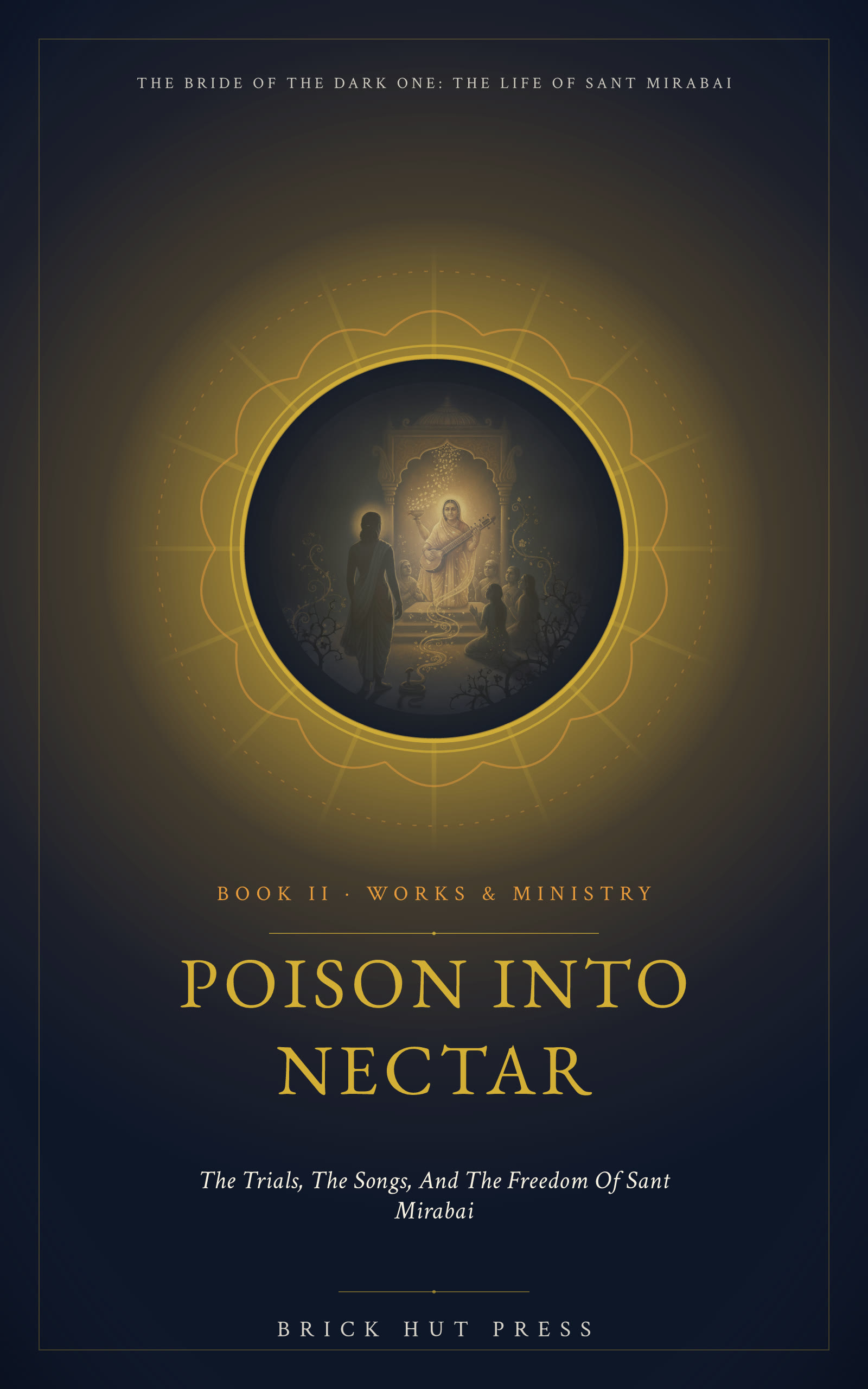
She Was Given Poison. She Drank It as Prasad. Princess. Prisoner. Pilgrim. Poet. When the in-laws of Mirabai placed a cup of poison before her, she did not plead for mercy. She did not flee. She lifted it to her lips, offered it to Krishna, and drank, and the poison became nectar. This is not legend. This is the blazing, lived reality of the most fearless bhakti saint India has ever known.
Read the full description
Poison into Nectar follows Mirabai, Mira, from the royal halls of Rajasthan through exile, conspiracy, and relentless persecution, all the way to the luminous freedom found only on the other side of complete surrender. Every trial her enemies devised became fuel for a love that could not be extinguished. Every cruelty poured forth as song. The result was the most radiant devotional poetry ever offered at the feet of the Dark Lord of Vrindavan. The trials she survived, the poisoned cup, the basket meant to be her coffin, the commands of Vikramaditya she refused, and the doors they tried to close against her The roads she walked, from the palace that did not know what had entered it, through exile, to Vrindavan, Mathura, and Dwarka Her songs as living fire, the padas and bhajans of Mira explored as transmissions of grace, poured from the very heart of persecution The freedom she entered, the gate she walked through and did not look back, and the belonging that was always hers: to everyone, and to only One Written for devotees of Krishna, followers of the bhakti tradition, and all seekers who approach sacred lives not to dissect them but to be transformed by them. This is not an academic study. Walk with Mira through the darkness and discover, as she did, that no darkness can survive in the presence of that Love. Book Two of The Bride of the Dark One: The Life of Sant Mirabai.
Not sure yet? Begin free.
Where Her Anklets Still Ring, a complete book about this life, free, kept in your own library here, read and heard.
Receive the free bookAbout this volume
This is the second volume of a two-part life, and it opens where the first left a young bride's whole future still folded in silence: Meera has entered Chittorgarh, the fortress-world of the Sisodiya Rajputs, carrying nothing that Mewar's court considered an ornament worth carrying, only a small dark image of Giridhar Gopal, wrapped like a secret that would not stay one. What follows is the record of what a proud house does when a woman inside it will not bend her devotion to fit its idea of honor, and what a soul does when it has already given itself to something no palace can command.
The chapters trace a mounting pressure that any reader of bhakti literature will recognize as the shape trial so often takes: a husband who watches more than he opposes, doors closed against her by in-laws who mistake love of Krishna for defiance of family, and then the two attempts on her life that stand at the dark center of this volume, the cup of poison meant to end her devotion along with her body, and the basket lowered into a river to be her coffin. Brick Hut Press has kept these chapters exactly as the tradition has always told them: not as sensational incident but as the crucible in which Mira's bhakti is proven, poison becoming, in the old phrase the volume takes its title from, nectar. The book does not linger on cruelty for its own sake; it lingers on what she sang, and why the poison did not do what it was sent to do.
From there the volume turns outward. Strangers arrive at her door only to hear her sing, an early sign that her voice was already escaping the walls meant to contain it, and Rana Vikramaditya's direct order, and her quiet refusal of it, becomes the hinge on which the rest of her life turns. The chapter called "The Gate She Walked Through and Did Not Look Back" is written with the plainness such a moment deserves: no melodrama, no invented last words, only the fact of a woman leaving a fortress that had never known what to do with her, and not returning.
The second half of the book follows her along the roads that mattered most to her devotion, to Vrindavan, "where every stone knows his name," and onward to Mathura and Dwarka, the towns bound up with Krishna's own life on earth. These chapters treat pilgrimage not as travelogue but as theology in motion: each place is shown as it would have met her, and as she is remembered to have met it, singer among singers, a woman whose presence in Vrindavan's groves is still spoken of by those who walk there. "The Songs That Poured from the Fire" gathers the volume's account of her most enduring compositions not as literary artifact but as testimony, bhajans understood here the way devotees have always understood them, as the residue of an experience too large for ordinary speech.
The volume closes on the question that has followed Mira through eight centuries of devotion: whether she belonged to the world that sang her, or only to the One she sang to. "She Belonged to Everyone and to Only One" does not resolve this into a tidy formula. It sits with the paradox the way the tradition itself has always sat with it, honoring both claims, the crowds who have loved her songs in a hundred languages, and the singular devotion that made those songs possible in the first place.
Readers who came to this life through Book One will recognize its patient, unhurried register carried forward here, but the terrain has changed: this is the volume of trial and release, where a young bride becomes the Mira remembered in temples and village courtyards alike, poisoned, exiled, unbowed, and finally free to walk the roads that led her, at last, to him.
Lives that walk beside Sant Mirabai, chosen for their likeness, not their fame.