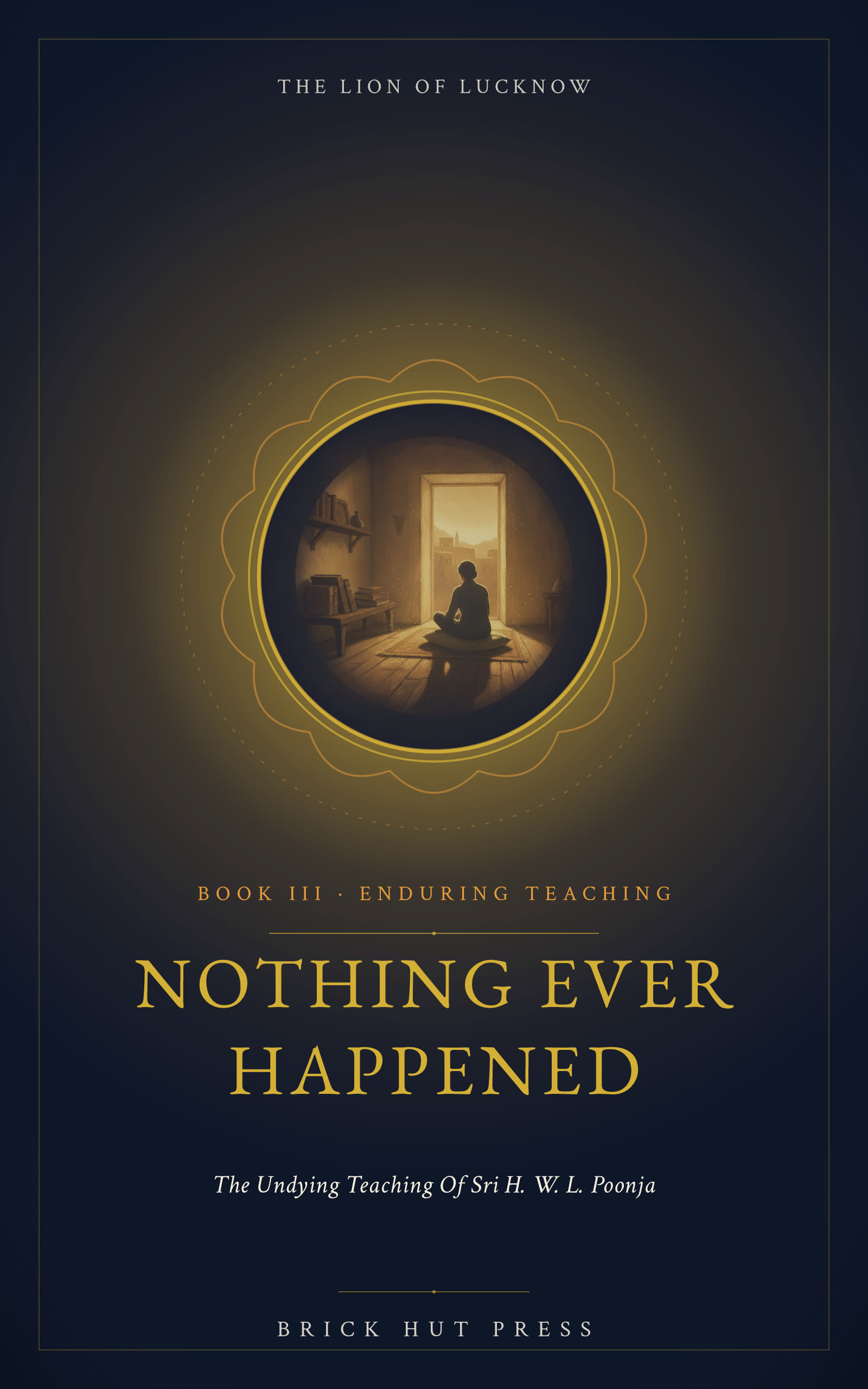
Nothing Ever Happened
A meeting with Ramana Maharshi that stopped everything.
The Man Who Pointed to What Was Always Already There Before the silence, there was a life. A search across India. A meeting with Ramana Maharshi that stopped everything. And then, satsangs in a Lucknow room that left thousands convinced the freedom they had been seeking was never once out of reach. Nothing Ever Happened is the luminous final biography of Sri H. W. L. Poonja, Papaji, one of the most beloved figures in the living non-dual tradition.
Read the full description
This is not a hagiography and not a philosophy text. It is something rarer: a life story in which liberation was not the destination but the ground. The last morning, how a life of singular presence came to its close He always said he was not a teacher, the paradox at the heart of everything Papaji did Keep quiet, the teaching distilled to its irreducible core The question that eats itself, Self-inquiry carried to its own dissolution What the poems knew, what the verses held that the discourses did not say The ambassadors carry the fire, how the teaching moved outward through those who received it What Lucknow looks like now, the living presence of a place shaped by his years there Nothing ever happened, the title teaching, given its full weight at last Papaji never built an ashram. He never asked for followers. He simply kept insisting, with tireless warmth and startling directness, that the one thing every seeker was looking for had never been absent for a single moment. Nothing Ever Happened honours that insistence, tracing the arc of a man who gave, as one chapter title declares, nothing , because those who came already possessed everything. Book Three of The Lion of Lucknow: A Three-Part Life of Sri H. W. L.
Not sure yet? Begin free.
Already Home, a complete book about this life, free, kept in your own library here, read and heard.
Receive the free bookAbout this volume
Nothing Ever Happened closes The Lion of Lucknow, and it closes it the way its subject would have wanted, not with a summation, but with a return to the plain fact of what was always already the case. This third volume opens where the life ends, in a room in Lucknow in September of 1997, and then moves backward and outward from that room to ask what, exactly, was being taught by a man who spent decades insisting he had nothing to teach. Readers who have followed Sri H. W. L. Poonja from the boy in Gujranwala who fell into samadhi beside a mango cart, through the long years of family, army service, and business that carried him across a divided subcontinent, and into the darshan hall at Tiruvannamalai where Sri Ramana Maharshi's silence undid him completely, will find in this final book the harvest of all of it: the teaching as it was actually given, in living rooms and courtyards, to whoever showed up asking to be free.
The chapters here do not proceed as a conventional biography would. "He Always Said He Was Not a Teacher" and "Keep Quiet" sit at the heart of the volume because they sit at the heart of the man, his flat refusal of the guru's chair even as thousands came to sit before him, and his insistence that the deepest instruction he had to offer was silence itself, the same silence Bhagavan Ramana had once turned on him without a word. "The Question That Eats Itself" takes up the self-inquiry he inherited and sharpened, the turning of attention back onto the one who asks, until the asking and the asker both fall away. And "Freedom Is Not Something You Arrive At" addresses directly the misunderstanding that dogged him his whole teaching life, the hope that liberation is a destination reached through practice, effort, or time, when he held, with Bhagavan before him, that it is what remains when the search for it is finally seen through.
The book is equally attentive to what happened around Papaji, and this is where it distinguishes itself from a purely doctrinal account. "What the Poems Knew That the Discourses Did Not Say" turns to the verses he wrote and sang, where a tenderness lives that the sharper discourse sometimes conceals, the bhakti that never left him even as the Direct Path matured in him. "The Archive That Breathes" and "The Ambassadors Carry the Fire" trace how his words survived him: the tapes, the transcripts, and above all the students, some now well known as teachers in their own right, who carried what they received in Lucknow out into rooms across the world, translating nothing, only pointing again at what had been pointed out to them. "What Lucknow Looks Like Now" brings the reader to the present, to the city and the house as they stand today, still visited, still quiet in the particular way he made quiet mean something.
The volume's final movement, "He Gave You Nothing Because You Needed Nothing" and the closing chapter that gives the book its title, is where the whole three-part life comes to rest. These pages do not attempt to resolve Papaji into a tidy legacy or a system that can be studied and mastered. They attempt, instead, to leave the reader exactly where he tried to leave everyone who sat before him: without a method, without a program, and without anything to achieve, because what was sought was never absent to begin with. This is not a book that argues for that conclusion so much as it walks the reader toward the same door Papaji stood in front of for eighty-six years, and holds it open.
For those who have read the first two volumes, this closing book will feel less like an ending than like arrival at the place the whole journey was quietly heading. For those coming to Papaji here for the first time, it stands complete enough to be read on its own, an account of a teaching that asked for nothing, offered everything, and insisted, to the very last morning, that nothing had ever actually happened at all.
Lives that walk beside Sri H. W. L. Poonja, chosen for their likeness, not their fame.