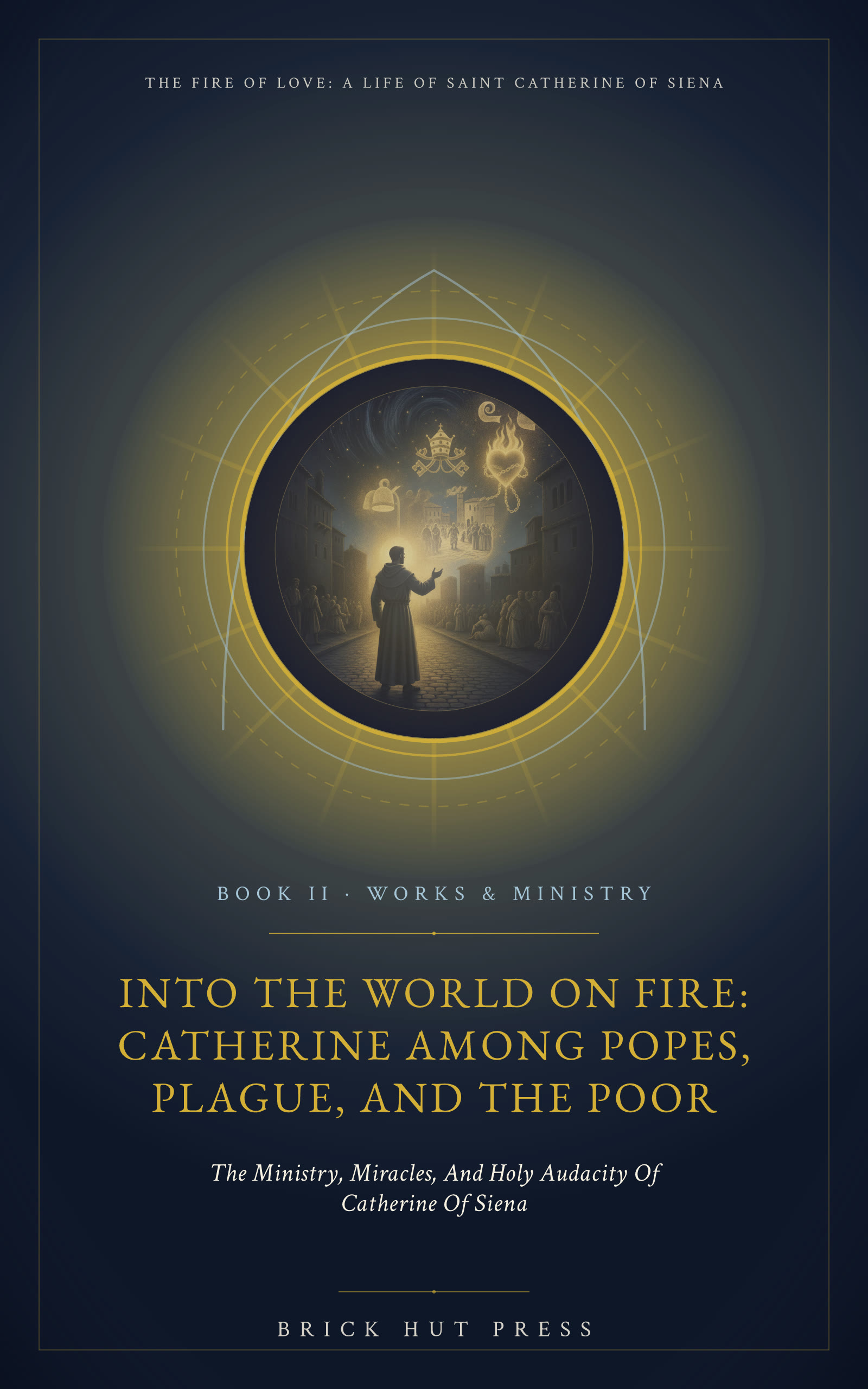
Into the World on Fire: Catherine Among Popes, Plague, and the Poor
Catherine of Siena did not wait for permission.
She Ran Toward Plague. She Corrected Popes. She Changed the Church, and She Was Only Thirty-Three. Catherine of Siena did not wait for permission. While the Black Death consumed her city, she entered the wards where no one else would go. While the papacy fractured and corrupt clergy looked away, she wrote letters of blazing clarity to kings, cardinals, and a pope in exile, addressing him as Babbo , dear father, before demanding he do his duty.
Read the full description
She received the stigmata, lived on almost nothing, and dictated one of the most luminous spiritual works in the history of Christianity. Then she died at thirty-three, still interceding for a Church she refused to stop loving. This is not a sanitized saint's life. Into the World on Fire is a devotional account written from within the Dominican tradition Catherine herself shaped, and it places you at her side through every hospital ward, every bold letter, every dark night of the soul, and every blazing moment of mystical union. Here you will discover that her contemplation and her holy audacity were never two things. They were always one fire. And that fire still burns.
Not sure yet? Begin free.
The Fire in the Heart of Siena, a complete book about this life, free, kept in your own library here, read and heard.
Begin reading, freeAbout this volume
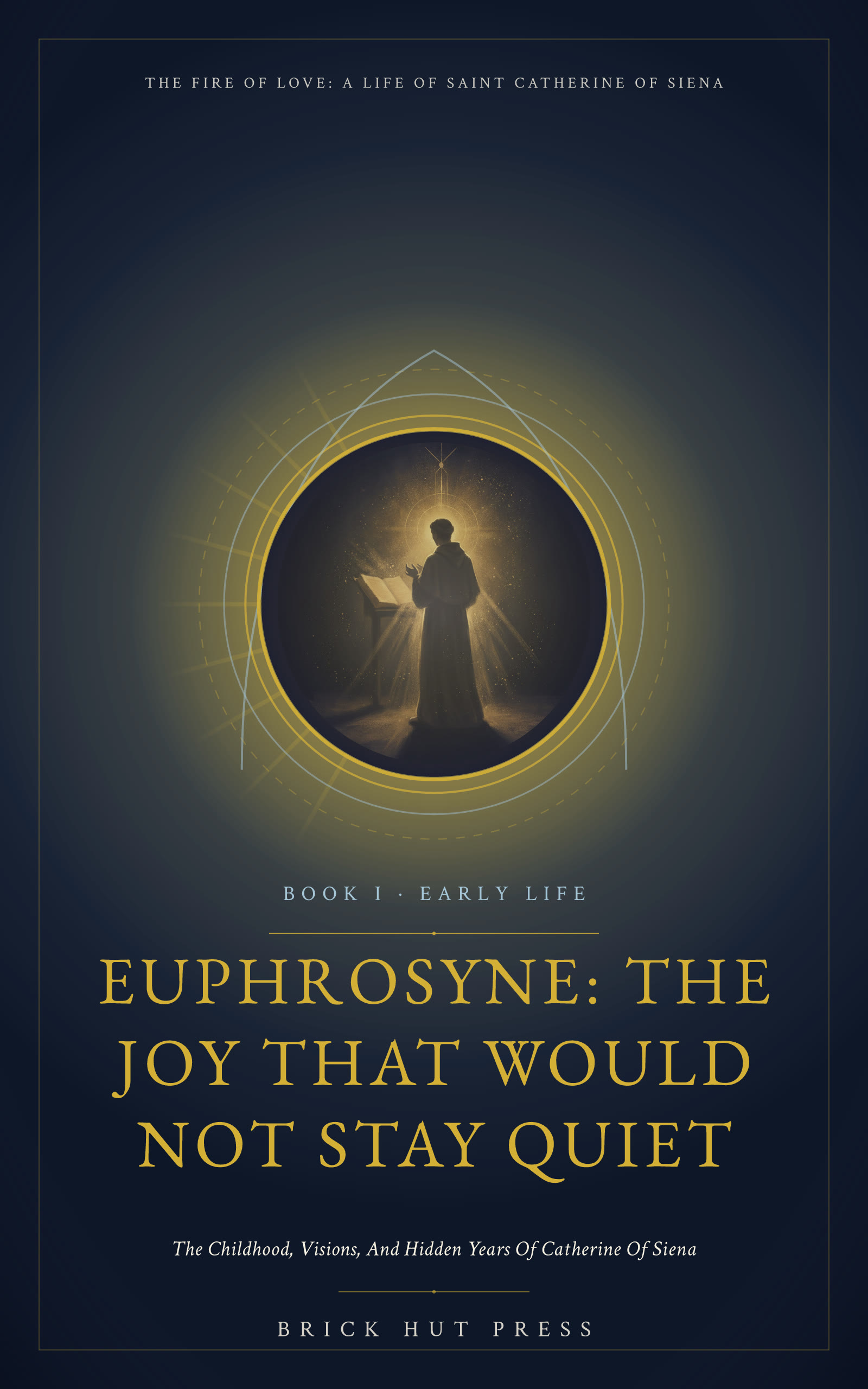
This is the volume where the cell empties out and the world rushes in. Volume One left Catherine of Siena at the threshold of her father's house on the Via dei Tintori, three years of silence behind her and a command she could not refuse ringing in her ears. Into the World on Fire opens with her crossing the piazza toward Santa Maria della Scala, the great hospital that took in what Siena could not otherwise bear to look at, and it does not let her rest there. This volume follows the Mantellata from the hospital wards into the plague-stricken streets, into the ecstasies and the wounds, into the correspondence that would make her one of the most urgent voices of her century, and finally into Rome, where her life's work and her life itself come to their end.
The early chapters stay close to the body: the ward she would not leave, the plague that returned and sent her running toward the sick rather than away from them, the mystical exchange of hearts that readers of the first volume have been waiting to see her receive. These are not chapters interested in explaining away what Catherine's contemporaries recorded. They sit with the strangeness of a young woman who nursed the dying with her bare hands, who asked for wounds rather than relief from them, and they let that strangeness stand as its own kind of argument about what love under obedience can look like when it is total.
From there the volume turns outward, and this is where Into the World on Fire earns its title in full. The chapter on her letters traces how a woman with no formal education and no ecclesial office became a correspondent whose words reached princes, cardinals, and a pope who had exiled himself to Avignon. "Babbo," the volume's hinge chapter, follows her extraordinary summons to Pope Gregory XI, the campaign of persuasion and plain speech that helped draw the papacy back toward Rome. It does not flatten the difficulty of that work or pretend the outcome was simple. The chapters that follow are frank about her failures as well as her successes: the peace she could not broker in Florence, the agony of watching the Church she loved tear itself in two during the Great Schism. A figure capable of holy audacity is also, this volume insists, a woman who grieved what she could not fix.
The final movement, "Come to Rome" and "The Morning of April 29," carries Catherine into her last campaign and her last days. These chapters do not rush past her death to get to canonization or legacy. They stay in the room, in the exhaustion of a body that had given everything it had to give for the unity of the Church, and they ask the reader to witness that ending with the same unflinching attention the first chapter asked of the hospital ward. The volume's closing pages are less interested in resolving the mystery of Catherine of Siena than in letting her final audacity, the audacity of showing up at the center of ecclesial power as an uncloistered laywoman with nothing but her voice and her conviction, stand fully in view.
Readers who have followed Catherine from the silence of her father's house will find here the counterpart to that silence: a life turned entirely outward, spent on the sick, the schismatic, the exiled papacy, and the poor who first taught her what love in the marketplace required. This is not a volume that asks admiration from a distance. It asks the reader to walk the piazza with her, into the ward, into the letters, into Rome, and to stay until the morning it ends.
Lives that walk beside Saint Catherine of Siena, chosen for their likeness, not their fame.