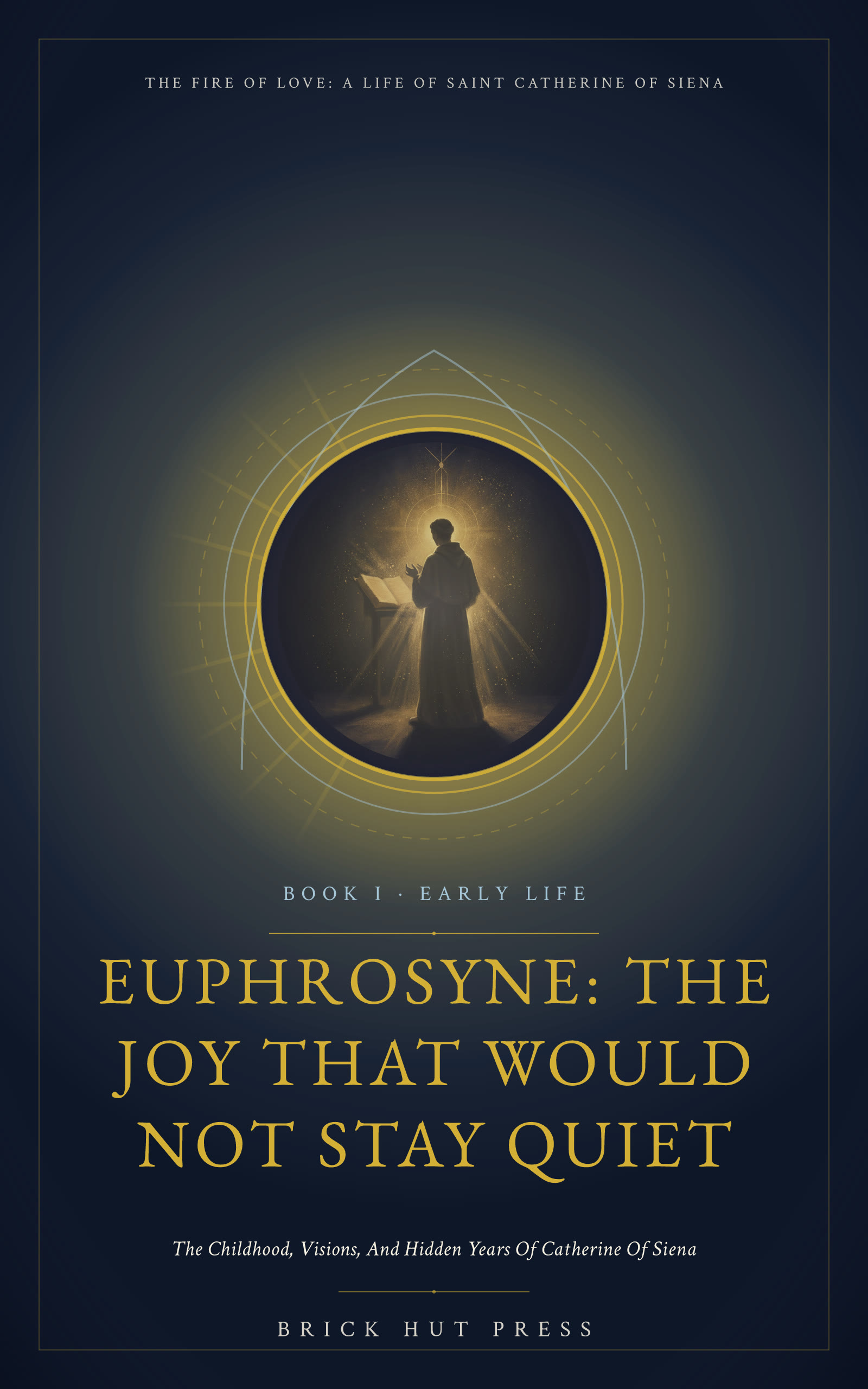
Euphrosyne: The Joy That Would Not Stay Quiet
Before she could string letters into words, she was already climbing, literally and mystically, toward something no one around her could see.
She Heard God's Voice Before She Could Read, And Nothing Would Ever Silence Her Again Born into plague-shadowed Siena, crushed between siblings in a noisy dyer's house, Catherine Benincasa should have been ordinary. She was not. Before she could string letters into words, she was already climbing, literally and mystically, toward something no one around her could see.
Read the full description
Euphrosyne: The Joy That Would Not Stay Quiet traces those hidden, luminous, often misunderstood years: the childhood visions, the fierce interior battles, the darkness that tested her, and the divine espousal that sealed her path forever. This is not a dry hagiography. It is a devotional account told with intimacy and fire, written for those who already love Catherine of Siena and for those meeting her for the first time and sensing, immediately, that she was made for them. If you have ever held a calling that the people around you could not understand, or walked through a spiritual darkness that felt permanent, or wondered whether joy and suffering can occupy the same soul at once, Catherine has been there. She went first. And she left a trail.
Not sure yet? Begin free.
The Fire in the Heart of Siena, a complete book about this life, free, kept in your own library here, read and heard.
Begin reading, freeAbout this volume
Before Saint Catherine of Siena became the woman who would one day write to popes and kings, she was a small girl in a dyer's house in the valley of Fontebranda, the twenty-fourth child of Giacomo and Lapa Benincasa, born on the feast of the Annunciation into a household too full and too loud to notice right away that anything unusual had arrived. This first volume of The Fire of Love stays close to that ordinariness, and to the extraordinary things that began to break through it before she was out of childhood. It opens with the house on the Via dei Tintori, the copper vats steaming in the yard, the twin sister who did not live to see the summer, and it asks the reader to sit inside that noisy, unglamorous world before any halo is allowed to appear.
The chapters that follow trace the visions and vows of a girl still years from the mantle she would later wear. At six years old, walking home from her married sister's house, she looked up above the church of San Domenico and saw something that would reorder the rest of her life, and the volume treats that moment with the seriousness it deserves, neither explaining it away nor rushing past it to get to the famous years. Soon after comes the vow she made in secret, a child's promise that her family would spend years trying to talk her out of, and the long domestic struggle that followed: the hair she cut off in protest, the fasting she kept against her mother's wishes, the slow and often painful negotiation between a daughter's interior certainty and a household's very reasonable expectations for a girl of her class and city.
Siena itself is a character in these pages, its brick towers and stone streets, its civic pride and its plagues, shaping the woman Catherine would become even as she turned away from much of what the city valued. The volume gives real attention to her sister Bonaventura, whose influence and whose death mark a hinge in Catherine's early life, and to the long, mostly hidden years that followed: her clothing as a Mantellata among the Dominican penitent women, a choice that placed her inside a tradition of lay holiness without requiring her to leave her father's house, and the years of enclosure that came after, when she kept a cell that, as the chapter title has it, had no walls at all, since her real solitude was interior, sustained by prayer rather than by stone.
This is also, frankly, a book about darkness as well as light. One chapter follows the temptations and desolations that came to her in that same hidden cell, the period when, by her own later testimony, the darkness seemed to speak her name directly, and the volume does not soften this into a brief trial before the reward. It lets the difficulty stand. The reward, when it comes, is the mystical espousal often called her spiritual marriage, the ring and the feast that followed, rendered here not as a decorative legend but as the culmination of years of hidden formation that the earlier chapters have carefully laid down.
The volume closes on the threshold of the public life for which Catherine of Siena is best remembered: the voice, as the final chapter has it, that told her to come out. Readers who already know the Catherine of the letters, the crossing to Avignon, the counsel given to popes, will find here the long quiet preparation that made that later voice possible. Readers meeting her for the first time will find a child of Fontebranda before they meet the saint of the Church, and that order matters. This is a book for anyone who wants to understand not only what Catherine of Siena did, but how a joy that would not stay quiet was first formed in her, in secret, long before the world had any reason to notice.
Lives that walk beside Saint Catherine of Siena, chosen for their likeness, not their fame.