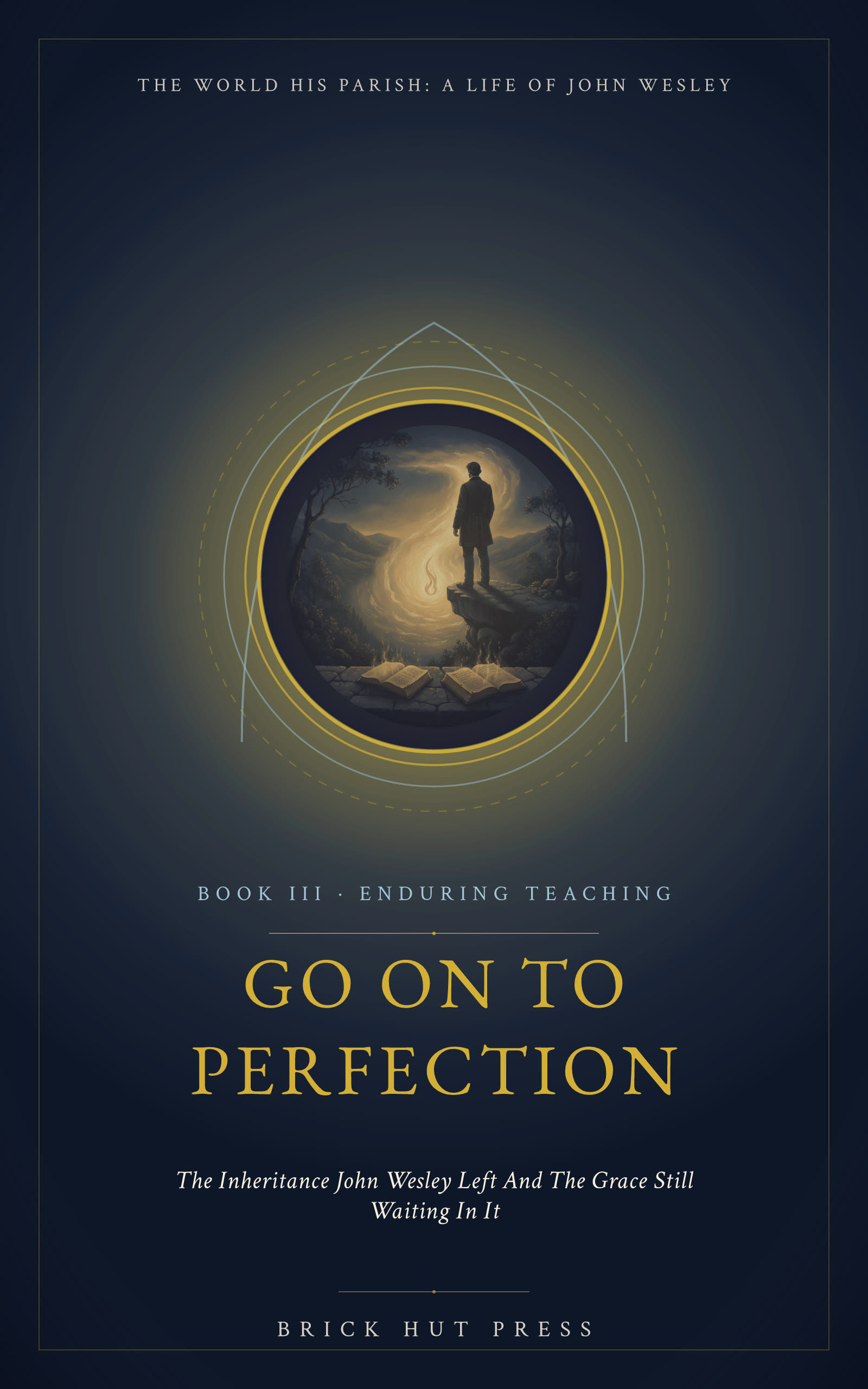
Go On to Perfection
John Wesley left the Church something more than a denomination.
Are You Going On to Perfection? John Wesley left the Church something more than a denomination. He left a living theology, and most of us have only touched the edges of it. If you were raised Methodist, Wesleyan, Nazarene, or in any corner of the evangelical-holiness tradition, you carry an inheritance richer than you may know. This book is your invitation to claim it fully.
Read the full description
Go On to Perfection is a warm, doctrinally grounded, and spiritually alive guide to the legacy Wesley actually left, not the sanitized historical footnote, but the man who preached in coal-mine fields at dawn, built accountability structures that changed lives, and dared to believe that grace could do far more than forgive. It could transform . This is the theology of grace that starts before you ask, holds you to your best self, and reaches into the street as surely as it reaches into the soul.
Not sure yet? Begin free.
The Heart Strangely Warmed, a complete book about this life, free, kept in your own library here, read and heard.
Receive the free bookAbout this volume
The first two volumes of this life follow John Wesley from Epworth rectory to Aldersgate Street, from the Holy Club at Oxford to the fields where he preached to colliers who had never set foot inside a parish church. This third volume asks a different kind of question. It does not ask what happened to Wesley. It asks what he left behind, and whether that inheritance still has claim on a reader three centuries later.
The volume opens where his public voice was most fully himself: in the sermons, forty-four of them fixed by his own hand as doctrinal standards, still being preached from the same pulpit at St. Mary the Virgin where the story began. From there it moves inward, to the doctrine that gave Methodism its shape before it had that name, prevenient grace, the conviction that God moves toward the sinner before the sinner has thought to move at all. A chapter on the fourfold reading of Scripture, tradition, reason, and experience shows how Wesley built not a system but a method, a way of testing every claim against four witnesses rather than one. Another sits with the plain account of Christian perfection, the doctrine that drew the most fire in his lifetime and the most misunderstanding since, and tries to say clearly what Wesley meant and did not mean by it.
The middle chapters turn to the practical architecture of the movement: the Notes on the New Testament written to sit beside an ordinary reader's Bible rather than above it, the class meetings where twelve people and one question, "how does your soul prosper?", did more to form Methodist character than any sermon could. A chapter on holiness and justice traces why Wesley could never let personal sanctification stand apart from prison visitation, opposition to the slave trade, and concern for the poor; for him these were never two projects but one. The Connexion chapter follows the harder, less romantic work of turning a revival into a durable structure, circuits and conferences and lay preachers, the scaffolding that let the movement outlive its founder. Charles Wesley's hymns get their own chapter, "And Can It Be" read not as ornament to the doctrine but as its clearest expression, poetry doing what prose could not.
The volume closes by following Wesley to the end of his road, the last entries in the journal, and then past him, into the tens of millions who trace their spiritual lineage to those Oxford Methodists and open-air congregations. It ends, fittingly, not with a summary but with the question the whole life was organized around: are you going on to perfection? That was never rhetorical for Wesley, and this book does not treat it as rhetorical either.
Readers who have followed the first two volumes will recognize the voice: careful with dates and sources, unwilling to flatten a complicated man into either plaster saint or convenient reformer. Readers coming to Wesley for the first time will find enough context in each chapter to stand on its own, though the fuller shape of the man, the family, the conversion, the decades of itinerant preaching, is drawn out more slowly in the volumes that precede this one. What this volume offers is the harvest: the sermons, the doctrine, the practices, the connexional structure, and the hymns, gathered together as what Wesley actually handed forward, and asked, without pressure but without evasion, whether that inheritance is still grace worth receiving.
Lives that walk beside John Wesley, chosen for their likeness, not their fame.