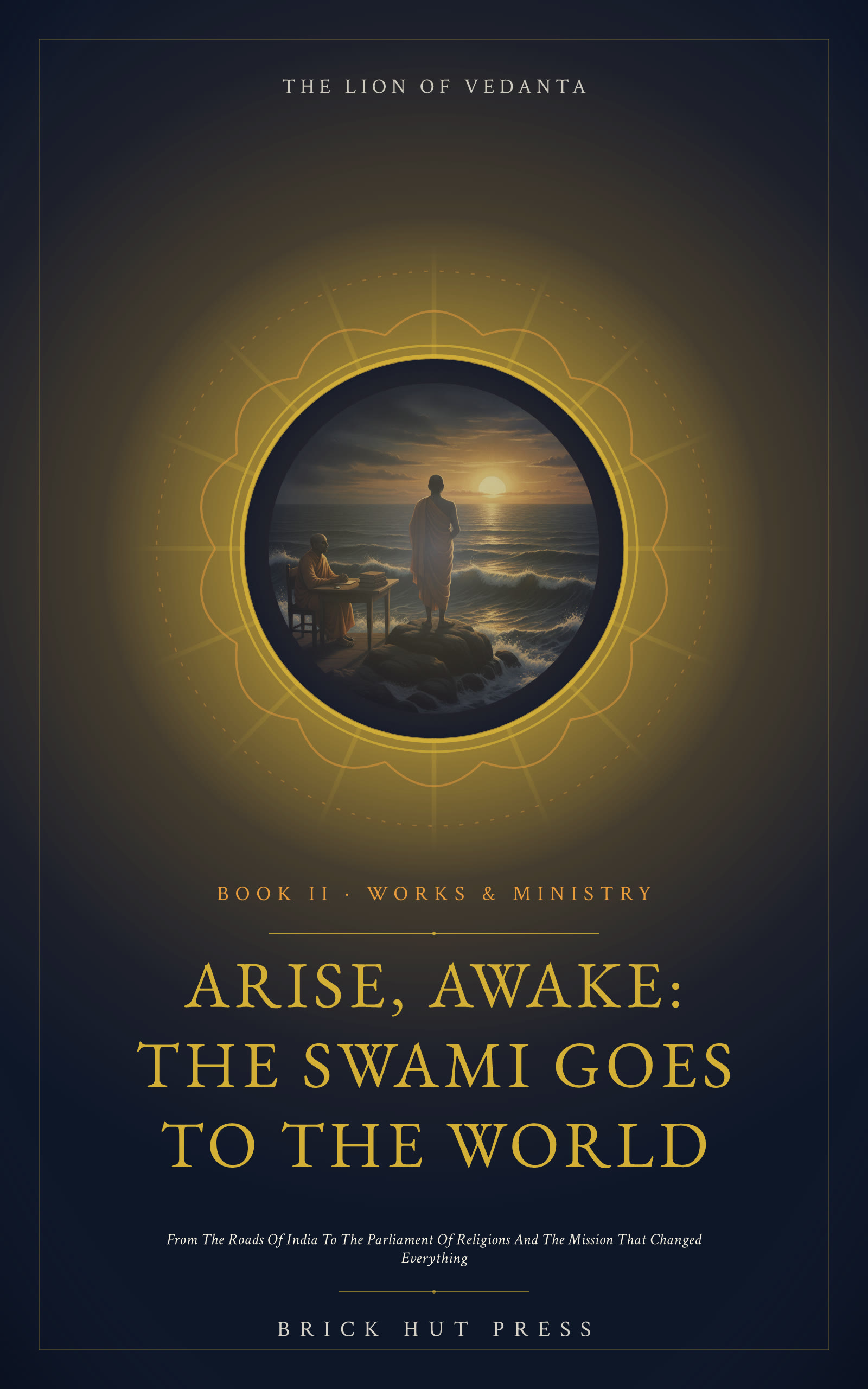
Arise, Awake: The Swami Goes to the World
Swami Vivekananda's was the latter.
He Walked Out of India with Nothing, and Changed the Spiritual World Forever There are lives that alter the course of history quietly, and there are lives that announce themselves like a thunderclap. Swami Vivekananda's was the latter.
Read the full description
Arise, Awake: The Swami Goes to the World is a devotional account of the years in which one young monk, carrying no money, no credentials recognised by the West, and no institutional backing, stepped onto the world's stage and redrew the map of spiritual understanding between East and West. This is not biography at arm's length. It is a walking-companion for those who already love Swamiji, and a reverent introduction for those newly drawn to his words. Drawing faithfully from the Complete Works and the living testimony of the Ramakrishna-Vivekananda tradition, this account takes you from the meditation rock at Kanyakumari, where a nation's destiny crystallised in a single monk's silence, to the thunderous welcome at the Parliament of Religions in Chicago, and onward through the founding of Belur Math and the mission that continues to this day.
Not sure yet? Begin free.
The Lion of Vedanta, a complete book about this life, free, kept in your own library here, read now; its narration joins free when it is finished.
Begin reading, freeAbout this volume
This is the volume where the wandering monk becomes the Swami the world would come to know, and the pivot is given to us whole: a man alone on a wave-scoured rock at the southern tip of India, two horizons before him, no name yet, no mission yet, only four years of walking the length of the subcontinent pressing in on him from behind. The book opens there deliberately, because everything that follows, the ship, the strange city, the hall full of unfamiliar faces, only makes sense if the reader has first sat with him on that granite outcrop and felt the weight of what he was about to decide.
The early chapters trace what those years of wandering had actually shown him: not a holiday across a beautiful country but an education in hunger, caste, princely courts, and village poverty that would shape everything he later said to the West and everything he later demanded of his own people. By the time he books passage on a ship bound for an unknown shore, the reader understands that Chicago was not where his mission began. It began on the roads of Rajputana and the temple towns of the south, and Chicago was only where it was first spoken aloud to strangers.
The heart of the volume is, of course, the Parliament of Religions, but the book does not linger only on the famous opening address. It follows the Swami through the harder, longer work that came after: the lecture circuits, the drawing rooms, the endless curiosity and occasional hostility of American audiences, and the quieter, more demanding teaching he gave at Thousand Island Park, where a small circle of students received, in whispers rather than oratory, the fuller shape of his Vedanta. It follows him to England, where he found in Margaret Noble a disciple willing to carry the fire back to India herself, a relationship the book treats with the seriousness it deserves, neither sentimentalized nor reduced to a footnote.
Raja Yoga, written and taught in this period, gets its own chapter, and rightly so: this is where the Swami's teaching takes durable written form, the four paths laid out not as abstract philosophy but as roads a Western seeker could actually walk. The volume then turns him homeward, to the return that Bengal still remembers as an arrival of near-mythic proportions, and from there to the founding of a mission that would outlast him: Belur Math and the organized body of monks and service that still carries his name. These chapters do not rush. They sit with the practical, unglamorous work of institution-building, because the book takes seriously that this, too, was part of what Kanyakumari demanded of him.
The volume closes with the second journey west and the slow darkening that the Order's own tradition does not hide from: a body failing under the weight of a mission it was never going to let him set down. The final chapter, at Belur Math, is written with the restraint the subject deserves, neither mournful spectacle nor triumphant summary, but a steady accounting of a flame that burned itself out doing exactly what it had been lit to do.
Readers coming to this volume after the first will recognize the young Narendranath in these pages only in flashes, in a gesture, a turn of phrase, the old hunger for truth now disciplined into purpose. Readers coming to it fresh will still find the arc complete in itself: a monk who left everything on a shore in Kanyakumari, swam to a rock with no plan but a decision, and returned from it with a mission that changed the shape of Hindu thought in the modern world. This is that mission's founding, told chapter by chapter, place by place, exactly as the Order itself has long remembered it.
Lives that walk beside Swami Vivekananda, chosen for their likeness, not their fame.