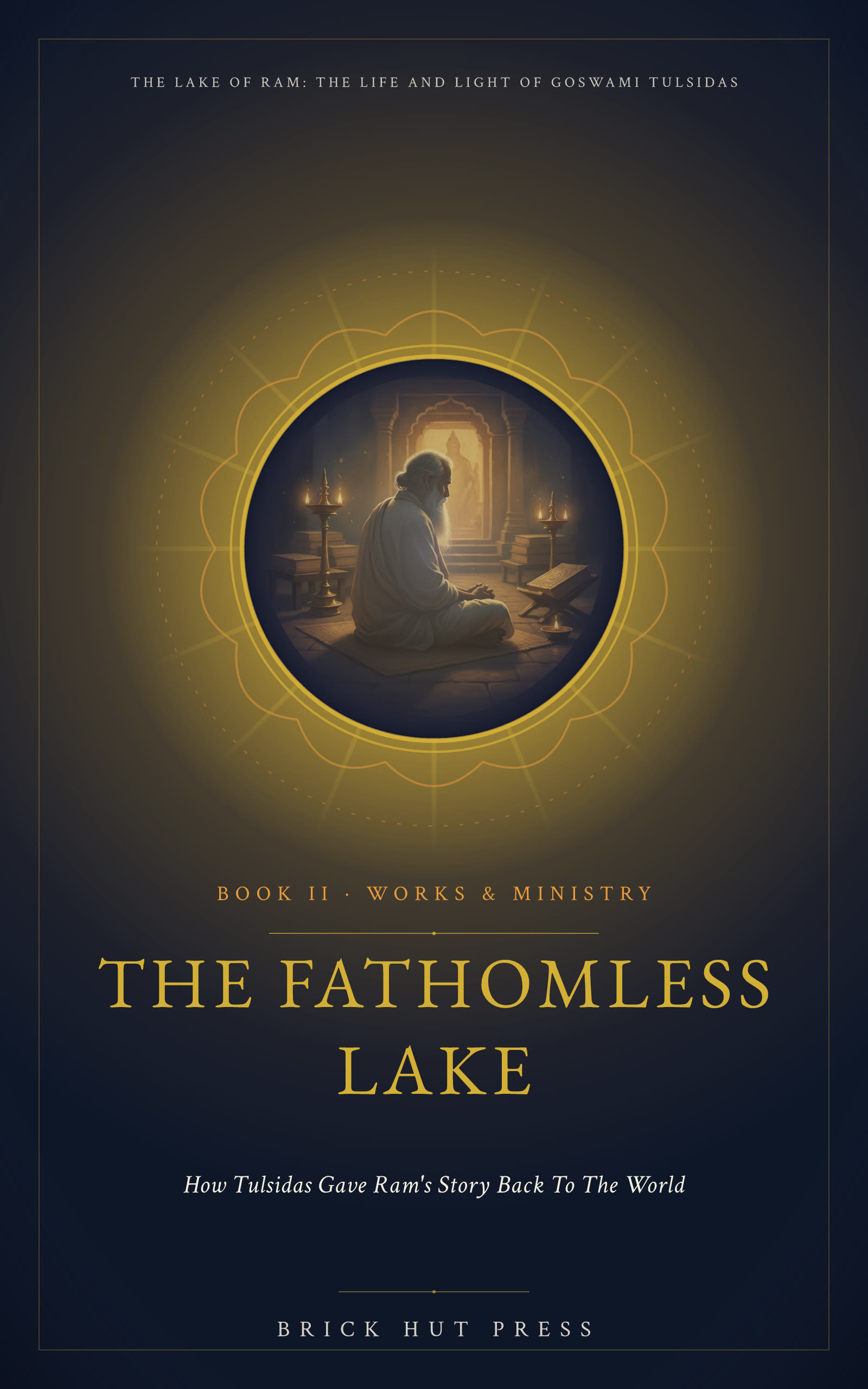
The Fathomless Lake
Book Two follows the life of Tulsidas and his Ramcharitmanas, detailing the great creative outpouring that defined his lifetime of sacred service.
Five centuries ago, a grief-struck poet sat down in Ayodhya on Ram Navami and began a lake of devotion that has never stopped filling. This Goswami Tulsidas biography tells the profound story of a man who brought the story of Ram back to the world. Book Two follows the life of Tulsidas and his Ramcharitmanas, detailing the great creative outpouring that defined his lifetime of sacred service.
Read the full description
By walking alongside the poet, the reader witnesses the deep faith required to compose his monumental work. Written from inside the tradition, this biography of a Rama bhakti saint illuminates the miraculous encounters that shaped his path. The miracles that confirmed the holiness of his composition are presented with reverence. We see the profound impact of Tulsidas on the Hindu bhakti tradition, as his wider ministry of poems, hymns, and temples established a legacy of devotion. His tireless efforts made the story of Ram a living presence. The narrative explores the full scope of his sacred offerings: The great composition: Walk alongside the poet through the composing of the Ramcharitmanas against criticism and doubt. Miraculous encounters: Read of the extraordinary miracles that confirmed the absolute holiness of his work. A lifetime of service: Discover the origins of the Hanuman Chalisa alongside the enduring temples and Ramlilas he left behind. A wider ministry: Understand how his collection of poems and hymns made the story of Ram the breath of northern India. This volume is written for those who already carry these words in their hearts.
Not sure yet? Begin free.
The Lamp That Still Burns at Assi Ghat, a complete book about this life, free, kept in your own library here, read now; its narration joins free when it is finished.
Receive the free bookAbout this volume
This is the second volume of The Lake of Ram, and it opens where the first left the reader waiting: not with the young Rambola Dubey learning the shape of loss and the discipline of the road, but with the seasoned tapasvi who walks each evening to the burning ghats of Kashi carrying water for the dead. That opening scene, quiet and unremarkable on its surface, is the volume's true threshold. What happens at that burning ground, the meeting that gives this book its first chapter, and the monkey who is never absent from the pages that follow, is the hinge on which the whole account turns, the moment a wandering Brahmin's forty years of walking finally find their shape and their hour.
From there the volume follows Goswami Tulsidas into the work by which the world would come to know him: the composing of the Ramcharitmanas. Readers will walk with him to Ayodhya on Ram Navami of 1574, will watch the lake of the story begin to fill, and will follow its filling across the almost impossibly precise span the tradition itself remembers, two years, seven months, and twenty-six days of composition, a span this volume treats not as legend to be waved past but as a discipline to be understood, verse by verse, season by season. Alongside the composing come the testings: the night in Kashi when the pandits who doubted a Sanskrit scripture's equal in the Awadhi tongue were silenced, and the older, deeper witness the tradition holds dearest, that Shiva himself listened. These chapters do not ask the reader to set aside discernment; they ask the reader to sit inside the devotional memory as the sampradaya itself has kept it, and to weigh it on its own terms.
The volume does not close the lake once it is finished. It follows the verses outward, the forty lines that, the tradition says, lit every lamp in India, and the wider songs that most readers of the Manas alone never meet: the Vinay Patrika's petitions, the Kavitavali, the Gitavali, the Dohavali, each a different instrument in the same devotion, each showing a different facet of how Tulsidas turned grief, praise, and plain daily need into meter. There is room here too for the builder and the teacher: the temple raised for the Remover of Sorrows, the Ramlila given to the villages so that Ram's story could be not only read but walked through and performed by ordinary hands, and the long, unglamorous ministry of teaching, receiving pilgrims, and simply remaining faithful to a single work across decades.
The volume ends where the body itself becomes the offering, in the Hanuman Bahuka, when illness and pain are turned, without complaint, into another form of prayer. It is a fitting close for a book that has spent its length showing how thoroughly Tulsidas made no separation between the sacred work and the sacred life, how the tarpan at the ghats, the verses composed by lamplight, the temple stones set in place, and the aching body offered up in old age were, for him, one continuous act of remembrance.
Readers who come to this volume looking for a tidy literary biography will find something else: a devotional account written from within the bhakti it describes, attentive to dates and places but unembarrassed by wonder, and willing to let the tradition's own memory of Shiva listening, of pandits silenced, of a lake fathomless in its depth, stand as the record deserves to stand. It assumes some familiarity with the man from the first volume, but it does not require the reader to have finished the road to Kashi before setting out on the road to Ayodhya. What it asks is patience enough to sit beside Tulsidas as he sits beside the river, and to watch, verse by verse, how Ram's story was given back to the world.
Lives that walk beside Goswami Tulsidas, chosen for their likeness, not their fame.