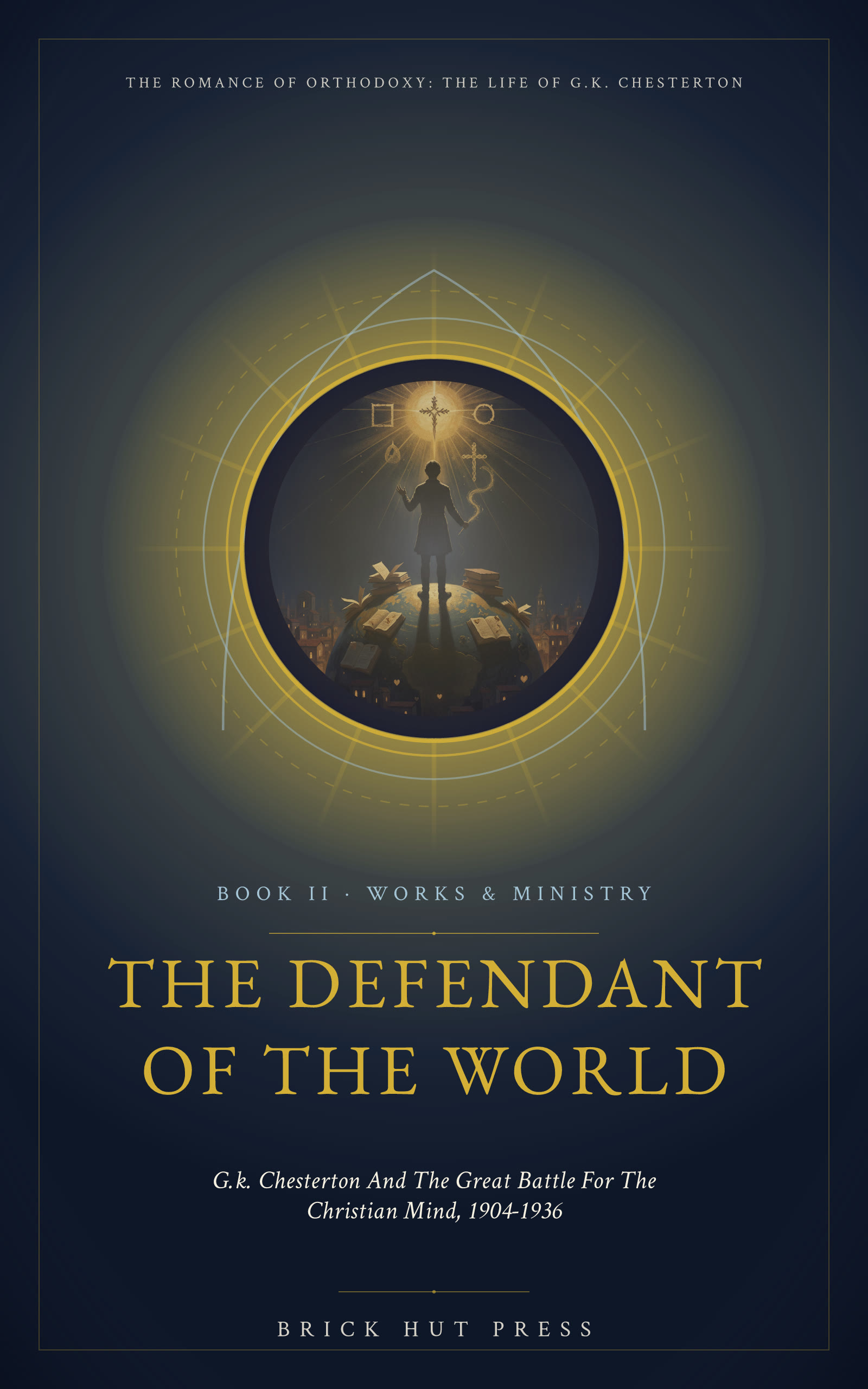
The Defendant of the World
Chesterton stood up, laughed, and dismantled the dismantlers.
He Fought for the Soul of the Modern World, With a Smile on His Face and a Sword in His Hand At a moment when the Christian faith was being dismantled by clever men in comfortable chairs, G.K. Chesterton stood up, laughed, and dismantled the dismantlers.
Read the full description
He was the largest man in any room, in body, in spirit, in sheer intellectual generosity, and for more than three decades he waged the most joyful, most consequential battle for the Christian mind that the twentieth century would ever see. The Defendant of the World walks beside him through every arena of that battle: the ink-stained trenches of Fleet Street, the crackling public debates with George Bernard Shaw and H.G. Wells, the heartbreak of the Great War, and the long, luminous pilgrimage that finally brought him into the Catholic Church. This is not a dry biography. It is a warm, reverent companion for every reader who has ever felt their faith strengthened by a Chesterton paradox or had their mind set gloriously on fire by a single blazing Chesterton sentence, and who has longed to understand the man behind the magnificent prose.
Not sure yet? Begin free.
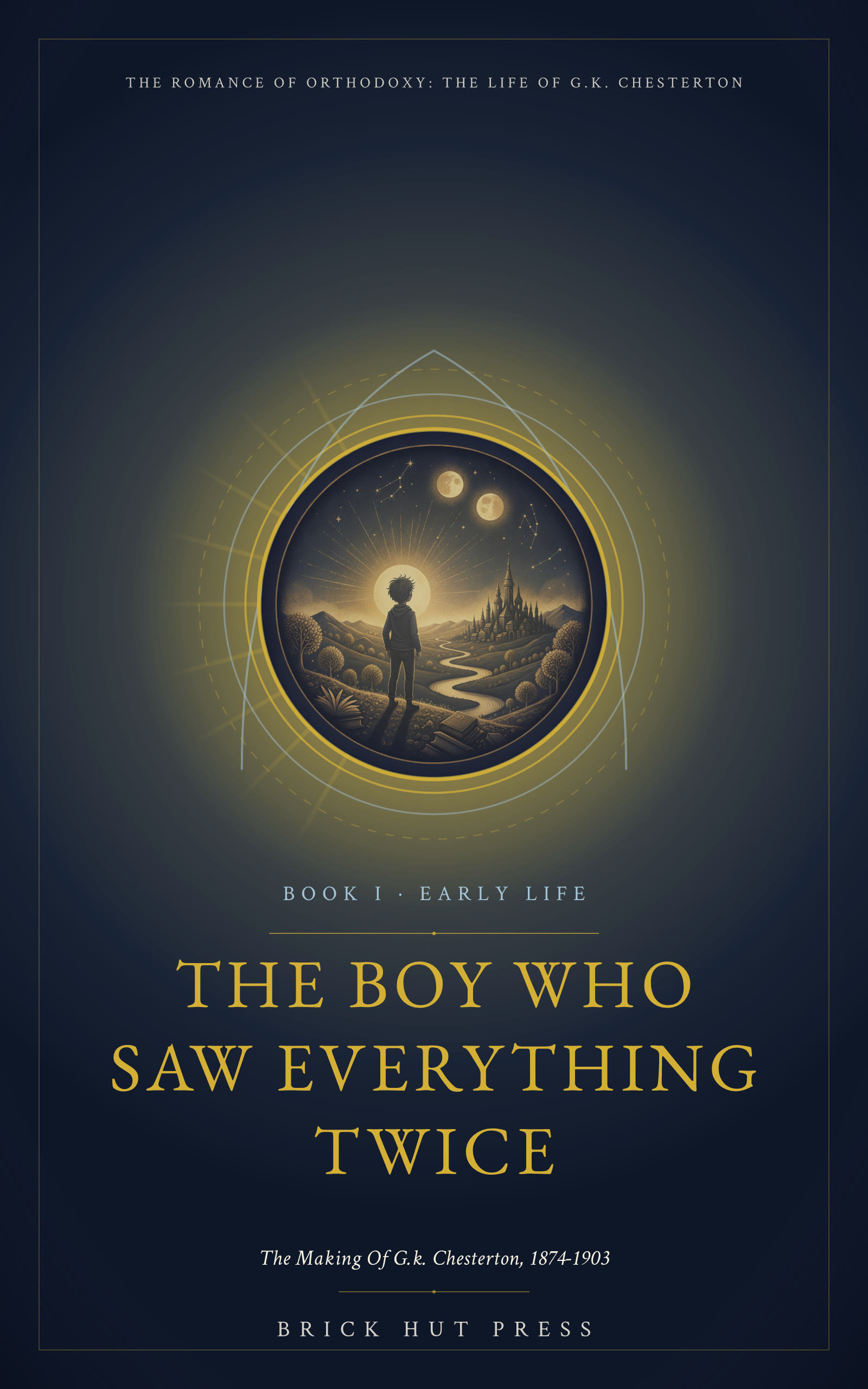
The Giant in the Doorway, a complete book about this life, free, kept in your own library here, read and heard.
Begin reading, freeAbout this volume
This is the volume in which the young reviewer becomes the great public defender, and the stakes rise with him. It opens at Overstrand Mansions in the winter of 1904, where a large man in a cloak is writing the book that will announce him to England: Heretics, which begins by noticing that the word "orthodox" had quietly become an insult, and ends by insisting, against the whole temper of the age, that a man's deepest beliefs about the universe are not a private hobby but the very thing a public argument should be about. From there this volume follows Gilbert Keith Chesterton through the years when he answered his own challenge, writing Orthodoxy as what he called the most joyful defense of the faith ever attempted, and following it almost at once with The Man Who Was Thursday, a nightmare with a theology folded inside it, a detective story about anarchists that turns out to be a parable about the hidden face of God in a chaotic world.
The chapters that follow do not treat Chesterton as a man who simply had opinions and wrote them down. They follow him into friendships and rivalries that shaped the thought as much as any book did: the long, warm, combative correspondence and public debate with George Bernard Shaw, thirty years of magnificent disagreement conducted with real affection on both sides; and the quieter, more decisive friendship with Fr. John O'Connor, the priest in the rain whose conversations gave Chesterton both a model for Father Brown and a slow, steady education in the Catholic mind years before he was ready to call himself a Catholic. This volume takes that waiting seriously. It does not rush him to Rome. It shows the Englishman who loved his country's ballads and battles, who wanted to be a Catholic Englishman before he wanted to be simply Roman, working out in essay after essay, in What Is Wrong with the World and elsewhere, what a just and human city would look like, and finding that his social vision and his theology kept arriving at the same place by different roads.
It also does not look away from the darkness. The chapter called The Long Darkness sits at the center of the book for a reason: the death of his brother Cecil, the strain of the war years, and a collapse that brought Chesterton closer to the edge than the public jokes ever let on. The volume treats this not as a footnote to be hurried past but as the hinge on which the rest of his life turns, the suffering that made the eventual joy credible rather than merely clever. Out of that darkness comes the slow road to Beaconsfield, and finally, in 1922, the baptism he had been circling for years, received, fittingly, in the rain.
The second half of the book shows what that conversion freed him to do. Writing St. Francis of Assisi "in the light of Rome," he found in the little poor man of Assisi a portrait of holy joy he had been reaching for his whole career. Writing Thomas Aquinas, the dumb ox who roars, he produced what many still consider his masterpiece of intellectual biography, a defense of reason itself as a gift of God rather than a threat to faith. The closing chapters follow him into his last public years as broadcaster, debater, and tireless friend of the poor, and then to the end itself, in 1936, dying as he had lived, with a joke on his lips and no fear in his heart.
This volume asks the question that makes Chesterton matter beyond his own century: whether cheerfulness and seriousness, wit and doctrine, can be the same virtue wearing different coats. It answers that question the way Chesterton himself did, not by argument alone but by the shape of a life lived, laughing, toward the truth.
Lives that walk beside Gilbert Keith Chesterton, chosen for their likeness, not their fame.