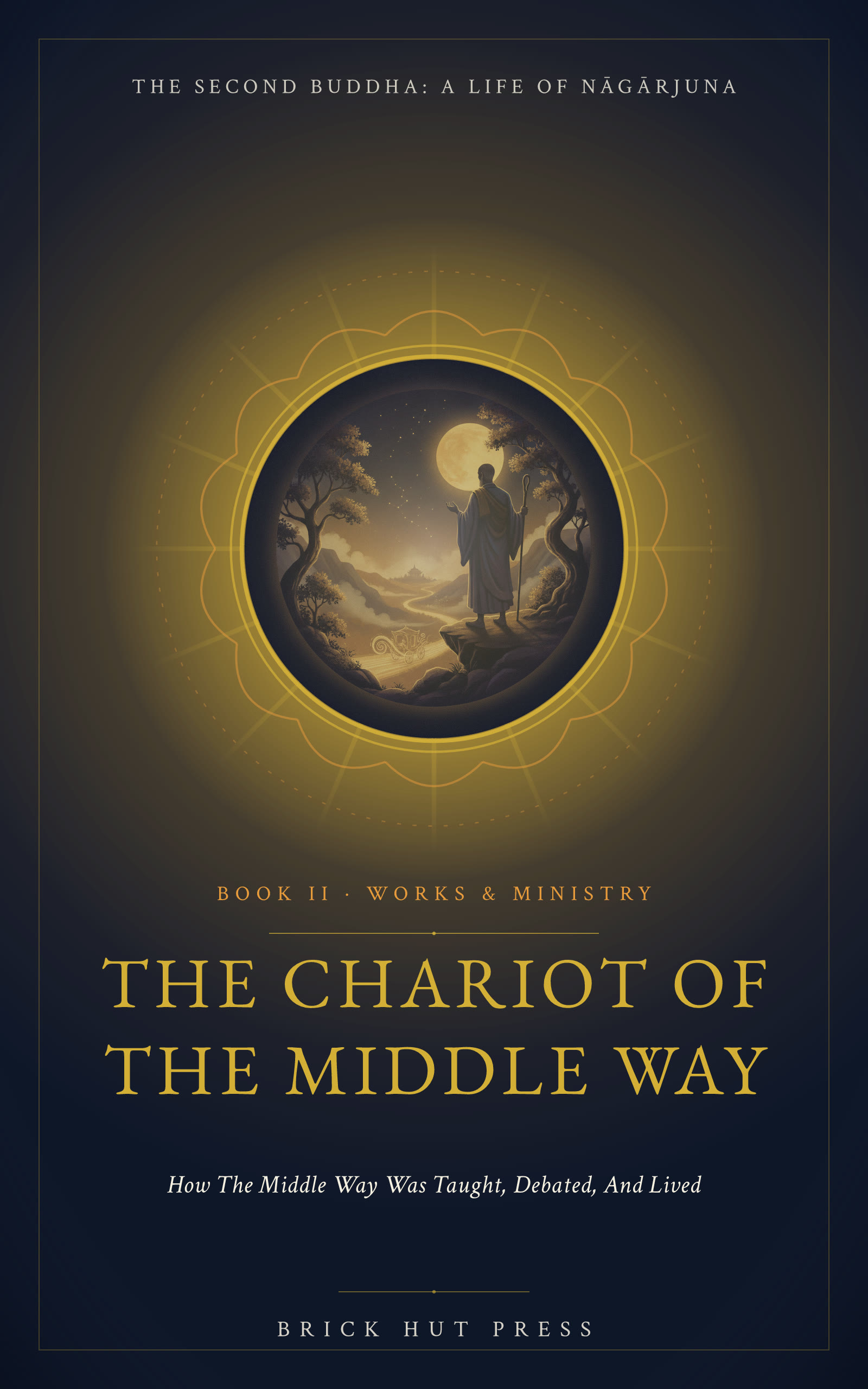
The Chariot of the Middle Way
Nāgārjuna's verses have been chanted, debated, and treasured for nearly two thousand years, yet the man himself remains a distant name to most practitioners.
The Teaching That Changed Buddhism Forever, And the Life Behind It Every lineage of Mahāyāna Buddhism traces something essential back to one figure. Nāgārjuna's verses have been chanted, debated, and treasured for nearly two thousand years, yet the man himself remains a distant name to most practitioners. The Chariot of the Middle Way changes that. This is the life behind the teaching: intimate, reverent, and alive.
Read the full description
Whether you sit in a Tibetan shrine room, a Zen meditation hall, or before a Pure Land altar, Nāgārjuna is already part of your path. This book invites you to meet him, not as a philosophical abstraction, but as a practitioner who composed under pressure, debated with courage, wrote letters of compassion to a king, and retreated to the mountain to deepen what he had realized. Drawn faithfully from the tradition's own sources, this is Madhyamaka as devotion, biography as dharma.
Not sure yet? Begin free.
Water From the Dragon's Realm, a complete book about this life, free, kept in your own library here, read now; its narration joins free when it is finished.
Receive the free bookAbout this volume
This is the volume where the robes finally become the work. Readers of the first book watched a Brahmin boy of Andhra grow into the monk who descended beneath the hood of the great serpent-king and returned with scriptures the world above was not ready for. Here, on the slopes of Śrī Parvata, that monk sits down with cut palm leaves and a sharp stylus and begins the labor by which he would become, to Mahāyāna Buddhism, the Second Buddha. The volume opens not with a treatise's throat-clearing but with two verses of homage and then an argument already in motion, and it asks the reader to stay inside that motion for the length of a life.
The chapters that follow do not summarize the Mūlamadhyamakakārikā so much as walk its load-bearing beams. "Nothing Exists From Its Own Side" takes up the great insight of dependent origination restated as emptiness, svabhāva denied at every turn, and shows why this denial is not nihilism but the only ground sturdy enough to hold a path. "Two Truths, One Path" sits with the hardest pastoral problem the doctrine produces: how conventional truth and ultimate truth can both be honored without either swallowing the other, and how an ordinary person is meant to live between them. "The Logician Who Refused to Have a Thesis" follows Nāgārjuna into the debating halls of his day, where his method of prasaṅga, undoing an opponent's position from within rather than proposing a rival one, baffled and infuriated rivals who wanted something to attack. These are not abstractions rendered abstractly; the volume keeps returning to the mountain, the robes, the actual hours of a teacher's life.
From there the book widens into the record of a teacher among kings, students, and rival schools. "Letters to a King Who Could Not Yet See" takes up the Suhṛllekha, the counsel sent to a ruler, and reads it as a document of real tenderness, a master trying to turn a powerful man toward the Dharma without presuming he is ready. "The Abbot and His Mountain" and "The Seventy Verses and the Sixty" trace the architecture Nāgārjuna built around his central insight, the lesser treatises that complete rather than repeat the Root Verses, each closing a door his critics kept trying to reopen. "When the Mahāyāna Was on Trial" places him at the center of a controversy larger than himself, the moment when the new scriptures he had carried up from the nāga realm had to answer for their legitimacy before the wider Buddhist world, and "The Student Who Argued Back" gives the reader the rarer, more human scene of a disciple pressing his teacher hard enough that the teaching had to answer back.
The volume closes gently rather than triumphantly. "The Nāgas Remember Their Own" returns to the serpent-king's world that gave this teacher his name and his scriptures, honoring the tradition's own memory of where the Prajñāpāramitā came from and what is owed to it. "The Hymns He Sang in Secret" ends the book not in argument but in devotion, with the praises Nāgārjuna is remembered to have offered quietly, away from the lecture hall, suggesting that the philosopher of emptiness was, underneath the logic, a man singing to what he loved.
What makes this volume worth a reader's time is its refusal to separate the thinker from the teacher, the logician from the devotee. It takes seriously that a man who could dismantle every thesis his opponents offered also wrote letters of real warmth to a king, argued patiently with a student who would not simply accept him, and sang hymns no one was meant to overhear. Readers who come wanting the Middle Way explained will find it explained with care. Readers who come wanting to know what it looked like to live inside that teaching, on an actual mountain, among actual people, will find that too.
Lives that walk beside Nāgārjuna, chosen for their likeness, not their fame.