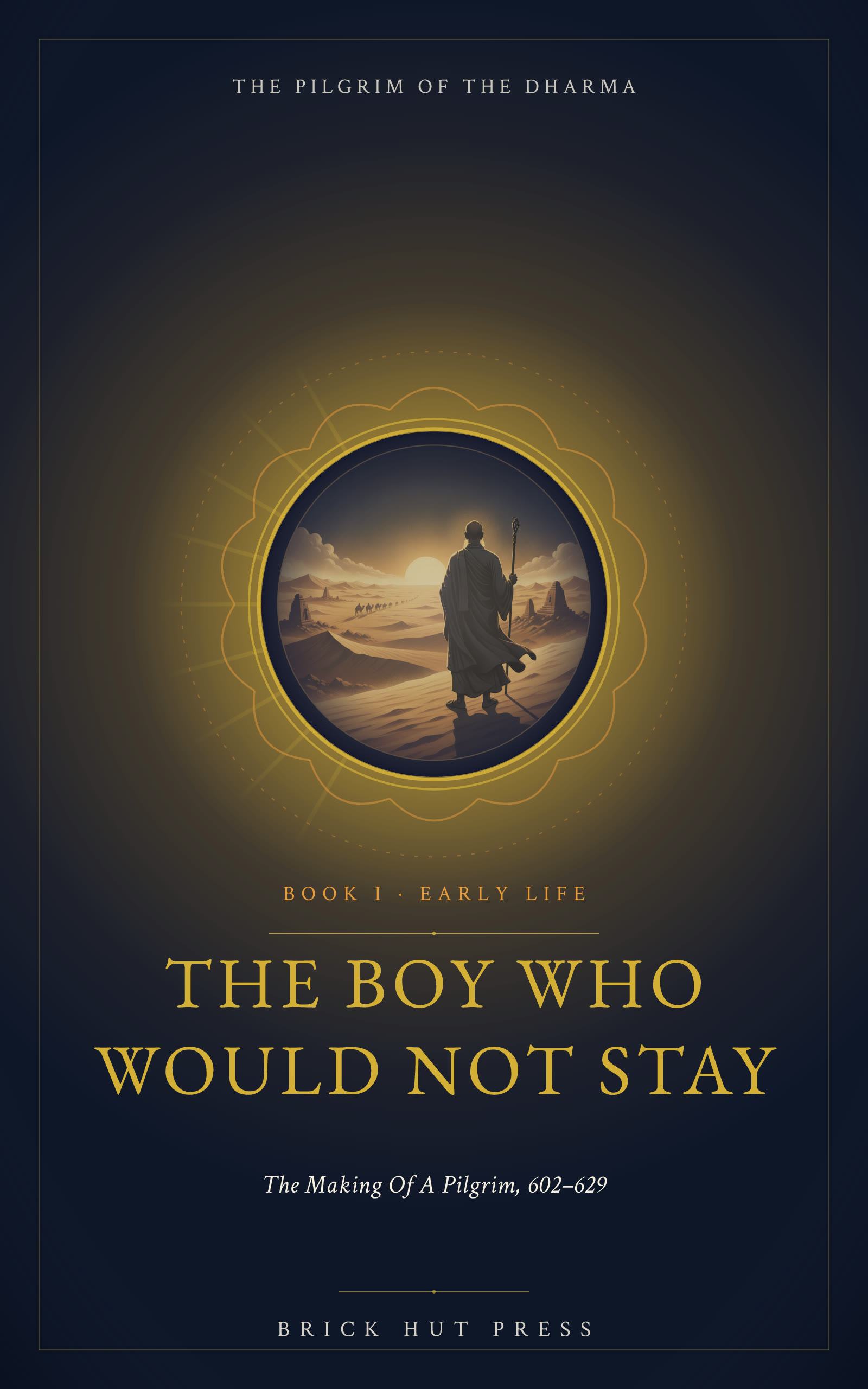
The Boy Who Would Not Stay
By twenty-seven, he had already outgrown every monastery in China.
He Left Everything. He Would Not Stop. He Would Not Turn Back. At thirteen, he was so small the abbot bent the rules just to let him in. By twenty-seven, he had already outgrown every monastery in China. So he walked out of the last gate of the empire, alone, unsanctioned, into the desert, heading west. What made a boy like that? What forged a pilgrim like that? The Boy Who Would Not Stay answers those questions with the depth, care, and devotion they deserve.
Read the full description
This is the first volume of the Sacred Lives series from BrickHut Sanctuary, covering the years 602 to 629 CE. It is not a retelling of legend. It is the devotional biography of a real human being: Chen Hui, born into a scholar-family in a dynasty crumbling at its edges, who became the monk Xuanzang, who would one day carry the Dharma across the Silk Road and return with scriptures that shaped Buddhism in China, Japan, Korea, and beyond for fourteen centuries. Before any of that could happen, there was a childhood, a brother, a vocation, and a restlessness that no wall could contain.
Not sure yet? Begin free.
The Flame Beyond Yumen Pass, a complete book about this life, free, kept in your own library here, read now; its narration joins free when it is finished.
Begin reading, freeAbout this volume
This first volume opens not in a desert or at a monastery gate, but in a lamplit room in Henan, where a boy stands half a breath too early at his father's reading of the Classic of Filial Piety. From that small, exacting gesture, the volume builds the case that the pilgrim who would one day cross the Gobi and climb the passes into India was shaped long before he ever left home, by a household of books, by grief, and by a restlessness that no single teacher could satisfy.
The chapters that follow trace a boyhood and young manhood unusually alert to loss and to texts. An older brother takes ordination first and draws the younger one after him into monastic life, a departure that reads less as imitation than as a boy discovering where his own hunger might be fed. At thirteen, in a scene the volume takes care to set plainly rather than embellish, an abbot bends the ordination rules of his own order to admit a child too young by the letter of the law, because something in the boy's answers to the examining monks could not be waved away. The volume does not dress this up as destiny announcing itself; it lets the irregularity stand as what it was, a judgment call by one monk about one unusual boy, and trusts the reader to feel its weight.
Around this personal arc, the book sets the convulsions of a country coming apart at the seams, the late Sui collapse and the uncertain early Tang, so that the young monk's travels from monastery to monastery are also a record of a China in upheaval, teachers scattering, communities displaced, certainties about the dharma itself fracturing into rival schools and partial transmissions. It is in this unsettled landscape that he reaches Chengdu, sits with its most respected masters, and finds, chapter by chapter, that what they can give him is real but not enough. The volume is unsparing about this: it does not pretend the Sichuan teachers were inadequate or lesser, only that the young monk's questions, particularly about the Yogacara texts on consciousness and the nature of mind, kept outrunning what any single lineage in China could settle. Five years of further walking, monastery to monastery, master to master, follow this same pattern, a man looking for an answer rather than a credential.
The heart of the volume is the slow tightening of a single obsession: a text, or a cluster of related treatises on consciousness-only teaching, translated unevenly, argued over inconclusively, that would not let him rest until he had gone to the source. The book treats this not as abstract scholarly ambition but as a species of devotion, the same quality that made a child rise early from his mat now turned toward the question of where the true transmission lay. When the petition to travel west is refused by the court, and the volume neither softens the refusal nor explains it away, what follows is a decision made in defiance of ordinary prudence: a dream that arrives uninvited, and a night at Yumen Pass when a monk still formally forbidden to leave the empire simply does not stop walking.
This volume ends at the frontier, not beyond it. It covers the twenty-seven years before the famous crossing of the Taklamakan and the long road to Nalanda, and it does so deliberately, on the conviction that the man who endured those deserts cannot be understood without first knowing the boy who stood up early, the brother who went first, the abbot who broke his own rule, and the five years of walking that preceded the one great walk still to come. Readers who know only the legend of the pilgrim to India will find here the quieter, harder-won story of how that pilgrim was made.
Lives that walk beside Xuanzang, chosen for their likeness, not their fame.