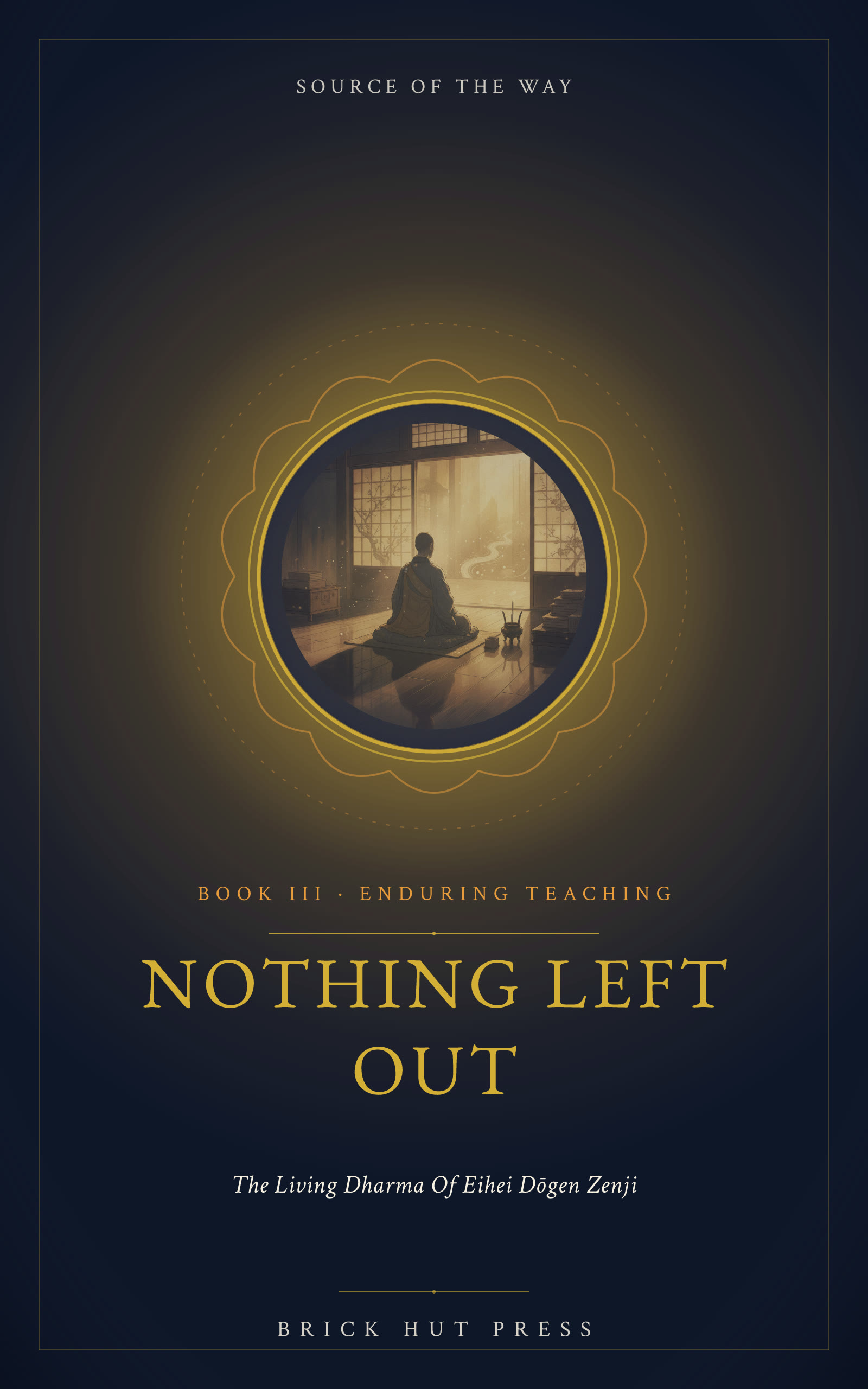
Nothing Left Out
In this ordinary, irreplaceable breath.
The Ancestor Who Left Nothing Out, Dōgen's Living Dharma, Breathing Again What if the most radical teaching in the history of Zen is not a koan to solve, but a life to inhabit? Nothing Left Out: The Living Dharma of Eihei Dōgen Zenji opens the great fascicles and intimate writings of the founder of Sōtō Zen and lets them do exactly what they were always meant to do, land. In the body. On the cushion. In the kitchen. In this ordinary, irreplaceable breath.
Read the full description
Dōgen Zenji encoded an entire universe inside a bowl of rice, a walking mountain, the turning of a single season. He taught that shikantaza, just sitting, is not preparation for the Way. It is the Way. This book honors that teaching by refusing to shrink it into doctrine or reduce it to technique. Here, Dōgen's words are met with the seriousness, the tenderness, and the lived attention they demand from every sincere practitioner of Zen Buddhism.
Not sure yet? Begin free.
The Fire He Carried Home, a complete book about this life, free, kept in your own library here, read now; its narration joins free when it is finished.
Receive the free bookAbout this volume
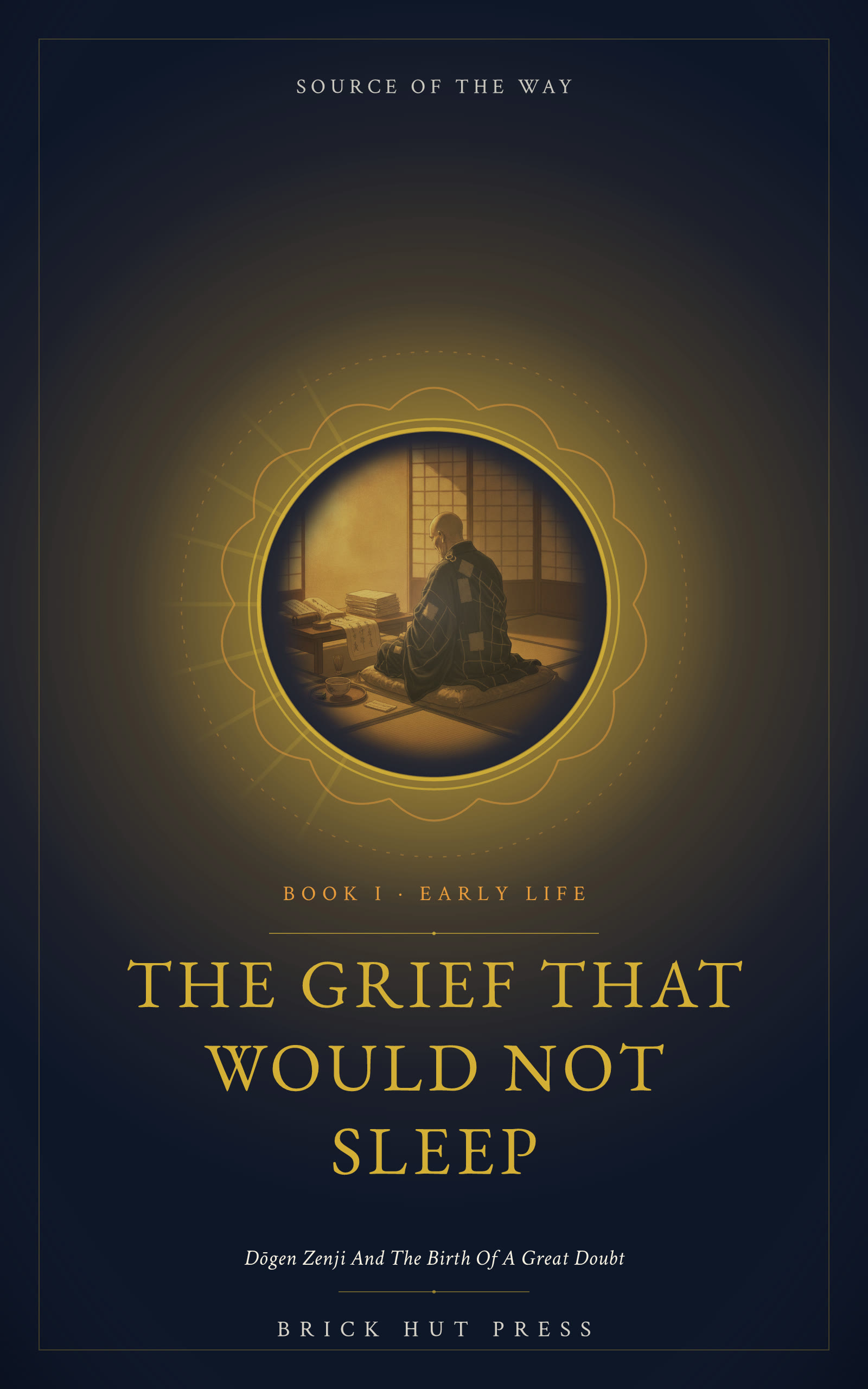
The first two volumes of this series followed Eihei Dōgen Zenji through the facts of a life: the early loss that sent him seeking the Way, the crossing to Song China, the long search for a teacher whose answer would hold, the return to Japan and the founding of monasteries. This third volume sets the chronicle aside. Here the subject is not what happened to him but what he actually said, and more than that, what he meant, read the way he asked to be read: not from a safe distance, but from inside the moment his words are still describing.
The volume opens where the Shōbōgenzō itself opens, with the Genjōkōan, the short letter Dōgen Zenji wrote in 1233 to a lay disciple in Kyushu who simply wanted to know how practice applied to an ordinary life full of household obligations. From there it moves through the teachings that lay students and monastics alike have returned to for seven centuries: shikantaza, the just-sitting that is not a means to enlightenment but its direct expression; uji, the teaching that you are not a being who merely exists in time, but a being made of time, as time is made of you; shōji, which refuses to treat birth and death as problems to be solved and instead names them the very life of Buddha; and Sansuikyō, where mountains walk and waters flow and nothing, seen rightly, is out of place.
From these great fascicles the volume turns toward something closer to the ground: the Tenzo Kyōkun, Dōgen Zenji's instructions to the temple cook, in which washing rice and keeping a clean kitchen are shown to be the dharma gate itself, no less than zazen in the hall. It turns, too, toward the voices least often quoted in summaries of his thought: the Shōbōgenzō Zuimonki, where students wrote down what he said informally, unguarded, teaching rather than performing; and the Eihei Kōroku, his extensive record, the sermons given in the dharma hall at Eihei-ji that still carry the cadence of a living teacher addressing a living assembly. A chapter is given over to his waka, the poetry in which the ancestor who wrote some of the most demanding prose in the Zen canon also wrote simply, movingly, of the moon.
The volume closes by asking what remains of all this now. One chapter considers shinjin datsuraku, body and mind falling away, not as a single transformative event safely located in the past but as a ground still falling open beneath every reader who takes up these texts. Another considers Eihei-ji itself, the temple in the mountains of Echizen, as a kind of living ancestor, a teaching that continues simply by being sat in, generation after generation. A further chapter follows the sitting posture Dōgen Zenji insisted on as far as it has gone, across oceans and centuries, into zendos that bear no resemblance to the valley where he first taught it. The final chapter, Nothing Left Out, returns to the claim that gives the volume its title: that the treasury, the Shōbōgenzō, the true dharma eye, is not a vault to be unlocked by the especially advanced, but is already open, already available, to anyone willing to sit down.
Readers who come to this volume from the first two will recognize the man; here they meet the mind, unhurried and exacting, that could write with equal seriousness about the nature of time and the washing of a rice pot. Readers coming to Dōgen Zenji for the first time will find no simplified introduction, no shortcut around the difficulty of his language, but something more useful: a steady companion through the fascicles, the recorded talks, and the poems, read closely enough that the question he kept asking, what is this moment, actually, right now, begins to feel less like a doctrine to be learned than an invitation still open, still waiting to be taken up.
Lives that walk beside Eihei Dōgen Zenji, chosen for their likeness, not their fame.